




Why Sarajevo?
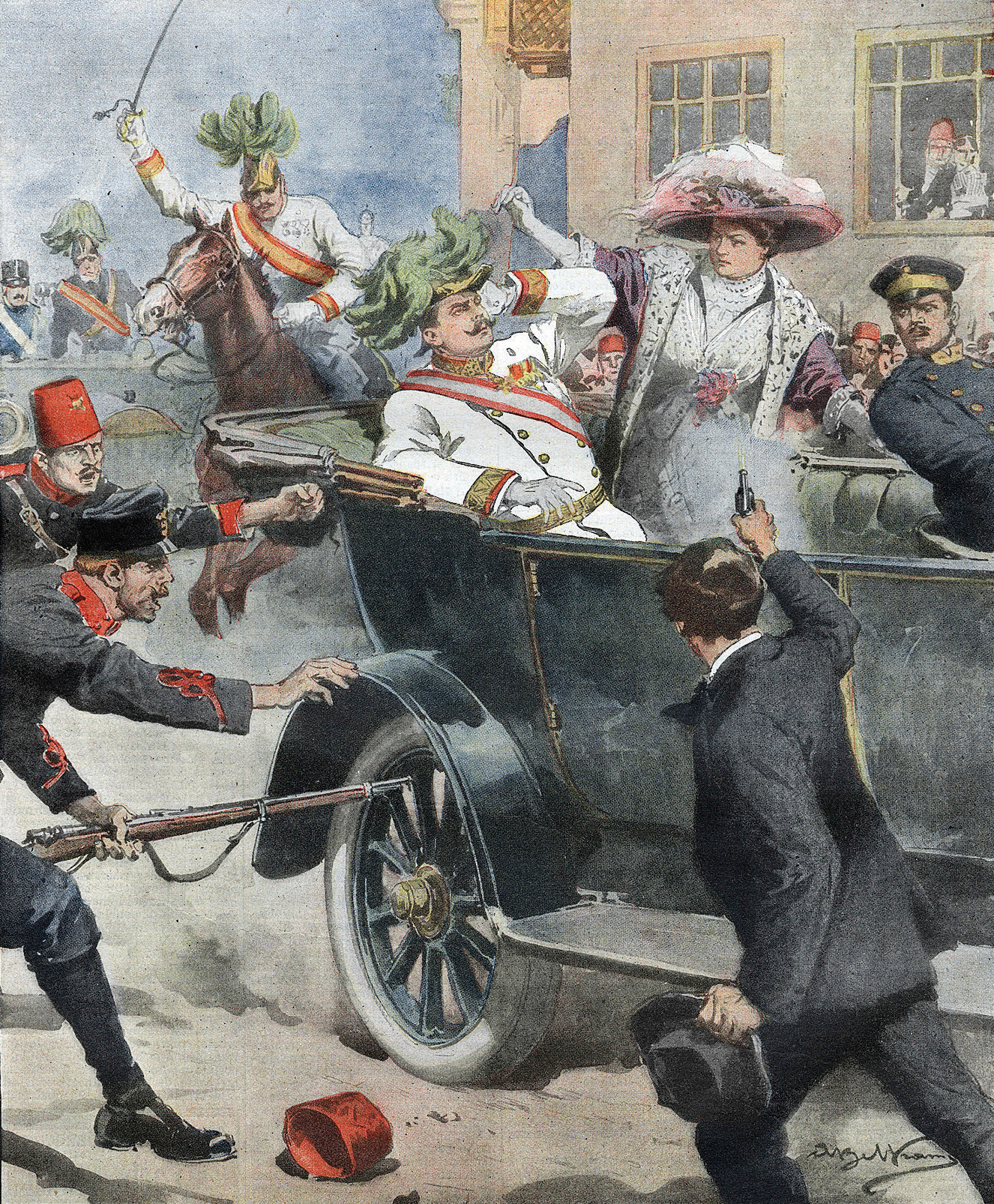
I’m sure I don’t need to tell you that today is the 100th anniversary of the assassination of the Austrian Archduke Ferdinand and his wife at Sarajevo–the long-tailed and tangled fuse that began World War I. And I’m not going to go through the details of the assassination itself–though it would be a nail-biting thriller, complete with close calls and bad-decisions if we didn’t all know how it ends. Instead I’d like to spend a little time on the backstory.
Balkanization–Not Just a Metaphor
In 1878, at the end of the Russo-Turkish War, the Great Powers effectively forced the Ottomans out of the Balkans, which had been part of the Ottoman empire for centuries. The treaty signed at the Congress of Berlin gave Serbia, Romania and Bulgaria their independence. For many Serbs, independence was not enough. They felt that had been cheated of territory that should have been theirs, most notably Bosnia-Herzegovina, which had been part of Serbia in the distant past.* Serbia managed to seize more territory from the Ottomans during the Balkan Wars of 1912 and 1913, but Bosnia-Herzegovina remained out of reach.
Still officially part of the Ottoman Empire, Bosnia-Herzegovina was occupied and administered by the Dual Monarchy of Austria-Hungary. Control of the Slavic province was a mixed blessing for Austria-Hungary. On the plus side, it kept Bosnia-Herzegovina’s largely Slavic population out of the hands of both the increasingly powerful kingdom of Serbia and the empire’s major political rival, Russia. On the other hand, the addition of more Slavic peoples to Austria-Hungary’s multinational mix threatened to unbalance the empire’s uneasy pattern of ethnic rivalries.
Under Emperor Franz Joseph’s Dual Monarchy, created in 1867 in an ill-conceived attempt to win over Hungarian nationalists, Germans and Magyars in the twin kingdoms of Austria and Hungary ruled over larger populations of mostly Slavic peoples. Inspired by the creation of the new states of Germany and Italy, Austria-Hungary’s Slavic populations, including Serbian nationalists in Bosnia-Herzegovina, demanded political concessions that ranged from the freedom to use their own languages instead of German or Hungarian to succession from the empire. Many sought change by legal means. Others resorted to terrorism. Romanians nationalists resorted to bombs in response to Magyar attempts to suppress the Romanian language in Transylvania. Italian extremists blew up a railway tunnel in Trieste. And Serbian terrorists made six attempts to assassinate Austro-Hungarian officials in Bosnia-Herzegovina between 1910 and 1914.
The Black Hand Makes A Fist
In 1911, Dragutin Dimitrijevic the Serbian army’s head of intelligence, formed a secret society of extreme Serbian nationalist called Unity or Death, more commonly known as the Black Hand. Its goal was to re-unite the countries that had once been part of the medieval kingdom of Serbia. Terrorism was its preferred weapon. By 1914, the Black Hand had 2500 members, most of them junior officers in the Serbian Army. Only about thirty of its members lived and worked in Bosnia-Herzegovina.
Early in 1914, Dimitrijevic decided to assassinate the Archduke Franz Ferdinand, the heir to the Austro-Hungarian empire. The Archduke wanted to reorganize the empire, replacing the Dual Monarchy with a federalist system that would give the empire’s Southern Slav citizens, including those in Bosnia-Herzegovina, an equal voice with Germans and Magyars. Dimitrijevic feared political recognition of Slavs within Austria-Hungary would weaken their desire for succession and make it harder to gain support for a pan-Serbian state.
Historic Echoes on June 28
An opportunity for assassination presented itself that June. The Austro-Hungarian governor of Bosnia invited Franz Ferdinand to Sarajevo to observe the imperial army’s annual maneuvers on June 28. The choice of date demonstrated how little the imperial bureaucracy understood or cared about Serbian nationalism. June 28 was an important date in Serbian history. Some would argue that it was THE important date: on June 28, 1389, a Turkish army defeated Serbian forces at the Battle of Kosovo, ending the medieval kingdom of Serbia and beginning five centuries of Ottoman rule.
From the perspective of the Black Hand, the Archduke’s arrival in Sarajevo provided the perfect target at the perfect time.
*The idea that “It was ours once several hundred years ago, so it should be ours today” almost guarantees conflict between neighboring states.
Drowning In Books About World War I

It is a truth universally acknowledged (at least in the circles I hang out in) that major historical anniversaries are celebrated not only with documentaries, blog posts and re-enactments, but with the publication of Big Fat History Books. It makes perfect sense from the point of view of writer and publishing house: the centennial of World War I is a ready-made if slightly crowded PR hook for a new book about the war.
From the point of view of a historically inclined reader, blogger, and occasional reviewer, it can be a tad overwhelming. A solid phalanx of World War I books has taken over my TBR shelf, shoving their way ahead of all the other fascinating unread books piled up in my office.* Old favorites are demanding their fair share of attention. Then there are the novels. And the poetry. In short, I could spend the next year reading and writing about nothing but World War I until next June, when the Battle of Waterloo will demand its share of attention.*** But I won’t. I’d get bored. And worse, so would you.
So I’ve decided on an interim step. Below are mini-reviews of three new WWI books that have caught my imagination. I’ve read enough of each of them to feel secure in recommending them to your attention–and enough to know I want to finish them.
Philip Jenkins. The Great and Holy War: How World War I Became a Religious Crusade.
Possibly the oddest the WWI books to appear in my mailbox so far, The Great and Holy War looks at the role religion played in shaping the course of the war–and the peace. Jenkins looks at how the powers involved-Christian and Muslim alike-used the rhetoric of crusade, holy war, apocalypse and Armageddon. He considers the Angel of Mons, the Christmas Truce, the legend that dead French soldiers rose to fight alongside their comrades, and the British push to conquer Jerusalem in the Palestine campaign. This is fascinating stuff.
Sean McMeekin. July 1914: Countdown to War.
This is a gripping account of more familiar ground: a day-by-day political history of the weeks between the assassination of Archduke Franz Ferdinand and the beginning of World War I. I picked up July, 1914 with an initial feeling of “ho-hum”, then was caught by the quality of the story-telling. It’s a cliche to say that a work of history reads like a novel. In this case, it’s true.
Geoffrey Wawro. A Mad Catastrophe: The Outbreak of World War I and the Collapse of the Habsburg Empire.
I’ve been fascinated for a long time by the failed melting-pot of the Austro-Hungarian empire. A Mad Catastrophe is an in-depth examination of how the empire’s decline at the end of the nineteenth century set the stage for Sarajevo and the impact of its weakness on the eastern front. If you’re interested in the decline and fall of empires, this one’s for you.
*Actually, they piled up in my old office. In my splendid new office they are arrayed neatly on shelves, alphabetized by the author’s last name. This makes things easier to find if I know the title or name of the author. It’s still a trick to locate a book when I know only that “memory” is in the title and the author’s first name is Paul.**
**At this point a clever use of Google is the only solution.
***Save the date: June 18, 1815.
The Nile
I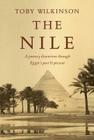 n The Nile:A Journey Downriver Through Egypt’s Past and Present, popular Egyptologist Toby Wilkinson leads the reader on a historical travelogue that moves from Aswan, home of the river’s First Cataract, to Cairo’s Gezira Island, from Paleolithic rock drawings to the Arab Spring.
The voyage that shapes The Nile is not simply metaphorical. Wilkinson floats down the river on a dahabiyah–a large luxury boat descended from the royal barges of the pharaohs. Aware that he is simply the latest in the historical line of travelers drawn to Egypt by its climate and its ancient civilizations, Wilkinson engages with their commentary as well as his own observations, creating a palimpsest of Nile voyages in the process. (Ancient Greek historian Herodotus and 19th-century British journalist Amelia Edwards are particular favorites.)
Because Wilkinson organizes his work by geography rather than chronology, his narrative is anecdotal almost to the point of stream of consciousness. His combination of scholarship and storytelling allows him to draw unexpected relationships through time. The ruins at Kom Ombo lead to a discussion of the crocodile god, Sobek, then on to ancient Egyptian tales about the dangers of crocodiles, a modern Crocodile Museum, and the impact of both 19th-century Western tourism and the Aswan Dam on the crocodile population in Egypt. Occasionally such temporal leaps are disorienting, but for the most part they are illuminating. Once a reader has learned to navigate the rapids, The Nile is worth the effort.
This review previously appeared in Shelf Awareness for Readers.