




In Which I Give Away A Copy of Nick Lloyd’s Hundred Days
As those of you who hang out in history-land know, the centennial of World War I is just around the corner. So far I’ve resisted the temptation to add to the flow of WWI-related blog posts, tweets, and images.* But the pile of books to review and the list of things I want to talk about is growing. So brace yourself, here we go.
* * *
In the comments to my post last week on historical periods, friend/relative/reader Carol Hallock broadened the definition of historical figures to include, well, everyone:
“…we can have the same realization about the general Mr. and Ms. walking down the street, but their “big experiences” maybe never made headline news or history books. Everybody is a walking story.” **
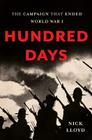 Nick Lloyd, the author of Hundred Days: The Campaign That Ended World War I, would agree. *** The book is inspired, in part, by his great-uncle, Tom Cotterill, who died at the age of nineteen only six weeks before the Armistice as part of the final campaigns of 1918. Visiting Cotterill’s grave in the British cemetery at Neuville-Bourjonval, Lloyd found himself “filled with a powerful urge to write a story of those final days; to do all that I could to bring him home.” From my perspective, he succeeds.
The “Hundred Days” is a British term referring to the often ignored period from the Battle of Amiens on August 8, 1918, through the Armistice on November 11, also known as the “Advance to Victory”. **** Lloyd begins his account in July, with the Second Battle of the Marne and follows the final campaigns in France and Belgium step by bloody step. Despite the British roots of his title, Lloyd does not look at the campaigns solely from the British, or even the Allied, perspective. Instead he analyses the battles from the point of view from each of the main warring sides, big picture and close-up alike. His accounts of each battle are both lively and clear (though I wish the maps were better). But the real strength of Lloyd’s work is his treatment of the experience of the war from an individual perspective. He paints vivid portraits of the character and motivations of the various commanders and draws on a variety of first hand accounts from men at all levels on both sides of the front. (His portrayal of the disintegration of German morale and discipline and the deprivations on the German home front are particularly powerful.) In a very real way, he has given us Tom Cotterill’s experience of the final campaigns of World War I: “the shattering bombardments; the storm of machine-gun fire; the sight of hundreds of dead and wounded; the exhaustion of endless marches; the glow of burning French villages; the comradeship and fear.”
Hundred Days is well worth the read. And since I recieved two copies, I have one to share. If you want your name to go into the hat, make a comment here on the blog, send me an e-mail, or comment on my Facebook post on or before noon CST, June 28.
*I don’t open Christmas presents early either.
**Carol’s comments encapsulate the idea behind what was called “the new social history” when I was in college. You can see the rest of what she had to say here.
***Why yes, I am starting my posts about WWI with the end of the war.
****Technically 95 days, but who’s counting?
In which I consider historical novels

Occasionally two separate projects overlap in my head, creating bubbles of thought. (The process is a bit like pouring vinegar on baking soda: the end product is active and slightly acidic.) This is one of those times.
As I mentioned before, I’ve been reading about Boudica’s revolt against the Roman empire. At the same time, I read and reviewed Mary Beard’s latest book about Roman stuff. for Shelf Awareness for Readers.* It was one quick mental step from Roman Britain and Roman jokebooks to Lindsey Davis‘s excellent series of murder mysteries set in ancient Rome (and its empire) shortly after the British revolt.
If I had access to my fiction collection** I probably would have re-read Silver Pigs (set partially in post-Boudica Britain) and Last Act in Palmyra (which deals in part with a jokebook) and this blog post would have never been written. Instead I found myself thinking about the role of the historical novel in my reading life and understanding of history.
I will be the first to admit that historical novels–genre and literary alike–have shaped my image of historical periods, places, and people outside of my specific area of expertise. They’ve often spurred an interest in a period I otherwise knew nothing about. At their best, they provide a vivid picture of a moment in time, adding details of daily life and the experience of “normal” people to the big picture. At their worst? *Bleah*
I’m pretty clear about what I want in historical fiction: impeccable historical detail that supports the story but does not call attention to the author’s research and characters who are rooted in their time.*** What’s your stand on historical fiction? And what authors should I add to my To-Be-Read list?
* Coming to a blog post near you sometime after it runs on Shelf Awareness
.
**Currently in boxes in the living room waiting the installation of new floor to ceiling bookcases.
***My pet peeve? Breaking historical plausibility to create an appealing character. I’m happy to have a female character push against the constraints of social mores; don’t give me a modern woman in historical costume.
In which I consider the nature of historical periods–and moving
Despite good intentions, and a couple of creative efforts,* I succumbed to radio silence here in the Margins while My Own True Love and I moved four whole blocks. The construction isn’t quite done, but we’re half-way settled into the new house.  (Okay, maybe a quarter of the way. Between us we have a lot of books to unpack and
 stuff onto shelves organize. )
I may not have been writing about history for the last two weeks, but I’ve certainly been thinking about it. At the risk of revealing too clearly the zigzag way my mind works, here’s an odd bit that I’ve been mulling over:
The relationship of historical figures to historical periods is often complicated and occasionally misleading. Several months ago I was stunned to realize that Woodrow Wilson was a child during the American Civil War–a fact that fundamentally shaped his policies in World War I. This past week I was equally surprised to learn that Charles Dickens, whose novels helped shape our images of Victorian London, was in fact born in the reign of George III.** When Victoria took the throne in 1837, Dickens was 25 years old and already a successful novelist. ( The Pickwick Papers had met with unprecedented success, with each issue selling 40,000 copies a month.***) Oliver Twist is set during the reign of George IV–making it an iconic work about the Industrial Revolution and the growth of cities but not an iconic portrait of Victorian London.
Therefore what, you ask? I’m not sure yet. Perhaps no more than a reminder that the boundaries of historical time periods are as fluid and artificial as the boundaries of nations. Perhaps a hint that we need to look more closely at books with titles like [Historical Figure of Your Choice] And His Time.
I’d love to hear what some of you think about this. Do you have favorite examples of important figures who straddle periods like the Colossus of Rhodes? Can you put me out of my misery by explaining why it’s important–or alternately why it isn’t? Is this just the befuddlement of a person overwhelmed by packing boxes, construction details, and the overwhelming number of colors they make bath towels in?
Now if you’ll excuse me, there’s an unpacked box of books calling my name.
* My apologies to those of you who were confused by the re-runs. We did not take off to Belgium in the middle of the move,though there were moments when it was tempting.
**For that matter, so was Queen Victoria.
*** A salutary reminder that today’s genre best seller may well be next century’s literary classic and that today’s heralded literary genius may be lucky to find a fading half- life in someone’s doctoral dissertation.