




Moving Pictures
It’s a week and counting ’til our move. I’d rather be writing blog posts than sorting, pitching, packing, and hauling. But that’s not realistic.
Instead, I’d like to share with you these two video clips from the British Pathé archives. The first is King George VI giving the real speech that inspired the film The King’s Speech.* The second is George VI struggling with a public speech pre-speech therapy. That takes courage.
[A reminder to those of you who read these posts in your e-mail: You may need to view the post through your browser to see the film clips. Just click the post title twice and say “there’s no place like home”.]
* I strongly recommend that you track it down if you haven’t seen it yet. In fact, I may watch it again myself as a treat tonight or tomorrow. I’m in the mood to watch the triumph of the human spirit.
Re-Run: The First Common Market?
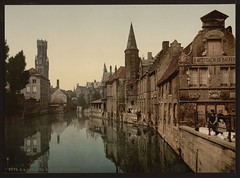
Bruges. Image courtesy of the Library of Congress
My Own True Love and I leave next week for Belgium and my thoughts are turning toward Waterloo, Flanders Field, and the Hanseatic League.* Especially the Hanseatic League.
I’m fascinated by traveling merchants, from the Silk Road caravans that brought luxury goods from China and India to the Muslim peddlers who sold dry goods and notions to farm wives in the upper Midwest in the nineteenth century.** Part of it’s the romance of the thing: desert caravans, clipper ships and gypsy-style wagons. Part of it is the hardheaded economics of who bought what from where.
In many ways, the Hanseatic League can be seen as Europe’s first attempt at a Common Market. In the twelfth century, the European economic world was expanding. Increased agricultural productivity allowed more people to work at something other than farming, creating surplus goods for sale and a need for raw materials. (This is the same thing that made the Crusades possible. Cool, huh? The way different bits of history link together like that?) At the same time, the Teutonic Knights, a fighting monastic order interested in conversion and conquest (or possibly conquest and conversion), invaded the Slavic lands to the east. They established a network of fortified bases along the Baltic Sea that became new towns with markets where foreign goods could be bought and sold.
Being a merchant was dangerous work. By land, you had to worry about armed brigands and raiding militias. By sea, you were in danger from storms as well as pirates and their legally sanctioned cousins, privateers. Merchants from the newly formed cities of the Baltic began to join together into informal associations (hansas) to make long-distance trading safer.
They soon learned that working together not only brought greater safety at sea, it also made it easier to negotiate in the foreign towns with which they traded. (Collective bargaining, anyone?) Loose associations grew into merchant companies and guilds. By the end of the thirteenth century, Hanseatic merchants had built a trading network that stretched from Bergen (Norway) in the north, to Novgorod (Russia) in the East, and London (you know this one, right?) and Bruges (modern Belgium!!) in the west.
Hanseatic merchants were intermediaries between the workshops of Western Europe and the forests of Eastern Europe. They brought salt from the mines at Kiel to the herring fisheries of the Baltic. They exchanged cloth from Flanders, wool from England, and metalwork from Westphalia for furs, timber, wax, grain, and amber from Russia. They traded in salted fish from Scandia, wine from the Rhineland, copper and iron ore from Sweden and beer from north Germany, once Hamburg brewers figured out that adding hops would stabilize their product for transportation.
The Hanseatic League dominated northern Europe until the mid-sixteenth century, when they were elbowed aside by England and the Netherlands, whose merchants had larger, more seaworthy ships and a free-trade philosophy that made them welcome in foreign markets.
Bruges and Antwerp, here we come!
*Not to mention chocolates, waffles, beer and pommes frites.
** Yes, you read that right. Muslim peddlers in rural Iowa in the 1890s. A story for another day.
Re-Run: Word With A Past: Kidnap
I’m dipping into the archives again, because I’m in over my head here at the Margins. (So much so that I didn’t even celebrate the blog’s 3 year anniversary on May 11. Hmmmm….) We move on June 2 and to say we are not yet ready is an understatement. Too much to do, not enough hands to do it.
And speaking of labor shortages…
In the mid-seventeenth century, the British colonies in North America and the Caribbean were suffering from a labor shortage.
The colonies had originally attracted Britain’s surplus population: dreamers, fortune-hunters, religious nuts, younger sons, prisoners of war, political failures, vagrants, criminals, the homeless, and the desperate. Some came with a small financial stake. Many came as indentured servants. A few were physically coerced onto ships sailing west.
In 1640s and 1650s, the population base in Britain took a hit. More than eleven per cent of the population died in the English Civil War. (In World War I, Britain’s second most devastating war, the loss was only three percent.) With so many young men killed, the birth rate went down. Consequently, wages went up. Plenty of people must have asked themselves, “Why leave civilization for the colonies?”
With voluntary immigration down, involuntary immigration became more important. The inmates of Britain’s prisons were given a chance at a new life–whether they wanted it or not. Grown men were “Barbadosed”–the seventeenth century equivalent of being shanghaied (another word with a past, now that I think about it).
Worst of all, children were snatched from their parents and sent to the colonies as indentured servants. As a result, a new word entered English:
Kidnap. .vt. To steal or carry off children or others in order to provide servants or laborers for the American plantations.