




Little Norway and Sigrid Schultz
First, let me say that this post is not about either the now defunct Little Norway living history site in Wisconsin or Little Norway Resort in Minnesota, which are the first things that a Google search of Little Norway will pull up.
Instead it is the story of the main training camp for the Royal Norwegian Air Force during World War II. Or at least a story about the camp. There is probably a story to tell about every man who trained there.
Here goes:

After King Haakon VII and members of the Norwegian government escaped from the Nazis, they formed a government-in-exile in London. They decided to keep those Norwegian military pilots who also managed to escape as a separate, wholly Norwegian military unit.
In the best of all possible worlds, the Royal Norwegian Air Force would have established a training base in Europe.* With most of Europe under Nazi control, the best alternative was Canada. On November 10, 1940, the base known as “Little Norway” went into service outside Toronto. The camp was initially set up at the Toronto Flying Club’s airport on the Toronto Islands. Hundreds of young men escaped from Norway through Sweden or by way of the North Sea and found their way to Canada to enlist in the new service—a trip that in many cases required a heroic effort. The islands soon proved to be too small and the base was relocated to Muskoka Airport, north of Toronto. More than 3300 Norwegian air men and ground crews would train at the camp.
The first Norwegian squadron arrived in Iceland in April 1941. They patrolled the North Atlantic looking for German submarines. The second, a fighting squadron with an all-Norwegian air and ground crew, arrived in England in June, 1941, followed by a third in January 1942. Both of these squadrons fought as part of the British RAF; they participated in the Dieppe Raid, the Normandy landings, and the liberation of Holland.
In the spring of 1942, the leaders of the base invited Sigrid Schultz to visit Little Norway.** They had heard her broadcasts from Berlin about the invasion of Norway and thought she might be interested in doing a story about the camp as the second anniversary of the invasion drew near.
Sigrid spent a week in Toronto, meeting with the young pilots and working on her story. It was easy reporting by her standards: instead of rushing to meet her filing deadline with the details of a breaking story, she could take time to collect material and write the story. She met with the young Norwegians who had escaped from their country to help fight the Germans in a canteen that smelled of fresh cut wood, pine, cleanliness, and a whiff of coffee—scents that perhaps carried with them memories of summer holidays with her cousins in Norway. The young fliers were eager to tell her whatever they knew. She asked each of the men the same question: “What convinced you that you had to leave Norway and come out and fight?” Each had a story of the incident which finally made him decided to risk his life to join the armed forces in exile. Many had thrilling stories of dangerous escapes. The details of each man’s story were different, but the core was the same: the crimes of the Gestapo and the SS convinced them that life in Norway under Nazi rule was not to be tolerated
During her visit, the airmen gave her a parade, passing in review before her while she struggled to hide her tears, perhaps remembering her young Norwegian fiancé who died in the Great War.
As part of her visit, she did a fifteen- minute broadcast from Toronto for the Canadian radio network and Mutual Broadcasting on the second anniversary of the invasion of Norway. Before she spoke, she had to show the text of what she had written to Lieutenant-Colonel Ole Reistadt, the commanding officer of the camp. Speaking to the young men had reminded her about the role neutral Sweden had played in defeat of Norway by allowing Germany to send army supplies through the country. She had been angry then. Now she was angry again. She “made some very nasty remarks about the Swedes” in her script. Reistadt reminded her that neutrality had two sides: “Miss Schultz, you can’t do that because you have a lot of Swedish civilians who help our people escape from the Germans over the mountains. You cannot be nasty to them.” So, she later said with a sigh, “I had to be ladylike.”
Her article ran in the Chicago Tribune on August 16. It was a lively tribute to the young men of the Norwegian air force.
*Actually, in the best of all possible worlds, the Nazis would not have occupied Norway and the question of where to establish an aviation training base would not have arisen.
**Anyone who’s been reading along here for the last several years knows who Sigrid Schultz was. But in case you stumbled on this post while looking for info about Little Norway, here’s the short version: Sigrid Schultz was the Berlin bureau chief for the Chicago Tribune from 1925 to 1941. She was one of the first American reporters to warn her readers just how dangerous the Nazis were and one of the last American reporters to make it out of Berlin.
_______________
It is worth pointing out that the Norwegian merchant marine played a much larger, if less glamorous, role in supporting the Allies in World War II than the Royal Norwegian Air Force. In 1940, Norway had the largest merchant fleet in the world, some 1100 ships. At the time of the Nazi invasion, 1024 of those ships were at sea. King Haakon ordered them to proceed to allied ports. All of them complied. They were then put in the service of the Allies. Norwegian ships carried half the fuel and one third of all other supplies transported to Britain, at great cost to themselves: almost 4,000 seaman killed, some 6,000 additional casualties and 570 ships lost.
From the Archives: Last Hope Island
Often when we’re traveling, something we see makes me think about posts from the past, books I’ve read, or posts from the past about books I’ve read.
While we were in Norway, that book/post was Lynne Olsen’s Last Hope Island. As soon as we got home, I pulled it off the shelf and have been dipping in and out ever since. It is just as good as I remembered.
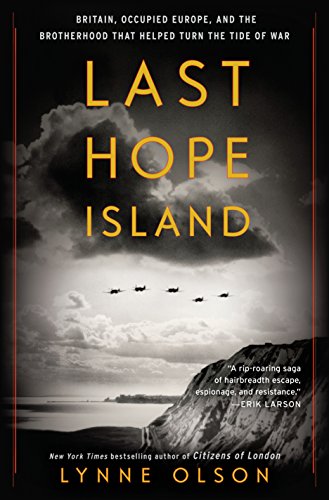
As those of you who hang out regularly here on the Margins have probably guessed, I love it when a book turns what I think I know upside down and shakes the change out of its pockets. Last Hope Island: Britain, Occupied Europe and the Brotherhood that Helped Turn the Tide of War is one of those books.
Historian Lynne Olson looks at the seldom-told stories of how European refugees—both governments-in-exile and individual patriots—continued to fight Nazi Germany from a (relatively) safe base of operations in London.
Taken individually, their stories are dramatic, and occasionally tragic. Queen Wilhemina of the Netherlands was outraged when the captain of the British destroyer on which she escaped Amsterdam refused to put her ashore at Zeeland: she had been determined to “be the last man to fall in the last ditch” in defense of her country. (She continued to be outraged throughout the war. Her grandchildren were not allowed to listen to her radio broadcasts because her language was so bad when she talked about the Nazis) A young French banker named Jacques Allier, traveling on a fake passport, smuggled the world’s supply of heavy water from German-occupied Norway to Scotland under the nose of Abwehr operatives—hamstringing Germany’s efforts to develop a nuclear bomb.
Told in combination, these stories challenge traditional accounts of the war. Olson reminds us that French forces guarded British troops during the heroic evacuation at Dunkirk. That Polish pilots played a critical role in the Battle of Britain and in defending London during the Blitz. That Britain’s successes in breaking the Enigma codes rested on the work of the Polish underground, who were able to decipher a high percentage of Enigma intercepts by early 1938. That Churchill was a butthead as well as a great leader.*
In the English-speaking world, Britain and the United States are often portrayed as standing alone against the Nazis in World War II. Last Hope Island reminds us that was never true.
*Okay. She doesn’t say that. But the stories she tells reinforce my growing dislike for the man.
Road Trip Through History: Oscarsborg Fortress and the Nazi Invasion of Norway (plus a little bit about Sigrid Schultz)
As those of you who read my newsletter know,* My Own True Love and I spent two weeks in Norway on a history-nerd tour run by the Vesterheim Museum. We began with Vikings and ended with a tour of the royal palace in Oslo, which was far more interesting than I expected. (As is so often the case when we’re on the road. Never presume.)*** Instead of focusing solely on the decor and its treasures, the docent gave a brief history of the Norwegian royal family. She wove the royal family’s history into the larger history of Norway, nicely wrapping up a number of recurring themes from the last half of the tour. The most important of these was King Haakon VII’s refusal to cooperate with the Nazis and the Norwegian government’s subsequent escape to London.
A history tour of Norway necessarily spends a great deal of time on the Nazi invasion and occupation of Norway. Going in, I had a general sense of the Nazi invasion of Norway, which signaled the end of the “Phony War” and the beginning of action on the Western Front. I was familiar with the story of King Haakon’s heroic stand. But I had forgotten the action at Oscarsborg Fortress which made it possible for the king, the Norwegian government, and members of the Storting (the Norwegian parliament) to escape.
In the early hours of April 9, German troops launched surprise attacks on every major port in Norway. (Though why anyone was surprised is not clear. As Sigrid Schultz reported in her account of the invasion, “Hitler acted according to the pattern so often successful for him: On the one hand, he amazed the world by his swiftness. On the other hand, he gave ample warning of his intention to strike.”)
Norway’s military defenses were shockingly weak, despite the king’s urging that the country re-arm. Despite its strong maritime heritage, the country owned only 70 ships, including the two oldest ironclad ships in the world that were still sailing. (The naval chief of staff called them “my old bathtubs.”) Its army was small, with an elderly officer corps and equally elderly armaments. It had one tank, no submarines, and no anti-aircraft guns. Not surprisingly most of Norway’s military commanders failed to defend their positions. By noon, German forces controlled Narvik, Trondheim, Bergen, Stavanger, Egersund and Kristiansand.

The sole exception was Birger Erickson, the commander of Oscarsborg Fortress. Erickson was scheduled to retire in the fall of 1940. Most of the men under his command were new conscripts who had only been on the island for one week. The fortress itself was no better equipped than the rest of the Norwegian military. Oscarsborg had been the strongest fortress in Europe when it was built in 1855. Norway upgraded the fortress at the end of the nineteenth century, installing new guns (made in Germany) and an underwater torpedo battery. Those “new” weapons were 40 years old when the Nazis attacked Norway. There was no reason to think that Erickson would do any better than his counterparts on the mainland. German intelligence dismissed the fortress and its two antique cannons as obsolete, and was apparently unaware of the torpedo battery.
Obsolete or not, Oscarsborg Fortress was Norway’s last line of defense against the the Germans.

CC BY-SA 3.0, https://commons.wikimedia.org/w/index.php?curid=96375
A small flotilla of German ships, including a new warship, the Blücher, entered the Oslo fjord shortly before midnight, sailing toward Oslo. In addition to 1500 inexperienced sailors, the Blücher carried German invasion troops, a cadre of government officials, and a military band. Their assignment was to seize the government buildings, including the palace, arrest the royal family, and establish a German administration. The band’s job was to celebrate their success by playing “Deutschland über Alles” in the city center.
The Blücher had to pass the narrows at Oscarsborg Fortress to reach Oslo. Two small island forts fired on the German ship as it sailed up the fjord. Hampered by the fog, they did not hit the ship but their guns warned Erickson that the Blücher was approaching. Shortly before 4 a.m., the ship reached Oscarsborg. The fog lifted as the ship approached. As it came into view, searchlights from the main land illuminated it further and the fortress’s two old cannons, called Moses and Aaron by their crews, fired.**** Both hit their target. Within minutes the ship was on fire. Moments later, the torpedo battery fired, hitting the ship below the water line. Within an hour, the Blücher had sunk. More than 1000 men were lost, including the government officials who had been tasked with setting up the Nazi administration in Oslo. Only a few hundred men escaped
The remainder of the small invasion fleet retreated.
The actions of the men at Oscarsborg Fortress did not stop the Germans from taking Norway, but they delayed the invasion of Oslo and the establishment of a viable Nazi government long enough for the royal family and key members of the government to escape. It also gave the Bank of Norway time to ship out fifty tons of gold bullion that the Nazis had planned to seize.
* It’s time for my occasional reminder that in addition to History in the Margins, I also write a semi-monthly newsletter. With a very few exceptions, this blog and the newsletter have completely different material. In the newsletter, I struggle with historical concepts rather than telling historical stories and share my experience of the process of writing. In recent issues, I’ve considered a special case of active vs. passive voice, talked about the new-to-me concept of experimental archeology, and looked at the bigger themes of our multi-year road trip down the Great River Road.** If that sounds like your piece of cherry pie, you can subscribe here.
** I’ve shared stories of our adventures driving along the Mississippi over the last ten (!!!) years here on the Margins. We drove the last stretch in May, and there are stories yet to come. As you may have noticed, I’ve been busy for the last couple of months.
***One unexpected high point: when we were in the ballroom, the docent suggested that guests take a spin . After all, we might never have a chance to dance in a royal ballroom again. My Own True Love offered me his arm and we waltzed across the room. Big Fun! Also, swoon!
****Our guide was quick to point out the irony of cannons named after iconic Jewish historical figures taking out a Nazi warship.