




From the Archives: Joan of Arc and the French resistance
More than once in the last few years, I’ve stumbled across stories in old issues of the Chicago Tribune that caught my imagination even though they did not deal with my current project.
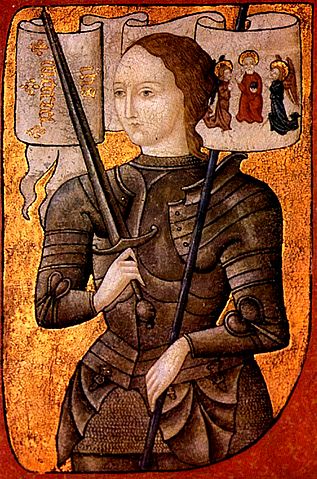
This headline from May 13, 1945, grabbed my attention: “FRANCE HONORS JOAN OF ARC AS ‘FIRST PARTISAN’. “
The piece began “The French paid homage today to their national heroine of five centuries, Joan of Arc, who was hailed as the ‘first of the resistants’ in military, religious and popular ceremonies.” The article went on to briefly describe the ceremonies and to point out that in prior years it had been French royalists who had celebrated the Maid of Orleans, not French republicans.
It seemed to me that with this recognition, the story of Joan of Arc had come full circle.
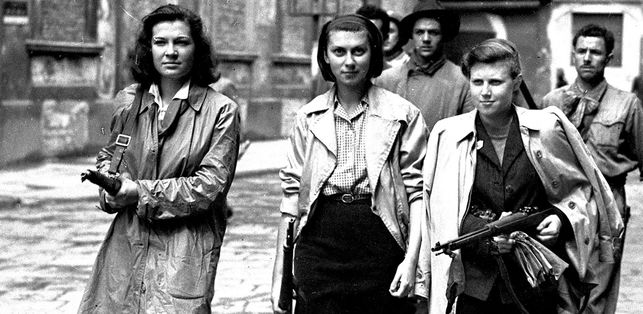
Over time, the phrase the “Joan of Arc of [fill in the blank]” has become shorthand for a (usually young) woman leading an army against an occupying foreign power. The term has been applied to the solidly historical Ani Pachen of Tibet and the semi-mythical Trieu Thi Trinh of third century Vietnam. The Women’s Era, a popular African American women’s newspaper founded in 1890, called Harriet Tubman “the Black Joan of Arc.” Novelist Henry Miller heard the story of Greek nationalist Laskarina Bouboulina and asked, “How is it we don’t hear more about Bouboulina? …She sounds like another Joan of Arc.” Even at the scale of a besieged city, we find a local heroine described as the “Joan of Arc of Braunschweig.” Each of these women embodied to some degree what Halina Filipowicz describes as the central element of the “Joan of Arc cult”: “a deeply felt need for a democratic hero of unflinching loyalty to a patriotic mission.”
Joan of Arc had long been the model against which other female resistance fighters where measured. Now it seemed the French government had turned the tables by dubbing Joan of Arc “the first of the resistants” rather than naming a woman resistance fighter “a twentieth century Joan of Arc.”*
*I almost typed “the Joan of Arc of France,” but that doesn’t work for obvious reasons.
From the Archives: In which I Finally Read A Woman of No Importance
Earlier this month, I was called to jury duty. I must admit, I thought about trying to get out of it on the grounds that I am under deadline on this book.* But I just couldn’t do it. I believe in the importance of the jury system. And I have spent the last few years thinking about the destruction of of the rule of law in Nazi Germany. So, I grumbled about the loss of a day. I prayed that I wouldn’t end up on a jury and lose more than a day. And I thanked the powers that regulate civic duty that I was assigned to a downtown court instead of one in the distant suburbs.
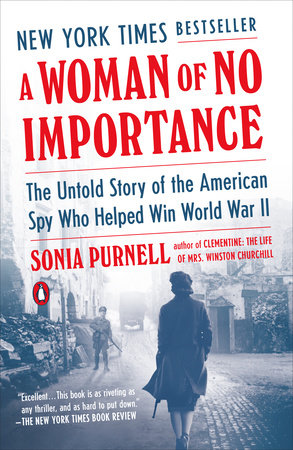
All of which is a long lead-in to the fact that I decided Sonia Purnell’s A Woman of No Importance: The Untold Story of the American Spy Who Helped Win World War II was the perfect thing to read in the jurors’ waiting room. The subject was adjacent to what I’m working on, but not so close that I needed to take notes. And by all accounts, it was a gripping read.
I am, as is so often the case, late to the game. Many of you may have already read Purnell’s bestselling account of Virgina Hall,** the American woman who talked her way into Britain’s Special Operations Executive (SOE) and was the first Allied woman deployed behind enemy lines—prosthetic leg and all.
A Woman of No Importance is a fascinating biography, with the tone of a thriller. Purnell starts with Hall as, in fact, a woman of no importance who had opted out of the life of a Baltimore socialite and been repeatedly frustrated in her attempts to join the diplomatic corps as more than a secretary. She traces Hall’s unlikely acceptance by SOE—in large part because the newly formed agency was desperate—and her invisible rise as a covert operator working with the French resistance in spite of repeated bumbling and failures on the part of SOE.
Because these days I read narrative non-fiction from a writer’s viewpoint,*** I was struck by the skill with which she weaves the larger story of World War II into Hall’s story. She consistently gives readers the information they need, without dumping a chunk of information that disrupts the story line. It is harder to do than you might think.
If you’re interested in World War II, spies, spies in World War II, or forgotten women who did amazing things, this one’s for you.
*Probably not a valid excuse, now that I think about it.
**After all, lots of people reading (or at least buying) a book is what makes a book a best-seller.
***A habit I hope to ditch after I recover from writing the current book. It may require serious rehab involving sitting on the rear deck with a pitcher of ice tea, a stack of really well-written books, and no way to make notes in the margins.
From the Archives-Shin-Kickers From History: Gaston Madru Secretly Films Occupied Paris
I have more new (or more acurately, old) stories to tell you, but I also have four book events over the next eight days–all different in format. So for the moment, allow me to share a few old posts dealing with occupation, resistance, and journalists at the front.
*****
Today I stumbled across an unexpected story–or at least a part of a story. Talking to a reporter about her experiences as a war correspondent Sigrid Schultz mentioned “our French colleague Gaston Madru” who had been killed by German soldiers when they caught him alone in his car near Leipzig on April 19, 1945. Because I am trying to look at events from the perspective of as many foreign and war correspondents as possible, I immediately looked up Madru and discovered that he was a newsreel cameraman. Before the war, he worked as a stringer for MGM’s News of the Day. During the occupation of Paris,from 1942 to 1944, he surreptitiously filmed the city and its Nazi captors. The images he captured were aired on September 18, 1944, after the liberation of Paris, on this newsreel:
It’s worth watching the whole thing: Madru got some amazing footage. (Reminder: If you subscribe to the blog and are reading this in your email, you need to shift over to your browser to see the video. Just double click on the post title.)
Madru’s bravery was not limited to photography, though that could have gotten him killed if he had been discovered. He also was a member of a Resistance “escape line” that helped downed Allied pilots to escape to safety.
After the liberation of Paris, Madru served as a war correspondent, again working for News of the Day. He was one of 314 civilian reporters who received campaign ribbons at the end of the war “for outstanding and conspicuous service with the armed forces under difficult and hazardous combat conditions.” He was one of eight newsmen to receive the award posthumously, along with Ernie Pyle.
******
Heads up Chicago-area friends! I’m thrilled to tell you that BookTV is going to film my book event at the Seminary Coop Bookstore on September 20. (Details here.) I’d love to see you there. (Bring lots of good questions!)