




Women in the Norwegian Resistance
My one complaint with the Resistance Museum in Oslo was that it did not include the role played by Norwegian women.* This is not surprising: we have only begun to hear stories about women in the resistance in various countries in Europe in the last few years.
A dive down the research rabbit hole made it clear that Norwegian women were in fact active in the resistance, just like their counterparts throughout Europe. Just like their counterparts, much of what they did was later dismissed as “passive resistance”** by scholars. And some of them were just plain “dissed” by their countrymen after the war.
Here are a few examples:

Eva Kløvstad began her resistance work in 1943 as an accountant at the Transport Office in Hamar, where she embezzled petrol marks and gave them to resistance workers who were moving refugees through Sweden. Later, under the code name Jakob, she was the defacto leader of 1,200 resistance fighters in the unit known as Milorg D-25 after its original leader was shot by the Gestapo. After the war, she was not allowed to march along the male members of her unit in the victory celebration.

Norwegian-born film star Sonja Wigert used her acting talents for the Norwegian resistance, as a double agent against the Germans for Sweden, and later for the OSS. Her code name was Bill. The Reichskommissar of occupied Norway had a weakness for beautiful actresses that Wigert effectively manipulated. She secured the release of a number of prisoners from Nazi internment, including her father. She provided information about Nazi agents in Sweden and was instrumental in getting a number of them expelled from the country. But she paid a high price for her work. After the war ended, she was shunned as a Nazi collaborator. In 1945, she sought to clear her name by giving interviews about her anti-German activities. The full extent of her contribution to the war efforts was only revealed 25 years after her death, when the Swedish secret service released the information.
On a happier note, Anne Margrethe Bang took part in the Battle of Hegra Fortress as a nurse. She was the only woman in the small group of Norwegians who held off the Germans for 25 days and were the last forces in southern Norway to capitulate to the invaders. She joined the volunteer unit when she learned that the forces at Hegra lacked medical supplies. After the fortress surrendered on May 5 1940, she was held as a POW. Once released, she joined the resistance movement again. After the war, she received numerous decorations for her war efforts, including the Norwegian War Medal.
To put this in context: 1433 members of the Norwegian resistance were killed during the German occupation; 255 of them were women
*In all fairness, the bookstore carried several books about women in the resistance. I did not buy any of them because they were in Norwegian. And working through documents in Sigrid Schultz’s archives taught me that Norwegian is not close enough to German to allow me to force my way through for more than a few paragraphs.
**A large percentage of the women involved in resistance movements in World War II did not actively carry guns or engage in sabotage, though their jobs were as dangerous as those of their armed counterparts. Because women could move more freely, they carried out critical activities that allowed the armed resistance movement to function. They acted as couriers, collected intelligence and arranged for food, supplies and shelter for armed insurgents. They transported weapons and ammunition and distributed illegal printed materials, sometimes using the trappings of pregnancy and motherhood to help them smuggle contraband under the eyes of German soldiers. Not passive actions by any reasonable definition of the term.
From the Archives: The Mother Jones Monument
It’s Labor Day here in the United States. One of the things I do to celebrate is to share a post from the past about major players in the early American labor movement. I think it’s important to remember that the labor movement fought hard for many things we shouldn’t take for granted, like a safe workplace, child labor laws, the forty-hour work week, and paid time off.
This year, I want to return to a post from 2022: the story of Mary Harris Jones, known in her time as Mother Jones
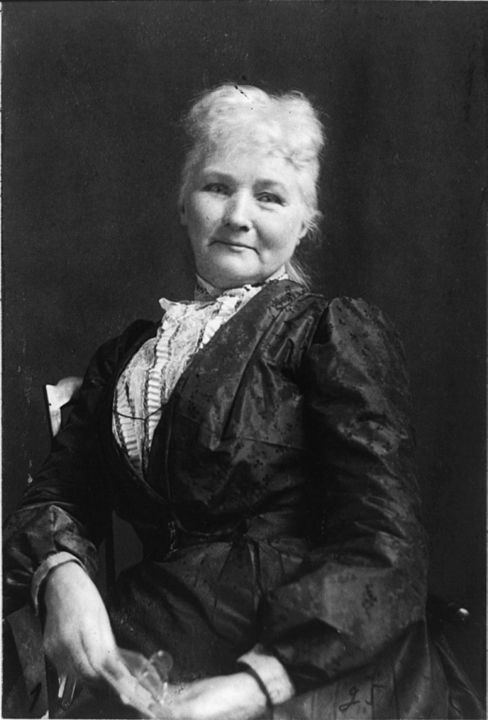
Driving from Chicago to the Missouri Ozarks and back over the last mumble years,(1) I have passed the sign for the Mother Jones monument many, many times. It is a plain, almost amateurish, sign, without the official imprimatur(2) of a brown tourist attraction sign(3) or the flash of billboard advertising a show in Branson. Nothing about it is designed to lure a curious history bugg off the highway. And up to now, we have not been lured.
That changed this year, thanks to an information panel in an Illinois highway rest stop.(4) My Own True Love and I were hooked.
I had been vaguely aware that Mother Jones was a union organizer, but I had no idea how important she was at her time.
Mother Jones was in some ways the Grandma Moses of union organizers: in fact, when she was testifying before a committee in the Senate on labor issues, a senator mocked her as the “grandmother of all agitators.” (She replied that she would someday like to be called the “great-grandmother of all agitators.”) At the point that she began her career as a union organizers, Mary Harris Jones was a poor, widowed, Irish immigrant. She had survived the potato famine, the loss of her husband and four children in a yellow fever epidemic, and the Chicago fire,bwhich destroyed her successful dressmaking shop.
After each loss, she reinvented herself. In the 1890s, she reinvented herself one more time, as “Mother Jones.” The name was subversive: playing against and with nineteenth century domestic stereotypes of women. Mary Jones cast herself as the mother of oppressed people everywhere. At a time when women were “supposed” to be quiet and stay home,(5) Mother Jones was a street orator with no fixed address, who traveled the United States for twenty-five years, moving from cause to cause. She had no interest in being “ladylike.” As she told a group of women in New York: “Never mind if you are not lady-like, you are woman-like. God Almighty made the woman and the Rockefeller gang of thieves made the ladies.”
Jones rose to prominence as an organizer for the United Mine workers, who paid her a stipend, but she went wherever she felt she was needed. She worked with striking garment workers in Chicago, bottle washers in Milwaukee breweries, Pittsburgh steelworkers, and El Paso streetcar operators, helping them fight against 12-hour days, low wages, dangerous working conditions, and the financial servitude of company housing and the company store.
Her motto was “Pray for the dead, and fight like hell for the living”—the world would be a better place if we all adopted it as our own.
****
When we got to the monument in Mt. Olive, Illinois, we learned there is a second part to the story. Illinois became a battleground for labor rights in 1898, when the Chicago Virden Coal Company challenged the miners’ contract. They brought in a train loaded with strikebreakers, and armed guards to back them. Miners from across the state joined together to stand their ground against the company. In the violent encounter that became known as the Battle of Virden or the Virden Massacre, thirteen people were killed, including six guards and seven miners. Thirty miners were wounded. Mother Jones considered the battle the birthplace of rank-and-file unionism.
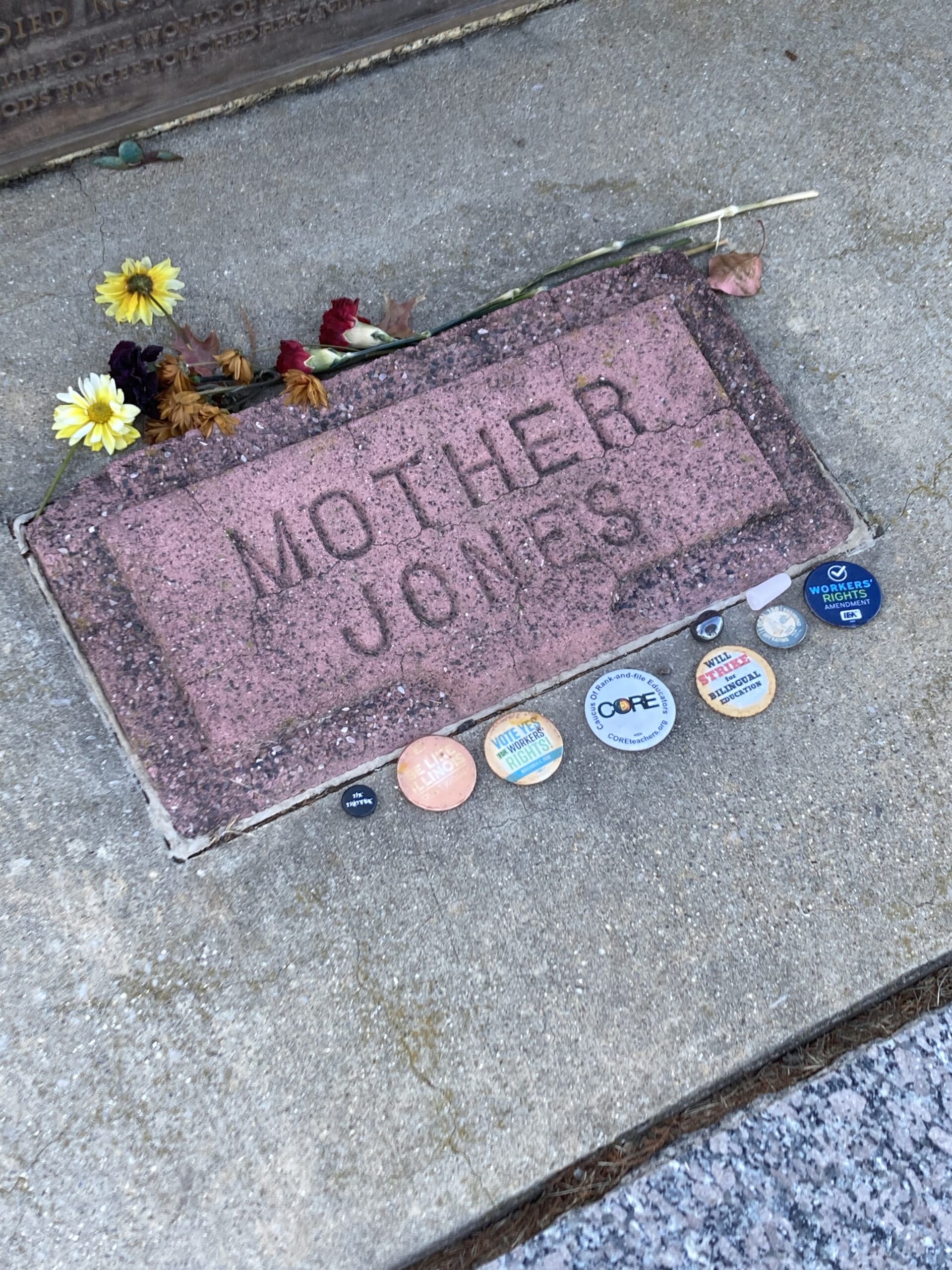
A Mt. Olive church refused to allow the miners to be buried in their churchyard, fearing their graves would become a pilgrimage site for the labor movement. (This is what is known as a self-fulfilling prophecy.) In response, the United Mine Workers built the their own cemetery in Mt. Olive, which in fact became a pilgrimage site after Mother Jones, at her request, was buried there in 1930. (Personally, the union buttons that had been left at the foot of the monument choked me up.)

(1) And by years, I mean decades
(2)Is there such a thing as an unofficial imprimatur?
(3) I went down a small rabbit hole trying to discover who approves such signs. I didn’t get an answer, but I did learn that the signs originated in France.
(4) We’re seeing more and more historical markers at highway rest stops, and I for one would like to say “bravo!” Not only because I love a historical marker, but because it encourages the curious to spend more time at the rest stop. After all, the point of the stop is not just to use the restroom, but to stretch the legs, rest the eyes, and fluff the brain, thereby making the next stretch of driving a little safer.
(5) Or so the popular account of history tells us. If I have learned anything in writing this blog, it is that the ideal of the “angel of the household” applied only to members of the relatively prosperous middle-class and that even within that class many women didn’t fit that mold for many reasons. Just yesterday a friend sent me the story of the team of “gentlewomen who had experienced reverses” who created the restaurants in Marshall Field’s in downtown Chicago. A very different story than that of Mother Jones, but one that also stands outside what we are taught was the nineteenth century norm.
Road Trip Through History: The Resistance Museum in Oslo

The Resistance Museum in Oslo was not included in our history tour of Norway.* That turned out to be a good thing in my opinion. My Own True Love and I spent the entire morning at the museum on our own the day after the tour ended. We would have been frustrated at being hurried through it as part of a group. And the museum told its own story very clearly. In short, it’s a history bugg must-see if you’re in Oslo.
Here’s the longer version:
The Resistance Museum is unusual in that it was created by members of the resistance. Because the museum is in some ways a historical document writ large, the exhibits have not been updated since it was opened to the public in 1970.** Even without the help of modern museum technology, it is a powerful example of visual story telling. And it was the perfect end to our trip.
Beginning with the first day of the invasion, the museum uses photographs, blown-up newspaper pages, recordings, and artifacts to tell the story of Norway’s resistance to its Nazi occupiers (We were grateful that the museum designers provided English signs alongside the Norwegian.) The museum provides a step-by-step history of the Nazi occupation, giving the larger context and lots of detail for many of the stories we had heard over the tour.
A considerable section of the museum focused on the creation, training, deployment and adventures of the Kompani Linge, which operated as saboteurs and resistance fighters in conjunction with Britain’s SOE (Special Operations Executive). But it did not limit the story to the obvious heroism of armed resistance. It also portrayed acts of civil disobedience against Nazi attacks on personal freedom. After all, heroes don’t always carry guns and blow things up.

Norwegian teachers in the concentration camp near Kirkenes.
If I had to choose a favorite story of the resistance from the museum, it would be the action of Norway’s school teachers, known as the Defense of Education. In 1942, Vidkun Quisling’s proto-Nazi government** created a new Norwegian Teacher’s Union. All teachers were required to join and pledge to teach Nazi principles in the classroom. Almost immediately, an underground group in Oslo sent out a statement for teachers to copy and mail to the authorities, stating that they refused to participate. Roughly 90 percent of Norway’s 14,000 teachers signed the protest statement.
Quisling responded by closing the schools for a month. Not a popular decision. More than 200,000 unhappy parents wrote letters of protest to the government. Meanwhile, many teachers defied the governments orders and held classes in private.
Hoping to break the teacher’s resistance, the government arrested some 1,000 male teachers. In April, the government of occupation sent 499 of those teachers to a concentration camp near Kirkenes, in the arctic. News of the relocation leaked and crowds gathered along the train tracks when the teachers were being transported, singing and giving the prisoners food.****
In mid-May, the Nazis gave up on creating a fascist teachers’ organization. By November, those teachers who survived had returned from the concentration camp. The Nazi curriculum was never imposed on Norway’s schools, thanks to Norway’s teachers.
*For those of you haven’t been reading along, in June My Own True Love and I spent two weeks in Norway on a history-nerd tour run by the Vesterheim Museum. It was fabulous.
**Which is longer ago than I like to think.
***More to come on Quisling in a later blog.
****Not a small gesture given wartime food shortages.