




175 Days of Bad News
I am slowly packing away my research materials for The Dragon from Chicago.* It is always harder than I expect. I have small stashes of material that I did not file at the time because I wasn’t sure where they should go. I stumbled across a stack of draft chapters that I never put away, probably because the project boxes were already full. (A problem I have not resolved in the interim.) And somehow I need to find room in the permanent bookshelves for the books currently stored on the rolling project bookshelf**—not an easy task.
In the course of dealing with the project bookshelf, I realize that there are a number of very good books that I never shared with you. Luckily, it’s never too late for a book review or two.

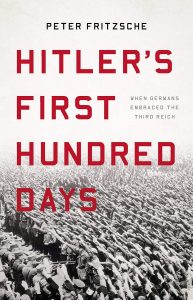
I think of The Last Winter of the Weimar Republic by Rüdiger Barth and Hauke Friederichs and Hitler’s First Hundred Days by Peter Frisch as a set, bookending the moment when Hitler became the German chancellor in January 1933.
The two books are different in structure and tone.
Barth and Friederichs take the reader day by day from November 17 1932 through January 30 1933. Each day opens with two or three newspaper headlines and is told in short segments that tell the story from different perspectives—a technique the authors describe as a “documentary montage.” Their goal is the let the story emerge without commentary based on hindsight. The result is powerful. (They also include a useful timeline at the end, which helped me keep a handle on the chronology of events at a time when things were moving very quickly.)
Hitler’s First Hundred Days has a more traditional narrative structure but is just as powerful. Frisch looks closely at the speed and brutality with which the Nazis built the structure with a terrifying combination of violence and parliamentary action—and the absence of resistance with which their actions wer met. His purpose is to understand how “a total fascist state that in January 1933 was highly contested rather improbable was widely accepted and broadly realized one hundred days later.”
Together, The Last Winter of the Weimar Republic and Hitler’s First Hundred Days give a reader a clear sense of the steps that allowed Hitler to take power and how the Nazis consolidated their position once they were in power. It is a chilling picture.
*Coming August 6 to your favorite purveyor of books. Which feels simultaneously like a long time from now and tomorrow.
**In theory, I can pull it next to my desk so that I can grab books as I need them. In reality, by the time I need to grab books , it is already too heavy to move. Besides, standing up and walking across the room multiple times a day gives me a moment to bend and stretch—always a good thing.
In which I finish reading Rin Tin Tin
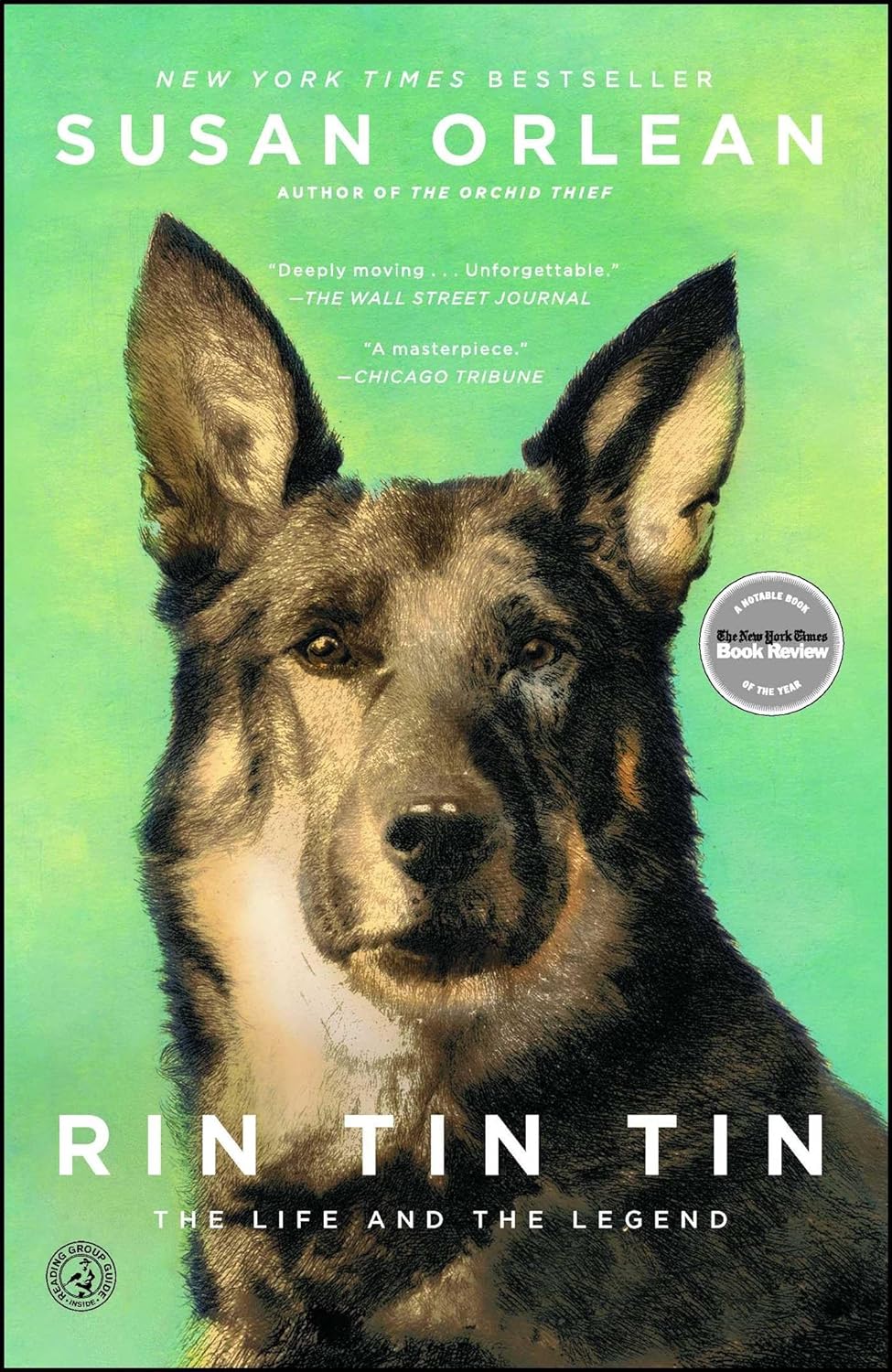
Last Sunday I sat down and finished the last sixty pages of Susan Orlean’s Rin Tin Tin: The Life and the Legend. I had been reading it on and off over the last six months in small bites. Sometimes I put it aside because another book called my name. For one reason or another. (The Girls of Atomic City, for instance.) But often I put it aside because it was so intense that I needed a little break.
The intensity took me by surprise. I have no emotional attachment to Rin Tin Tin as a cultural icon. I am not old enough to have seen the The Adventures of Rin Tin Tin when it ran in prime time and have no memory of watching it in reruns on Saturday mornings. (On the other hand, I have fond memories of seeing an occasional episode of Sky King.) I finally pulled the book off my shelf, where it had sat unread for a decade, because My Own True Love and I were watching The Thin Man movies and he wondered which dog appeared in the movies first, Rin Tin Tin, Lassie, or Asta.*
Rin Tin Tin is alternately heartwarming and heartbreaking. Orleans begins with the story of a man’s love for a dog that he rescued from the battlefields in World War I. The book then moves through the world’s love first for films and then television programs that initially starred and later featured characters based on the original Rin Tin Tin. It ends with a handful of people who were obsessed with Rin Tin Tin, both as an animal and as an intellectual property, including legal battles over control of the dog’s name, image, and descendants.
Orleans sets the Rin Tin Tin story against a rich backdrop of related stories, including:
- The development of German Shepherds as a working breed by by a German cavalry officer named Max von Stephanitz using various traditional German herding dogs in the early twentieth century.
- The changing use of dogs in film and television.
- The shift of dogs from outdoor working animals to pets, and the related growth of kennel clubs and obedience training.
- The Nazi idolization of German Shepherds as pure-bred “Aryan” dogs—and Hitler’s relationship with his own dogs.
- The recruitment of dogs for the United States Army’s K-9 Corps in World War II. (This was one of the points at which I had to set the book down for a while. I had learned about the K-9 corps previously when we visited historical Fort Robinson in Nebraska. Orleans looks at the story in more depth, which made it even more distressing as far as I was concerned.)
- Why Westerns were so popular after World War II
As is often the case with Orleans books, she includes her experience of reporting the story, bringing the reader through the process.
In short, Rin Tin Tin is a masterful piece of storytelling.
*Rin Tin Tin by a long shot. He first appeared in silent movies, beginning in 1922. Also, as Orleans points out, Rin Tin Tin was a real dog who played fictional characters. Lassie and Asta were fictional characters in novels adapted for film. Not the same thing at all.
Helena of Egypt, whose story looks mighty familiar
Roughly a year ago, I wrote a post about Tamaris, a woman in the fifth century BCE who was the daughter of a painter and an acclaimed artist in her own right. Recently I learned of a similar story, courtesy of novelist Joanne Harris, who is running occasional posts titled “Women You Deserve to Know” on her Threads account.
Helena of Egypt was a painter in the fourth century BCE, active in the period after the death of Alexander the Great in 323 BCE.* Like Tamaris, she learned her craft from her father, an otherwise unknown artist named Timon. And like Tamaris, we know little about her. Our main source is Pliny the Elder (23/24-79 CE), who included her in a list of women artists in his Natural History. She also appears in a list of women named Helena in an encyclopedic work by Photios I of Constantinople (ca 810/820-893 CE), who probably got most of his information from Pliny..
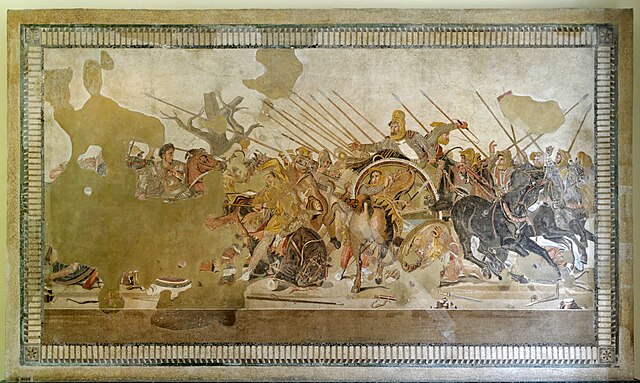
According to both Pliny and Photios, Helena’s best known work was a scene of Alexander the Great’s victory over the Persian ruler, Darius, at the Battle of Issus. According to Photios, the Roman emperor Vespasian (r. 69-79 CE) held what was then an ancient painting, along with other spoils of war, in the Temple of Peace in Rome The painting is long lost, but a mosaic of the same subject found at Pompei is believed by some to be a copy of Helena’s work.
It turns out that Pliny was also Boccacio’s source for writing about Tamaris. In fact, he is our only source for women artists in ancient Greece and Rome. The list is small: Tamaris, Helena of Egypt, Aristarete, Iaia, Eirene, and Calypso. Pliny does not have much information on any of them, though he does suggest that all but one of them had a father who was also a painter. Working from details given by Pliny, later scholars have dated them from the sixth through the third centuries BCE—in other words centuries before Pliny wrote about them.
Perhaps inevitably, some modern scholars have suggested that one or all of them did not exist, for the same reasons that scholars have argued that various women warriors did not exist. *Sigh*
*A time of political chaos as Alexander’s generals, and his older half-sister Cynane (also a talented general), duked it out over the remains of his empire. But I digress.