




Road Trip Through History: Oak Ridge Tennessee, aka Site X
This year My Own True Love and I spent Thanksgiving in Atlanta with family. Instead of joining the travel madness of flying over the holiday, we decided to drive. And since we were driving, we decided to turn the trip into a mini-historical road trip. (Does this surprise anyone?) Our goal: Oak Ridge, Tennessee, a “city” built from scratch as part of the Manhattan Project. We were, if you will pardon the expression, blown away.
Known as “Site X” in Manhattan Project documents, Oak Ridge was built specifically to house scientific facilities and the people who staffed them on land purchased by eminent domain, beginning in November 1942.* During the period when the Manhattan Project was active, Oak Ridge was the 5th largest city in Tennessee, but it did not appear on any map— though people in the surrounding region (especially those forced to leave their homes on short notice) certainly knew something was going on behind those fences. No one other than Oak Ridge staff and their families was allowed to live there. If you didn’t have a badge, you didn’t get in. (Even kids got badges when they turned 12.) The scientists and technicians at Oak Ridge developed ways to enrich uranium and ultimately produced the enriched uranium that fueled Little Boy, the bomb the was dropped on Hiroshima on August 6, 1945. Today Oak Ridge is home to a National Lab dedicated to nuclear science of all kinds, including disassembling nuclear weapons and safely storing uranium.
Oak Ridge is very conscious of its roots in the Manhattan Project. The city has four museums dedicated to its history and modern atomic science, as well as a plethora of historical markers throughout the town. (Signs directing tourists to the various museums and historical sites were simply labelled “Top Secret”—a playful approach that amused me greatly. ) 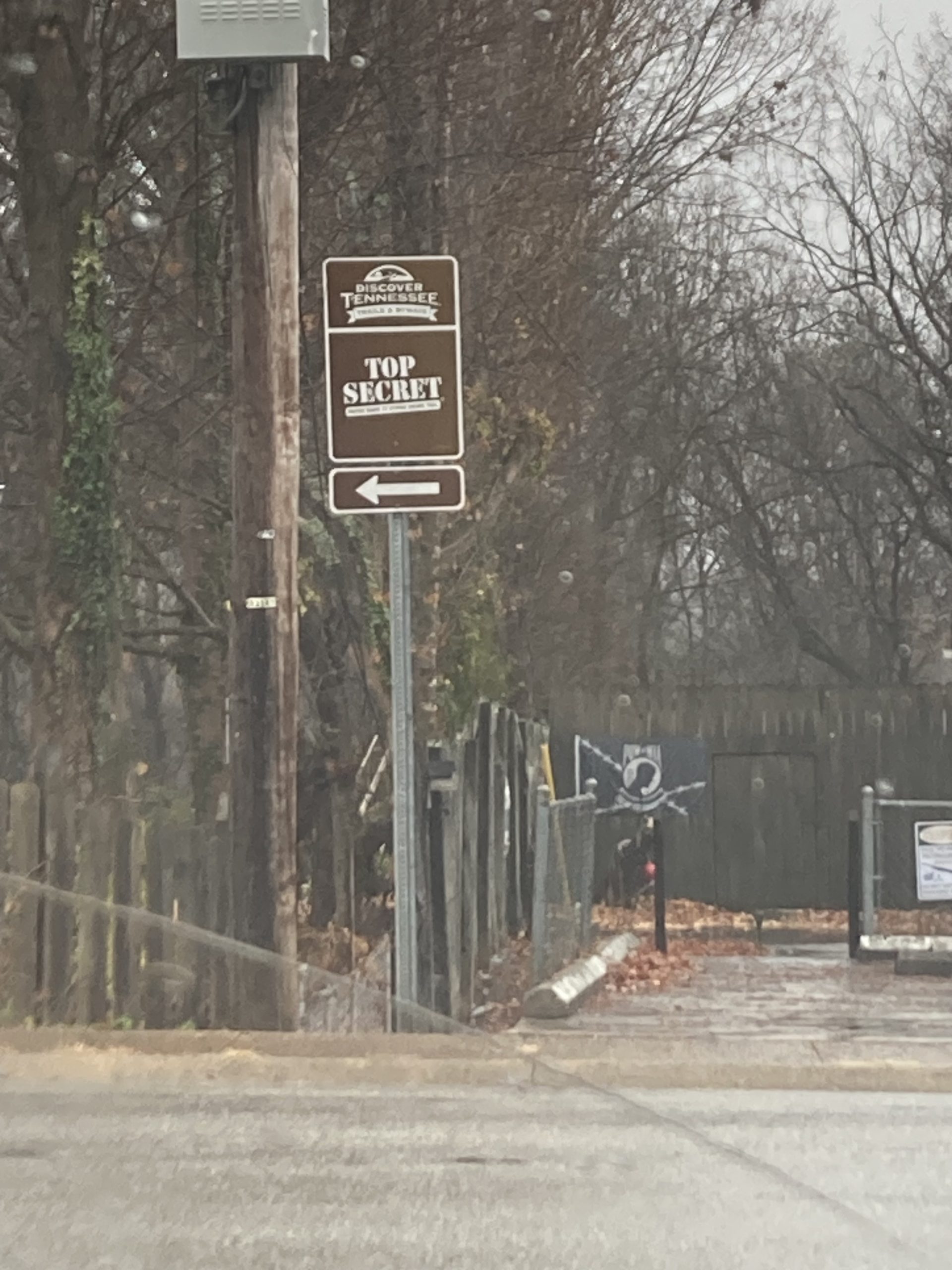 We managed to visit two of the museums during our one day visit: the American Museum of Science and Energy, which is a Smithsonian affiliate, and the Children’s Museum of Oak Ridge, which houses an outpost of the National Park Service.
The AMSE is divided into five major sections —the Manhattan Project, National Security, Big Science, Early Leadership and Environmental Restoration—plus a freestanding exhibit focused on Robert Oppenheimer. The exhibits as a whole were well-designed, with lots of interactive displays, but I must admit I began to flag the further we got from the history of Site X and the deeper we got into modern atomic science. The failure was mine. (Also, I get museum fatigue at about the two-hour mark no matter how interesting the displays. And also, it was two days before Thanksgiving and several local schools had scheduled field trips. ) The section dealing with the Manhattan Project itself consciously included displays dealing with the roles of women and people of color—and did not attempt to hide the discrimination faced by the Black workers at the site. One amusing display case included examples of unfamiliar technology used at the Oak Ridge facilities, including a rotary telephone.
Here were some of the things that caught my imagination:
- The average age of residents and workers at Oak Ridge was 27.
- The story of mathematician and physicist Dr. J. Ernest Wilkins Jr (1923-2011): Wilkins entered the University of Chicago at the age of 13 as an undergraduate. He completed his PhD at 19, and began to teach mathematics at Tuskegee University. In 1944, he joined the University of Chicago Met Lab, where he worked with Arthur Compton and Enrico Fermi, researching nuclear fission. That fall, his team was transferred to Oak Ridge, but Wilkins was not able to go due to Jim Crow laws in Tennessee. Instead, he remained in Chicago, where he worked in Eugene Wigner’s Metallurgical Laboratory, where he helped design the nuclear reactors used at Oak Ridge.
- One of the facilities, K-25, was so big that people rode bicycles from one work area to another. “Watch for bicycles” signs were common throughout the building.
The Children’s Museum of Oak Ridge is located in what was previously an elementary school built in 1944 to house the children who lived in the secret city—making it an exhibit as well as a container for the exhibit. It is a true children’s museum, with exhibits on a variety of subjects aimed at children with inquiring minds. (I was particularly taken by a hands-on exhibit about the lives of two fictional children in Appalachia in the summer of 1865. My Own True Love went straight for the stuffed polar bear.) Included in those exhibits is a two-part section on the Manhattan project that looks at Oak Ridge’s origins from a different perspective than that explored in the AMSE.
The first section, called the Oak Ridge Corridor, is a timeline titled “Difficult Decisions” that covers the length of one hallway. It puts the decision to build Oak Ridge into historical context, beginning with the Norris Act of 1933, which approved the establishment of the Tennessee Valley Authority—access to abundant electricity was one of the factors in choosing the Oak Ridge area as the home to Site X. The timeline dealt with questions of isolationism and the start of World War II as well as events touching directly on the Manhattan Project. One striking image was not directly related to Oak Ridge: a picture of Secretary of War Henry Stimson being blindfolded before he selected the first capsule in the Selective Services draft lottery—on October 29, 1940, a year before the United States entered the war.
The second section, another long corridor, focused on life in Oak Ridge when it was a secret city. This exhibit drew heavily on the amazing work of Ed Westcott, the site’s official photographer. The pictures of Oak Ridge residents at work and play make it clear just how young the average Oak Ridger was. They also make it clear the the “city” was an improvised place with strong overtones of the frontier.
The Children’s Museum is also home to the National Park Service’s visitor center: a small booth in the lobby. The ranger wasn’t on duty when we arrived, but I later had a chance to eavesdrop while he talked to a family about the Manhattan Project in general and Oak Ridge in particular. As usual, the park service did not disappoint.**
Quite frankly, I’m not sure I could have absorbed any more.
*For those of you who want the time line:
1939 German scientist Otto Frisch, working with his aunt Lisa Meitner (who is often left out of the story) produced the first theoretical interpretation of nuclear fission–which they named. Later that year, Albert Einstein and a number of other scientists wrote a letter to President Roosevelttelling him that the Germans had already started research on uranium and urging him to support similar research in the United States
The Japanese bombed Pearl Harbor on December 7, 1941. On December 8, the United States declared war on Japan. Three days latter, the Axis powers declared war on the United States.** Only then did the United States declare war on Germany and the other Axis powers.
The Manhattan Project was approved in August, 1942
** The National Park Service maintains a presence at three sites related to the Manhattan Project: Oak Ridge, Hanford, Washington, and Los Alamos, New Mexico. One down, two to go.
***
Travelers’ tip:
Dean’s Restaurant and Bakery, also housed in one of the original buildings, in this case the Jackson Square Pharmacy, is a classic meat and three. The docent at the ASME recommended it. I went with some hesitation because the photos on the website were not enticing. But we have had consistent good luck with museum staff suggestions, and this was no exception. The food was amazing. The portions are huge, so this is a good place to split a meal if you can agree. We could not. I also was unable to settle on one side, so I went with a meat and two, thus increasing the amount of food I left behind. The dessert menu looked excellent, but we were Too Full.
American Journalists and the “Grand Refrigerator”: A Small Pearl Harbor Story
Two days after the Japanese attack on Pearl Harbor on December 7, 1941, the American government arrested hundreds of German, Italian, and Japanese citizens who were resident in the United States as enemy aliens. Among those arrested were German diplomats and journalists. In retaliation, the Nazis put all the American correspondents who were still in Germany under house arrest. A few days later, they were sent by train to the resort town of Bad Nauheim, along with American embassy and consular personnel and their families. The Americans were held there for five months while the American and German governments negotiated details for a personnel exchange. No mail was allowed in or out.
The Americans were interned in the Grand Hotel, a summer resort hotel which had been vacant since the beginning of the war and was by that time not so grand. The building, which was not designed for winter use, was unheated. The internees dubbed it “the Grand Refrigerator.” The food was inadequate. (Some internees used the breakfast rolls to caulk the leaky windows in their rooms, preferring to be a little warmer at the cost of a little more hunger.) —in all fairness, the conditions weren’t that different from those suffered by the average German at the time.
According to the internees’ own accounts, their biggest problem was boredom. They responded by creating “Bad Nauheim University.” With the motto “Education of the ignorant by the ignorant,” internees taught each other a variety of courses that included tap dancing, Sanskrit, bridge, self-defense, and philosophy. The most popular of these was a course in Russian history taught by diplomat and Soviet specialist George Kennan, who could not fairly be charged with ignorance of his subject.
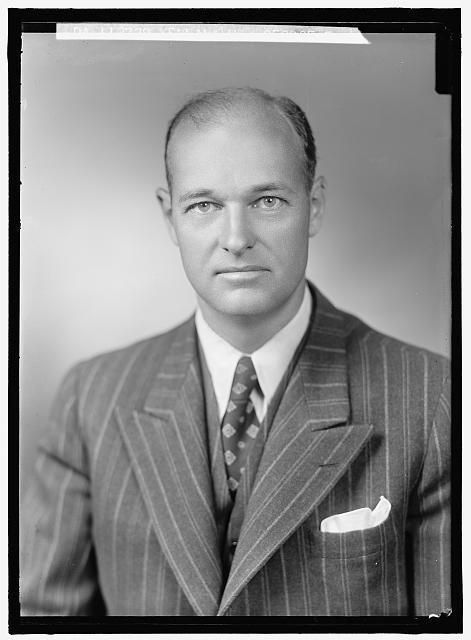
George Kennan, ca 1947
They also held readings, musical performances, spelling bees, treasure hunts and mock trials. When the weather warmed up, they organized baseball games, using a bat whittled from a tree branch and a ball stitched together by an America doctor from a champagne cork, one internee’s pajamas, and a sock.
They didn’t play baseball for long. On May 12, 1942, the internees left Bad Nauheim on a train for Lisbon, where most of them boarded a Swedish ship bound for the United States. Thirty-two employees of the diplomatic service were sent directly to new assignments in Europe or Africa. They arrived in New York City on May 30th, 20 to 40 pounds lighter than they were on December 7, 1941
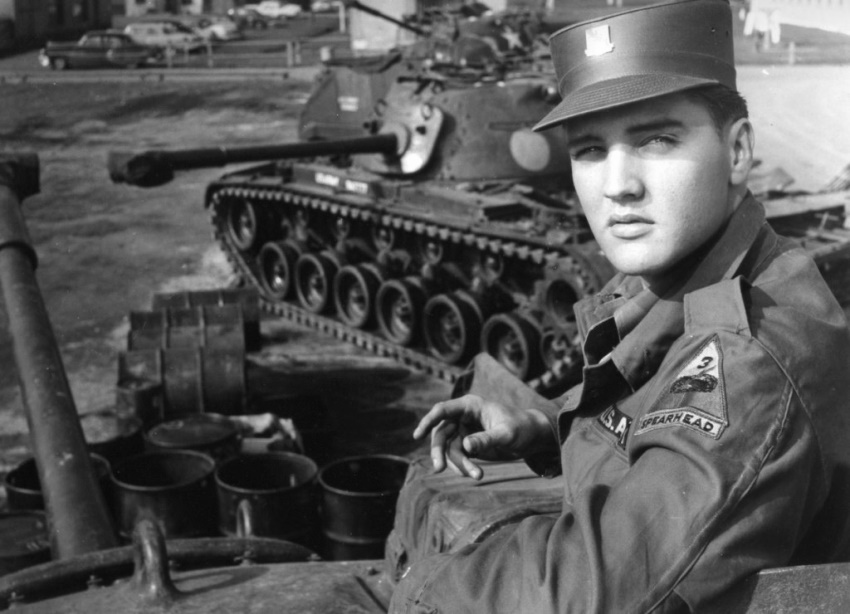
Perhaps not surprisingly, the Bad Nauheim tourist board prefers to emphasize another American who spent time there, in 1958:
History on Display: The Jane Addams Hull House Museum
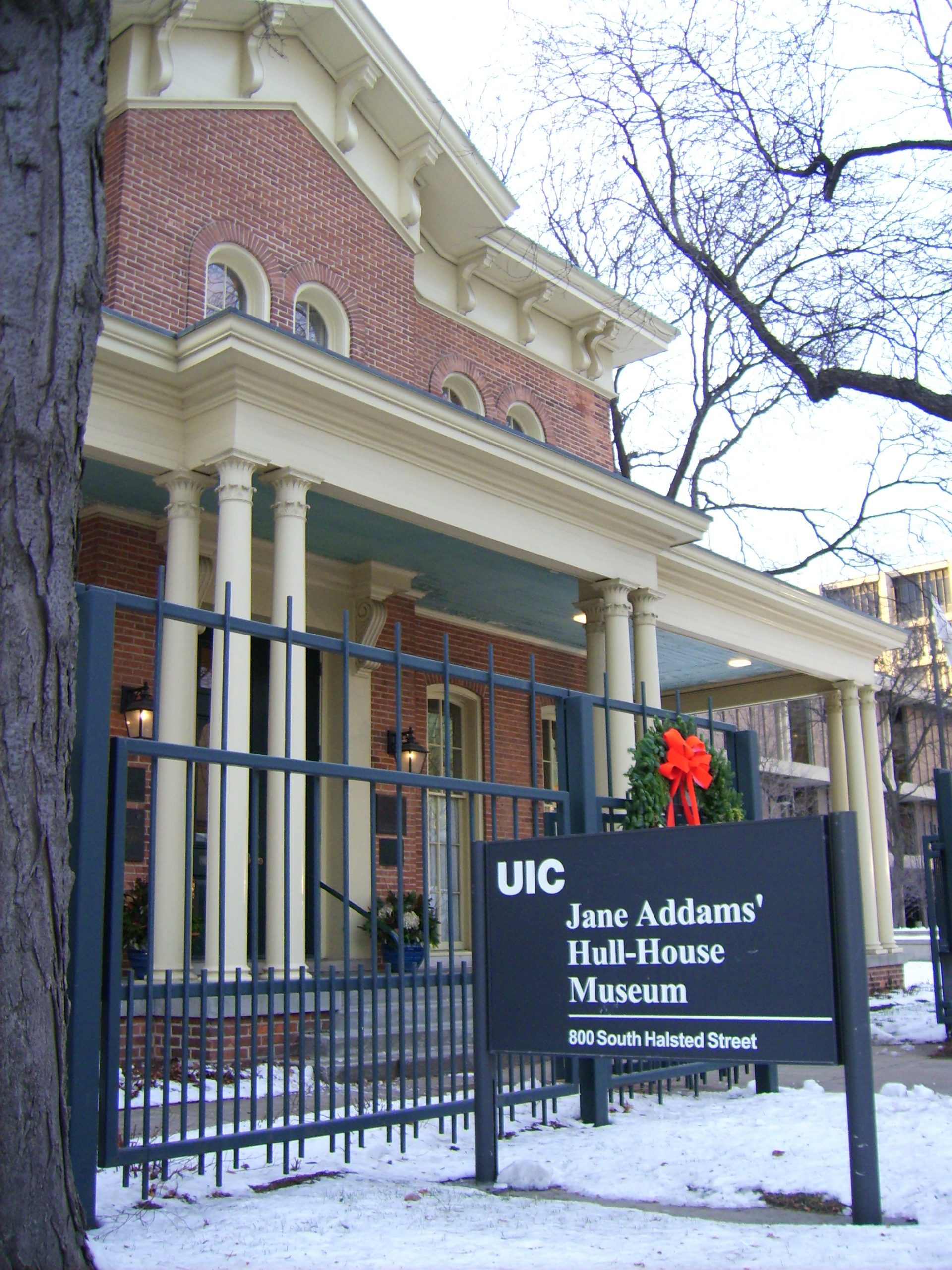
A few days ago, My Own True Love and I took a few hours off to visit a museum that’s been on our list for several years now: the Jane Addams Hull House museum. Jane Addams (1860-1935) and Hull House stand in the center of a Venn diagram of many of our interests: historical women who made a difference, late 19th and early 20th century reformers in general and the settlement house movement in particular, Chicago history, and the immigrant experience in America.
We were familiar with the basic story of Hull House: Jane Addams and Ellen Gates Starr were introduced to the concept of settlement houses, in which middle-class and upper-class reformers “settled” in group houses in poor urban neighborhoods, on a visit to London. On their return to the United States, they founded Hull House* in a densely populated, largely immigrant neighborhood in Chicago’s Near West Side. The settlement house offered a variety of social programs to neighborhood residents. All of which is true, but neither of us was prepared for the sheer scope of the Hull House project.
Hull House itself was only one of a multi-building complex that eventually filled an entire city block.** which is now part of the University of Illinois Chicago campus. Addams and Starr were the leaders of an extraordinary group of women—doctors, lawyers, artists, general shin-kickers—who made the world a safer, better place for women, children, blue collar workers, and immigrants. They helped lay the foundation for the field of occupational health and safety, helped pass laws against child labor, and published a report on conditions in their neighborhood that was the first to blame conditions in urban slums on economic systems rather than on the individuals who lived there. They pushed for an eight-hour work day and introduced art classes to the Chicago public schools. Addams won the Nobel Peace Prize in 1931, but not every one saw their actions as positive. Addams had an FBI file. The DAR dubbed her the most dangerous woman in America. And the “female führer” Elizabeth Dilling gave her a listing in her infamous Red Network.
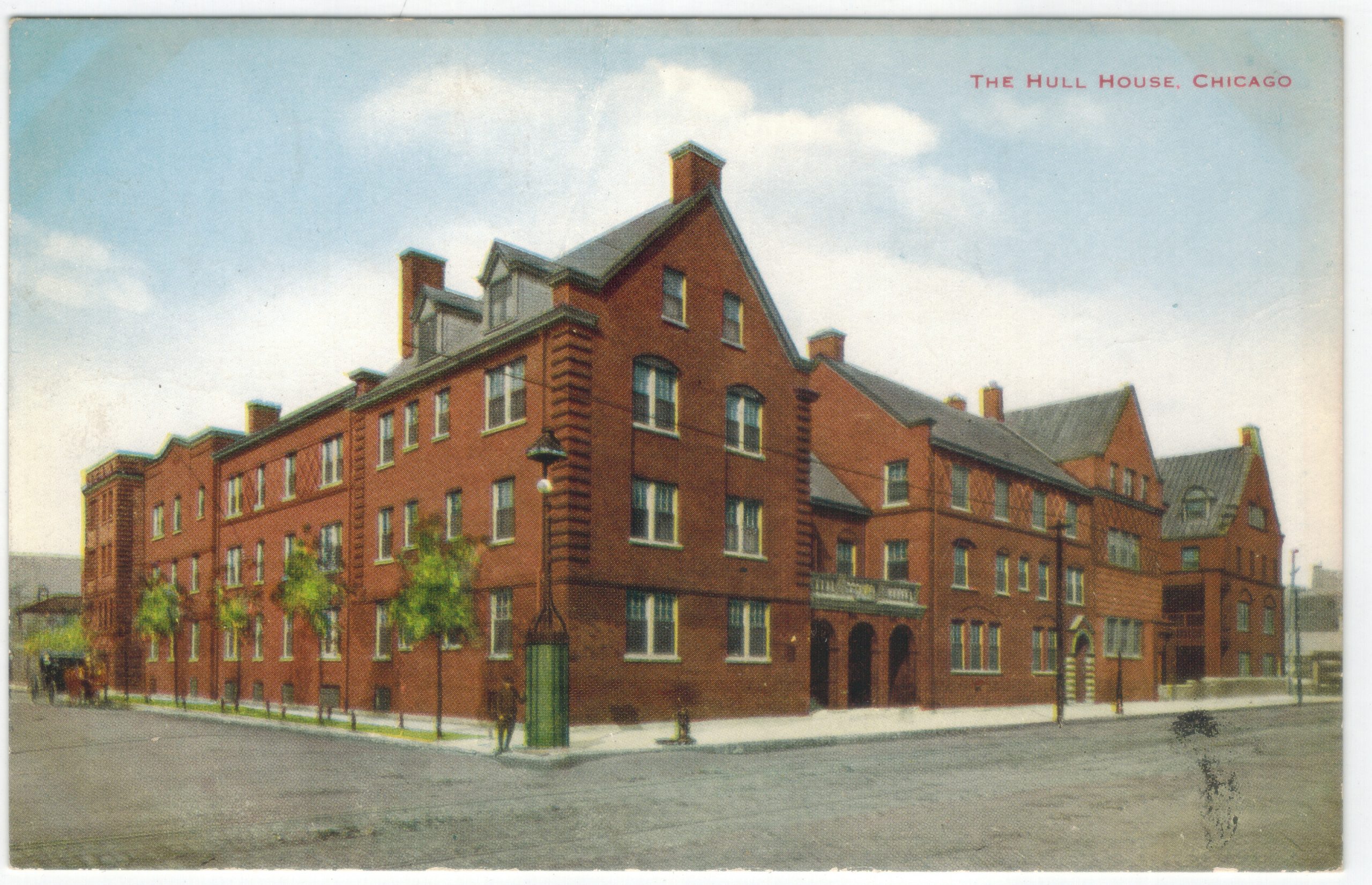

At the complex itself, Hull House offered classes in art and music, technical skills, cooking, sewing, and English as a second language. They offered a wide range of services to the neighborhood, including a nursery and kindergarten so working women would have childcare, a public kitchen that served 60,000 meals a year, public baths,** an employment bureau, a clinic, an art gallery and performance space. The complex housed a branch of the Chicago Public Library and the Jane Club, which provided housing for single working women. It also produced its own electricity, and sold the excess power to its neighbors.
The museum tells the story well, with artifacts, photographs, and quotations. You are urged to sit at Addams desk. And, in what is one of the most unusual museum programs I’m aware of, the Jane Addams Bedroom Project, UIC staff, faculty and students are invited to sign up to take a nap in Addams’s bedroom—a practical expression of Addams’s believe that play and rest were important.
If you’re in Chicago, the Jane Addams Hull House Museum is well worth a visit. If Chicago is not in your future, a virtual tour is available at the museum website.
*Named after Charles Jerald Hull, the original owner of the quite astonishing Italianate-style house, built in 1865, that was the heart of the settlement. Since we are old-house nerds as well as history buffs, we were occasionally distracted by the building itself.
** The block was taken over by the University of Illinois Chicago. Only the 1865 building, where Addams lived and worked remains.
***Soon after Hull House opened, Addams learned there were only 3 bathtubs in the 1/3 square mile east of the building. She had 3 public baths built behind the settlement which gave almost 1000 people a month access to baths that were previously unavailable.