




From the Archives: Orson Welles’ The War of the Worlds and the History of Radio Broadcasting
You’ve probably heard this story before:
On October 30, 1938, a 23-year-old theatrical boy-wonder named Orson Welles caused panic among radio listeners with the Halloween episode of his Mercury Theatre on the Air: an adaptation of H.G. Well’s The War of the Worlds.(1) Actors played the roles of correspondents who broke into an on-going [fake] radio program, seeming to report live as Martians invaded and destroyed the real life town of Grovers’ Mill, New Jersey. As the fictional invaders began to move toward Newark and then New York City, these “correspondents” told their audience that they were reporting from military command posts and from the roof of a broadcasting building in Manhattan.
Some listeners believed the show was a live broadcast and panicked, even though the opening of the show made it clear that the one-hour program was a drama.(2) A Princeton study published in 1940 claimed that six million people heard the program, and 1.7 million believed it was a real news broadcast. (Subsequent scholars question both numbers.)
As for me, I’ve always wondered why anyone would believe the broadcast was real, but as I learn more about radio in the 1930s it makes more sense. Radio was relatively new—the first national broadcast networks in the United States were incorporated in 1926 (NBC) and 1928 (CBS). News broadcasts were even newer, and infrequent. Stopping a program for “breaking” news was almost unheard of.
The growth of Nazi Germany changed the nature of broadcast news The first “news roundup” from multiple locations occurred in March, 1938, in response to the German invasion of Austria. Working on short notice, with serious technical difficulties, Edward Murrow and William Shirer of CBS cobbled together a half-hour of American newspaper correspondents commenting on the invasion from London, Vienna, Berlin, Paris and Rome. Listeners were enthralled.
When the Munich Crisis broke out that September, both NBC and CBS upped their coverage, broadcasting live from Europe 147 and 151 times respectively over the course of three weeks. Back in the United States, CBS’s primary news reader, H.V. Kaltenborn (3), held the story together for his listeners in 102 broadcasts that ranged from one-minute bulletins to two-hour marathons in which he simultaneously translated speeches from French and German. America stayed glued to the radio throughout the crisis.
The crisis ended, but the role of radio news was changed. Local radio stations increased the time they devoted to broadcasting the news and networks scrambled to expand their overseas coverage.
As a result, when Welles broadcast The War of the Worlds a month after the crisis in Munich, he reached an audience that was newly attuned (literally and metaphorically) to radio news, but was not yet sophisticated enough about the medium to tell fact from fiction.
(1) Am I the only one to just now notice the juxtaposition of Orson Welles and H.G. Wells in this event? Meaningless and yet curious.
(2) One scholar suggests that some people missed the beginning because they were channel surfing. Let this be a warning to you.
(3) I hadn’t heard of him either until I started working on this book. At the time, he was a Big Deal.
Around the World in Eleven Years
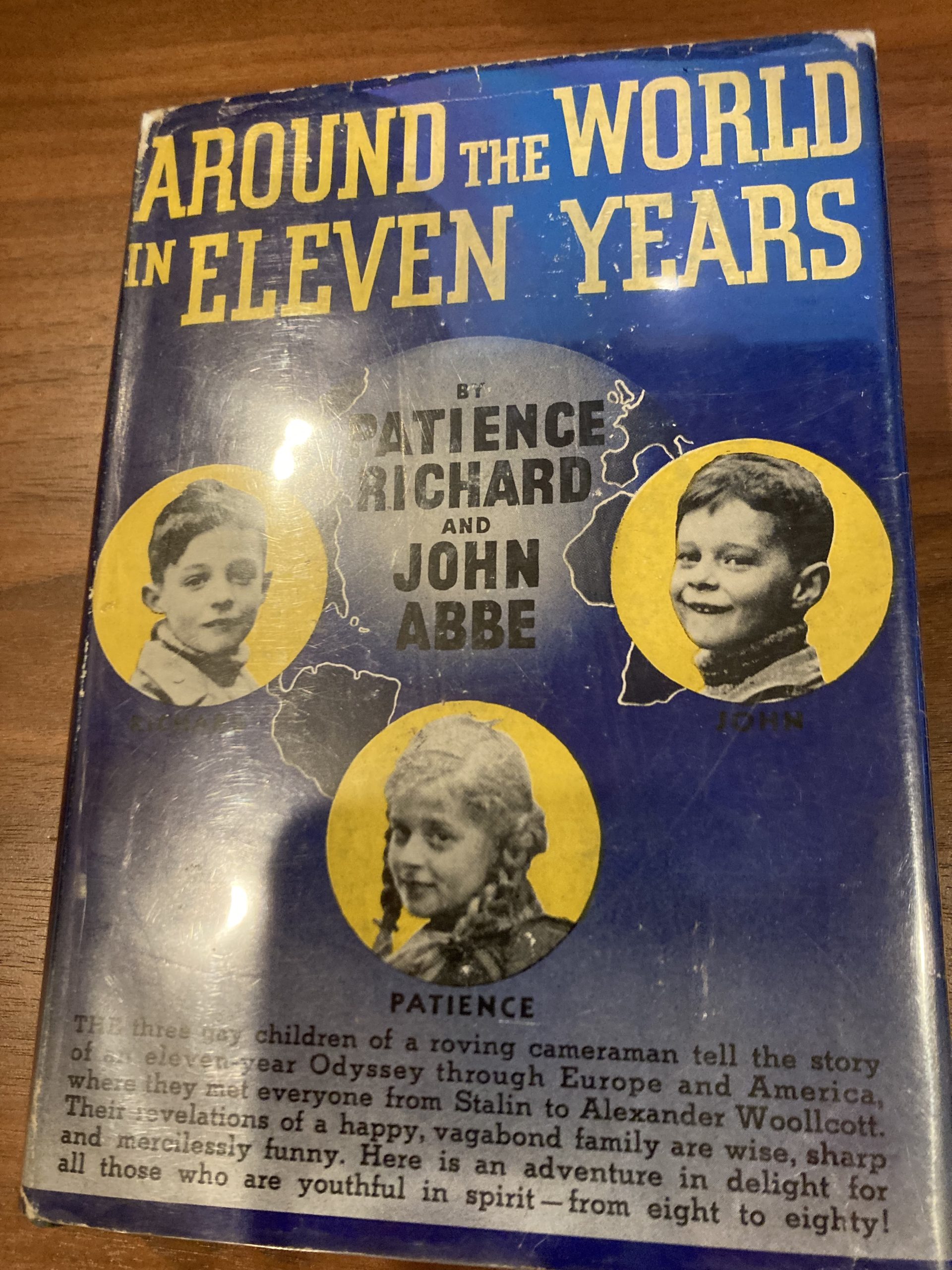
And speaking of memoirs about living in Nazi Germany, as I believe we were, allow me to introduce you to Around the World in Eleven Years, possibly the most unusual memoir of the period.
Published in 1936, the book was purportedly written by eleven-year-old Patience Abbe with occasional input her younger brothers Richard, and John. According to family lore, as reported in Abbe’s obituaries in 2012, the book was inspired by their mother, actress and former Ziegfeld girl Polly Abbe, who transcribed the children’s stories. Around the World in Eleven Years tells the story of the children’s nomadic childhood in Europe, following their father, photographer James Abbe, from France to Germany, Austria, Russia and England, returning “home” to the United States for the first time when Patience was eleven.
The book was an immediate best-seller, going through sixteen printings in its first year, perhaps because readers were eager to read what the reviewer in the Los Angles Times described as a “chronicle of rollicking kids” that smoothed the edges off the increasingly difficult news from Europe.*
James Abbe was one of the best known photographers of the 1920s and 1930s. He originally made his name as a stage and film photographer with portraits of Hollywood stars such as Mary Pickford, Charlie Chaplin and Lillian Gish. In the late 1920s James turned increasingly to photojournalism. His work included an exclusive photo session with Stalin in the Kremlin, documenting the rise of the Nazis in Germany, and images of the Spanish Civil War.
While there is no doubt that at least one adult, and probably several, edited Patricia’s stories, they retain a child’s eye view. Around the World in Eleven Days offered readers an innocent but sharp-eyed counterpoint to James Abbe’s photographs. In it, “I, Patience” described a Nazi march, in which her mother got entangled and crossing the Russian border with her father’s negatives wrapped around her brother’s bellies so the Soviets didn’t seize them. She talked about going to school in Nazi Germany, where they had to salute their teachers and say “Heil Hitler!”, and in Russia where she learned a communist version of “London Bridge is Falling Down.” She also shared her impressions of the people they met, including Sigrid Schultz:** “Aunt Sigrid is a little lady with golden hair and blue eyes and beautiful teeth. She is always smiling…She helps lots of people and speaks four languages. She is also very chic and always had parties and Mamma used to go to them all the time.” Sigrid Schultz in a nutshell.
Once back in America, the Abbe family traveled cross country from New York to Hollywood, where they finally made their home. Instead of meeting politicians and foreign correspondents, they met movie stars. (Patience once danced standing on Fred Astaire’s shoes for a photo shoot.)
Patience (or possibly Polly) ended the book with their dreams for further travels: “We would go to China. Richard wants to see the gold on the King’s house in China. Johnny wants to see the robber. I, Patience, want to see everything.” Hard to disagree with that, Patience.
**Just to put it in context here are a few high points, or low points, in the news in 1936 for those of you who don’t have the chronology in your head:
❦ March Hitler sent troops into the demilitarized Rhineland zone and renounced the Locarno, finally destroying any illusion that Germany would honor the Versailles treaty. It was Hitler’s first military action.
❦ May Italy conquered Ethiopia.
❦ July The Spanish Civil War began.
❦ August Berlin hosted the Olympics, presenting a whitewashed view of Nazi Germany to the world
❦ Also August In Russia, the dramatic trials began that would develop into Stalin’s first round purges, known as the Great Terror
❦ October Hitler and Mussolini signed the first of several treating, creating the Rome-Berlin Axis
Not a good year, with worse to follow. (In a recent post I promised to try to use “horticultural dingbats” here on the blog. I found they were too fussy to replace asterisks but are a more gentle choice than “bullets” for a list. Though bullets might be the appropriate choice for this particular list.)
** You knew there was a reason I read this book.
Bella Fromm’s Berlin Social Diary
Over the last four years, I’ve read a lot of memoirs and diaries written by people who lived in Berlin in the period between the two world wars. They are a wonderful source to use to enrich a story. They not only allow you to look at incidents from different perspectives but, depending on the author, they can give you details that it is impossible to get any other way. *
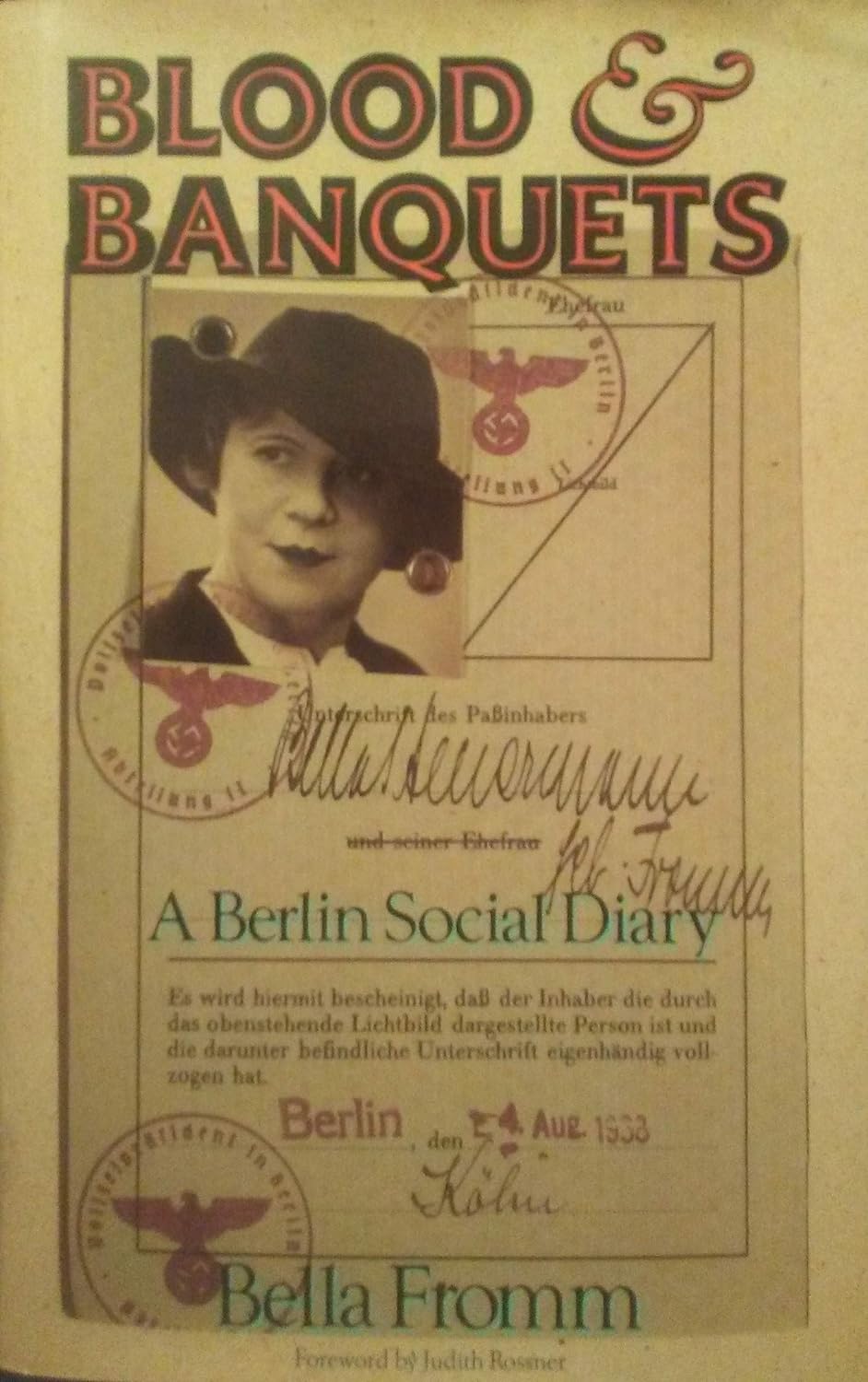
Most of the memoirs I used were written by American foreign correspondents stationed in Berlin. One memoir stands out because it was written from a different perspective: Bella Fromm’s Blood and Banquets: A Berlin Social Diary, published in 1942 once she was safely in the United States.
Bella Fromm (1890-1972) was a member of a family of wealthy Jewish wine merchants with long standing roots in Germany and connections with highest ranks of German society, including the Bavaria royal family. The inflation that wracked Germany’s economy in 1923 destroyed the family fortune. Forced to look for work, she used her family social contacts to get a job as a reporter with the Jewish-owned Ullstein conglomerate, one of the largest publishing companies in Europe.
At first, like most women reporters of the period, she worked primarily as a social reporter, aided by her contacts throughout Germany society. But she was talented and ambitious, and those same contacts that got her into the big social events also gave her access to government and diplomatic circles. She soon began writing about politics in addition to parties.
Within months of Hitler’s appointment as chancellor, Germany no longer had a free press. The Nazis shut down hundreds of opposition newspapers. They seized papers owned by the communist and Social Democratic parties as well as Jewish-owned publishing companies, including Ullstein. The few “independent“ papers that survived were effectively under the control of the Propaganda Ministry.**
Fromm’s position as a journalist was increasingly precarious, though she was protected to some extent by her friendships with foreign diplomats and conservative members of the Nazi government. After 1934, when the Nazis seized the Ullstein companies, she was no longer able to publish under her own name, though she continued to publish some articles without a byline.
Unable to support herself entirely by journalism, she returned to her family business as a wine merchant. She sent her daughter to the United States in 1933, but stayed in Germany as long as she felt she could use her contacts to help other German Jews get visas. She finally left in September 1938, after Jews were excluded from the wine trade, leaving her without an income.
At the time of its publication, Blood and Banquets was promoted as a secret diary smuggled out of Germany under the Nazis noses. Some scholars now believe it was written in the United States after she left Germany.*** Nonetheless, it remains a useful picture of life in Berlin from the perspective of a German-Jewish journalist.
*I wrote about this at some length in my newsletter back in May, 2021, if you want to know more.
**There’s a reason freedom of speech is the first amendment in the United States Bill of rights. A free press is a cornerstone of democracy.
***One of the arguments they use to suggest that she was not particularly important is that she does not appear in William Shirer’s Berlin Diaries, which was a huge success when it was published in 1941 and continues to be widely read, unlike the memoirs of many of his contemporaries. By that standard, many people would be erroneously dismissed as unimportant. What’s more, Shirer does not appear in Fromm’s book. They ran in different circles.****
****Sigrid Schultz, who appears to have known everyone, appears in both books.