




History on Display–Anne Frank: The Exhibition
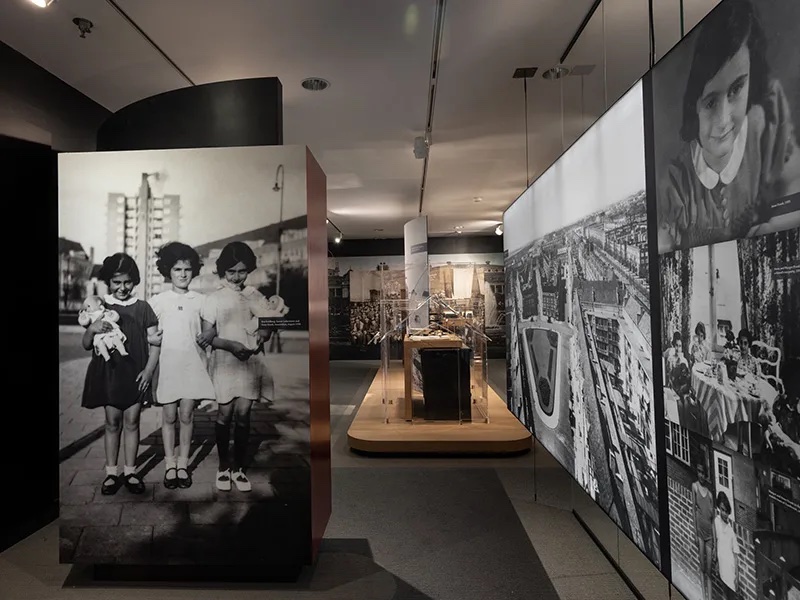
Photo credit: John Halpern, Courtesy of Anne Frank House
My Own True Love and I recently spent a morning at an extraordinary exhibit about Anne Frank, at the Museum of Science and Industry[1], or as I suppose we should call it now, the Griffin Museum of Science and Industry. Created by the Anne Frank House museum in Amsterdam, the exhibit does not focus solely on the often told and heartbreaking story of Anne’s life and death. It uses the Frank family’s experience as a lens for telling the broader story of the rise of the Nazis, the Holocaust, and what happened after the war to those who survived the death camps.
The exhibit is a brilliant example of the use of modern museum technology. It begins with the family’s privileged life in Germany before Anne’s birth and through her early childhood—all of which felt very new to me.[2] It does an excellent job of narrating the Nazi rise to power with a combination of a well-done audio guide,[3] film, photography, and artifacts— and then zooms in to consider the impact on the Frank family. Once the Franks are in Amsterdam, the exhibit once again gives us the larger context for their life in Amsterdam, before and after the arrival of the Nazis, alongside the specific experience of the Frank family. Again, much of this felt new to me.
The heart of the exhibit is a full-scale recreation of the Secret Annex in Amsterdam where the Frank family and four of their friends hid from the Nazis for two years. The recreation brought to life just how tight the space was—something that the flow of visitors emphasized. I don’t know if it was a deliberate design choice, but we were packed tightly enough at each stop through the annex that it triggered a bit of claustrophobia for me. The narrated account described the limitations on their lives and evoked their discomfort, fear, and monotony.
The annex recreation also serves as the narrative hinge for the exhibit. Once outside the annex, the exhibit follows family’s arrest, their movement through the camps, the deaths of the Frank family women, Otto Frank’s experiences after liberation, and the path to publishing Anne’s diary.
For me the most powerful moment came at a single panel after the report of Anne’s death—I’m not going to describe it because I don’t want to spoil the impact for any of you who make it to the exhibit.
The exhibit will be at the Museum of Science and Industry through early 2027.
[1] Wondering what Anne Frank has to do with Science and Industry? The link is Jewish-American philanthropist Julius Rosenwald, who was, among other things, the moving force behind the creation of the museum. (I will point out that he did not ask that it be named the Rosenwald museum.) The more I learn about Rosenwald, the more impressed I am.
[2] It’s been many years since I read The Dairy of a Young Girl, so it is not entirely clear to me what was new and what I had simply forgotten. However, I’m quite sure that I did not know that Otto Frank did a one year internship at Macy’s in New York, for instance.
[3] As some of you may know, I have historically been anti-audio guides. In this case, the auto-guide is absolutely essentially to the experience.
Pamela.
Loved this post. Name Julius Rosenwald jumped out for me, as I believe he was the philanthropic force behind the network of black schools created in the South, as detailed in excellent book a decade ago by Stephanie Deutsch. I seem to recall also, from my volunteer work at Library of Congress, that he may have been the person behind the library’s purchase of historically important Gutenberg Bible, around 1930. These connections are always so intriguing!!
I love the story of the Rosenwald schools, which in fact will be the subject of a future blog post.
The longer you play around in history, the more connections you see!