




History on Display: Suffs: The Musical
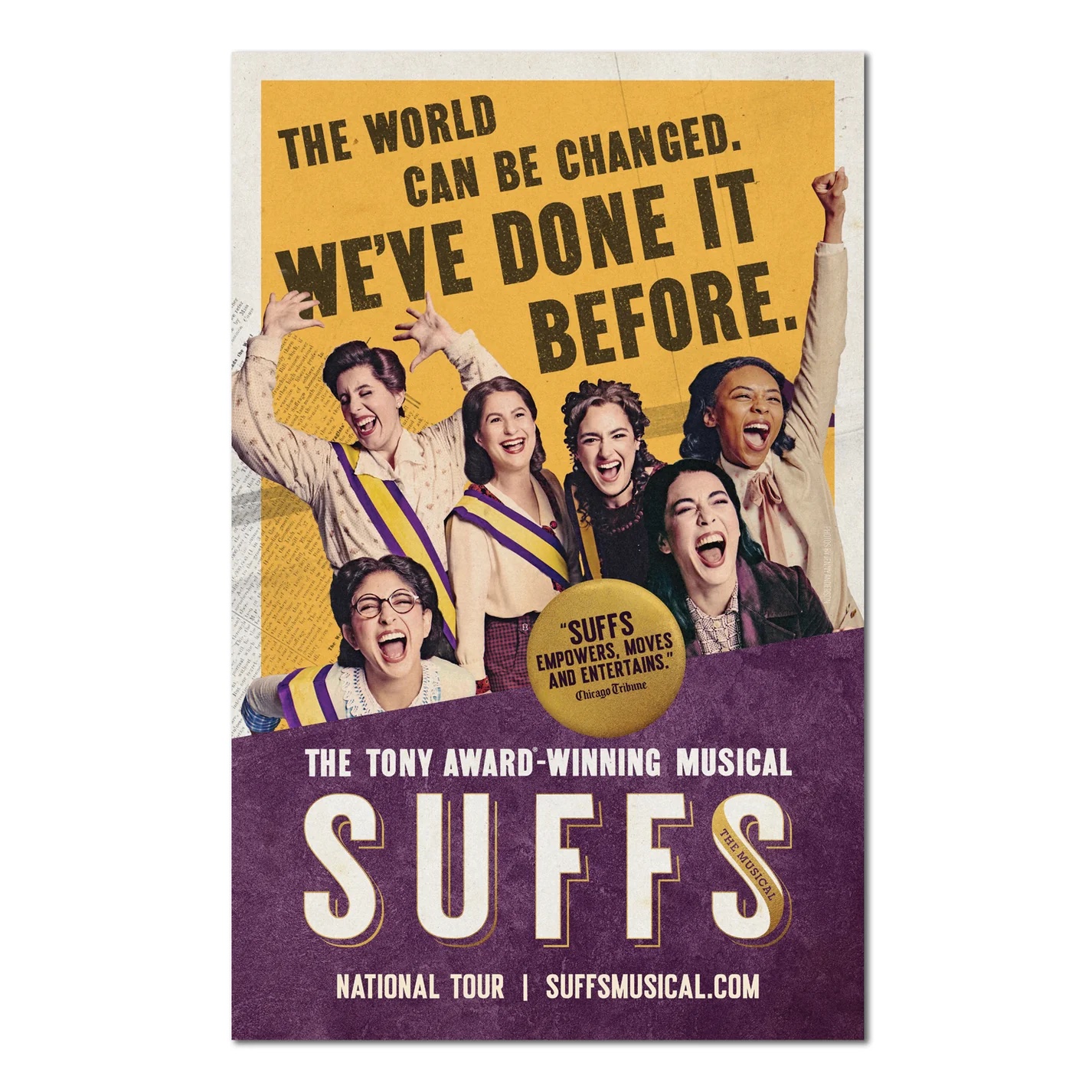
Earlier this week, a friend and I attended a performance of Suffs, Shaina Taub’s award-winning musical about the women’s suffrage movement, which I’ve wanted to see ever since it opened off-Broadway in 2022.
The short version? Suffs did not disappoint. I laughed. I cried. I cheered. So did everyone else as best I could tell. There was one moment when much of the audience gasped.[1]
Suffs :The Musical begins in 1913,[2] just as radical young suffragist Alice Paul (1885-1977)[3] is about to divide the suffrage movement with her demands for more aggressive action, including an unprecedented suffrage march in Washington on the eve of Woodrow Wilson’s first inauguration. Taub follows the movement through the final passage of the 19th Amendment in 1920. Paul is the central character, set in counterpoint to and often conflict with Carrie Chapman Catts (1859-1947), then 54 years old, successor to Susan B. Anthony as head of the National American Women’s Suffrage Association, and later the founder of the League of Women Voters. The two leaders embody two generations of suffragists with very different styles and strategies.
That description may make Suffs sound a little dull. It is anything but. Taub has built a powerful, often funny, sometimes heartbreaking historical drama about the suffrage movement. Paul and Catts are surrounded by a coterie of brilliantly characterized historical suffragists, including a fiery Ida B Wells, each of whom dominates the stage at least once over the course of the show, bringing to life the divisions within the movement. “Why are you fighting me? I’m not the enemy” is a powerful refrain between different members of the movement that Taub returns to again and again. Woodrow Wilson, who is in fact the enemy they are all fighting is pale and unenergetic, by contrast—clearly a deliberate choice.
Suffs ends with both triumph and the recognition of work left undone: making it a perfect show to attend as part of the Semiquincentennial.[4] Definitely worth seeing if it comes your way.
[1] Nope, not going to tell you. Just because we all know how the story ends doesn’t mean I’m willing to spoil surprises along the way. Which makes writing this harder than it would be if I felt free to share delightful moments.
[2] Sixty-five years after the suffrage movement began at the Seneca Falls convention—a fact that Taub skillfully shares with the audience in the opening moments of the show in the form of a speech by long-time suffragist Carrie Chapman Catts. It’s a critical point: the question of waiting for change and not being willing to wait anymore is a theme that Taub returns to over and over again.
[3] I must admit, I was stunned to learn that Paul lived and worked well into my lifetime. Progress in women’s rights remains relatively new, and fragile.
[4] Can anyone spell that right on the first try?
Thanks for highlighting the show. I saw the national tour in Detroit (before it came to Washington) and the cast was excellent. The themes are even more resonant today than when the show opened. Paul’s house in DC is now a historic site with programs and resources of interest to those working in eomen’s history. https://www.nps.gov/bepa/index.htm
I agree with the importance of the themes today. I shivered more than once.