




From the Archives: Beyond Belief
When I was working on my recent post on the display Americans and the Holocaust,I wanted to link to my review of Deborah E. Lipstadt’s Beyond Belief: The American Press & the Coming of the Holocaust 1933-1946. I couldn’t find one. I decided I must have failed to review the book, even though I regularly recommend it when I speak to groups about The Dragon From Chicago. Oops!
This morning, I sat down to redress that oversight. As a first step, I googled the book so I could find a bit more about Lipstadt. Right there on the front page of results was my review from 2020. Huh?
I don’t know how I failed to find it before,[1] but I think it is worth sharing again. As far as I’m concerned Beyond Belief remains the best book out there on the question of what the American public knew about the Holocaust and when they knew it.
I am currently taking notes on a pile of secondary source that I read over the last few months. I stuffed them full of sticky tabs as I went and moved on. On the surface, it’s not the most efficient way to do research, and I don’t always have the time to do it. But when time allows, I find it tremendously valuable. Coming back to the material a second time with a fresh eye and more information allows me to make connections that I didn’t make the first time. Re-reading is like re-writing as far as I’m concerned. It’s where the magic happens.
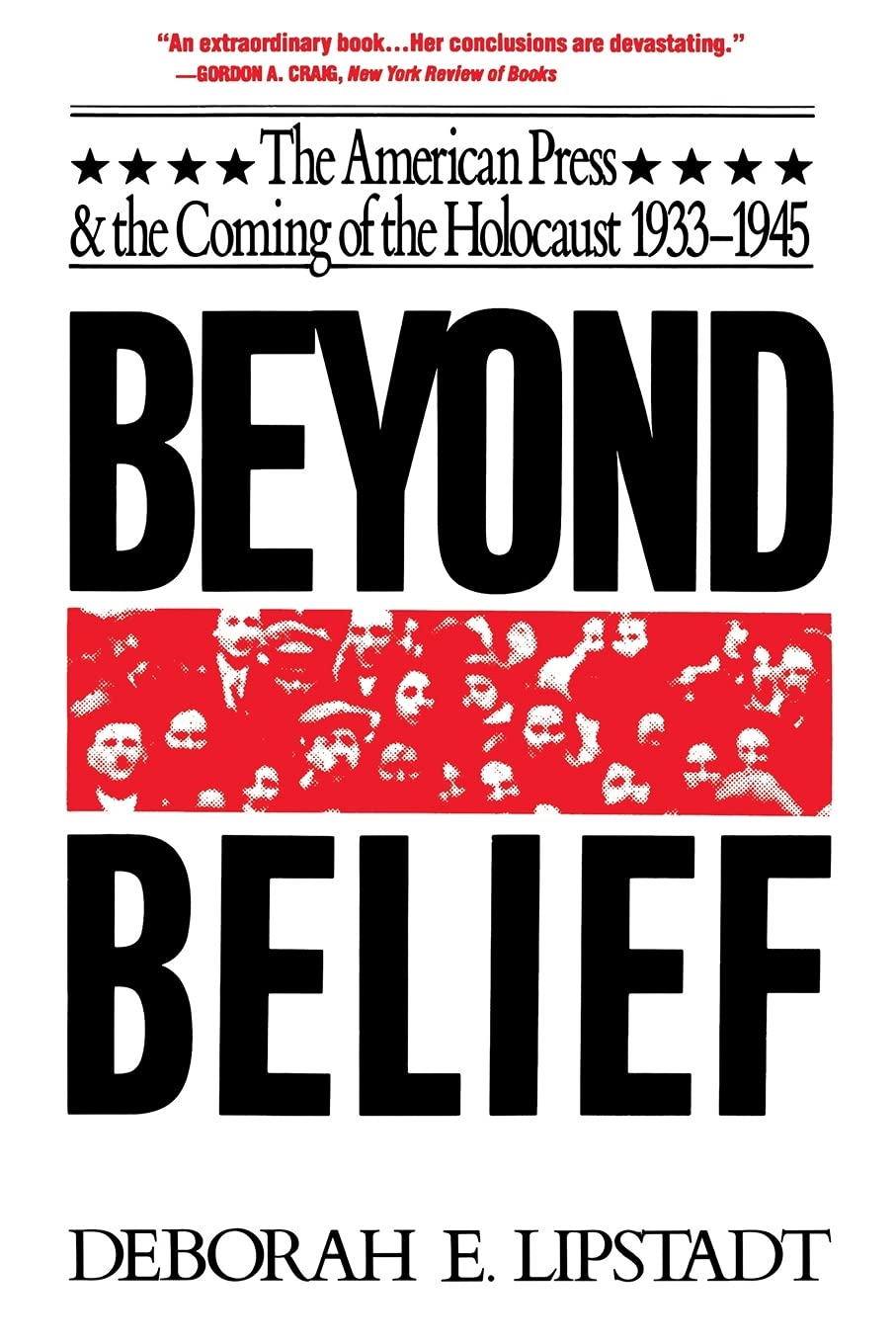
I just finished my second pass on Deborah Lipstadt’s Beyond Belief: the American Press and the Coming of the Holocaust, 1933-1945. The first time through it didn’t even occur to me to share it with you.[2] And yet, and yet: it is important, not only for understanding how Americans could have remained ignorant of the Holocaust at the time, but also as a starting point for the mindset that makes today’s charges and counter-charges of “fake news” possible.
The work had its roots in the classroom. After Lipstadt told her class that detailed information about the Nazi attempt to exterminate European Jews had been available to the Allies very early in the war, one of her students angrily responded “But what did the public—not just the people in high places—know? How much of this information reached them? Could my parents, who read the paper every day, have known?”
Lipstadt argued that a great deal of information was available. American reporters who were stationed in Germany until the United States entered the war had reported on the Nazis in detail, including information about Germany’s persecution of the Jews.
The student wasn’t convinced. “No,” he said. “I can’t believe people could have read about all this in their daily papers.”
Beyond Belief began as Lipstadt’s attempt to prove that she was right. Her final conclusion, which she offers to the student in her acknowledgements: “I was right, but so were you.”
The book consists of a detailed look at who reported what and when, what their editors did with it after they reported it,[3] and how readers responded. Some of the most powerful portions of the book, and the ones that I think are most important for us today, discuss what Lipstadt describes as “the barriers to belief.” The most critical of these was a legacy from World War I. Stories of German atrocities were reported in the first World War that later proved to be false. The result was an attitude of what journalist and historian William Shirer called “supercynicism and superskepticism” about reports of atrocities. As a group, Americans said “Fool me once, shame on you. Fool me twice, shame on me.” unfortunately, this time the stories were true.
Be warned, Beyond Belief is not an easy read. Lipstadt’s style is clear, but her work is dense with data. Nonetheless, I found it a worthwhile read for reasons well beyond my current research.
[1] Stressed, stretched, and tired perhaps.
[2] I don’t normally discuss purely academic works of history here in the Margins. They have a different purpose and a different audience and occasionally are just plain hard to read.
[3] Important stories often got buried deep in newspapers. Editors (and sometimes reporters) added seeds of doubt to the reported stories. And some papers didn’t run the stories at all.