




Lydia Pinkham: Women’s Health Entrepreneur
I recently spent a week in Maine, visiting my BFF from graduate school. We indulged in history nerdery. We binge-watched Ride or Die on Netflix.[1] We ate great food. And we talked about the ideas that are driving me these days: women artists, women entrepreneurs, and what a young woman from the Midwest would have experienced when she got off the train in New York City in 1893. I came away with a lot of notes, a lot of questions, and some progress on my book proposal.
When Karin suggested Lydia Pinkham (1819-1883) as a woman entrepreneur that I should look at, I pooh-poohed the idea. I wasn’t sure that Pinkham was a real person. (She was.) And even if she was a real person, she would be too early for my purposes. (True.) But not too early for a blog post.
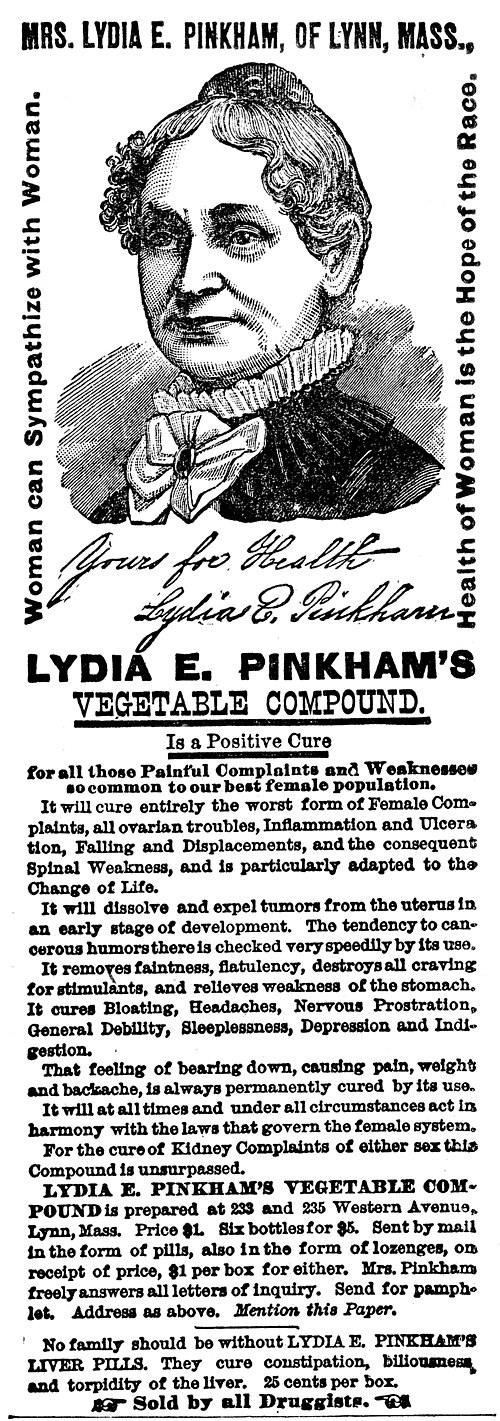
Lydia Estes Pinkham was a household name—and face— in the late 19th and early 20th centuries. Her image appeared on bottles of her famous tonic and in ads selling them. In fact, according to one of my sources, her image was so familiar that some American newspapers used her picture when they reported Queen Victoria’s death in 1901.[2]
She was born into a large Quaker family —the tenth of twelve children—on a farm in Lynn, Massachusetts., where she attended the Lynn Academy and was actively involved in movements dedicated to the ideas and causes of the time, including Swedenborgianism, abolition, temperance, and women’s issues. She spent several years working as a teacher in Lynn and worked with Frederick Douglass as the secretary of the Freedman’s Institute.
In 1843, she married Isaac Pinkham, a widower with a daughter. Together they had several more children. For the next thirty years, Lydia was primarily a homemaker, though she had a side hustle as an herbalist with a focus on perfecting an herbal treatment for “female complaints.”
For years she shared her tonic with family and friends, many of whom believed the formula helped them.[3] When the family’s finances, always shaky, reached a new low as a result of the bank failures of 1873[4], Lydia, at the urging of her son, Daniel, decided to try selling bottles of what they named Lydia E. Pinkham’s Vegetable Compound.
Ads for the product leaned heavily on slogans such as “Only a woman can understand a woman’s ills,” and in fact Pinkham’s compound was one of the earliest products made by a woman for women. The use of Pinkham’s image in advertising, another of Daniel’s ideas, underscored the idea.
Pinkham went further and invited women to write to her for advice. The company received so many letters that Pinkham set up an all-woman Department of Advice to respond to them. She also wrote a book intended to help women understand their bodies— the nineteenth century equivalent of Our Bodies, Our Selves. The book was distributed at no charge under several different titles.
Doctors dismissed the compound as just another quack nostrum; in fact, one of its primary ingredients, black cohosh, is used today to ease menstrual difficulties.[5] Women embraced it. The business grew from a one-woman operation to a factory that brewed and shipped roughly $300,000 of the tonic and related pills and lozenges each year at the time of Lydia’s death.[6]
The company stayed in business until the mid-twentieth century. Today at least two companies offer similar products, under variants of Lydia’s name, with an ingredient list very similar to her original tonic.
[1] Many thumbs up, with the caveat that it is more violent than the first two episodes would lead you to expect.Two middle-aged women on the run from bad guys, and from themselves. Funny and smart. Excellent storytelling. Think Thelma and Louise meets James Bond.
[2] I have not been able to verify this, but I couldn’t resist sharing it.
[3] An alternate version of this story has Lydia using family and friends as lab rats as she perfected the formula. Potato,.Potahto.
[4] The first of four major economic crises that hit the country in the late 19th century, the panic of 1873 was the result of over-expansion in railroads, and triggered by a stock market crash in Vienna which led European investors to dump their American securities
[5] Despite Pinkham’s stance on temperance, the tonic also had an high alcohol content, a fact that was clearly stated on the label, with the explanation that the alcohol was used solely as a preservative. If taken as directed, the alcohol would not have been an issue, but there is no guarantee that it wasn’t misused.
[6] Roughly $10 million today