




Fanny Palmer: The Norman Rockwell of the Nineteenth Century?
If you grew up in the United States, you probably are familiar with the work of artist Frances Flora (Fanny) Bond Palmer (1812-1876), even though I suspect you’ve never heard of her.
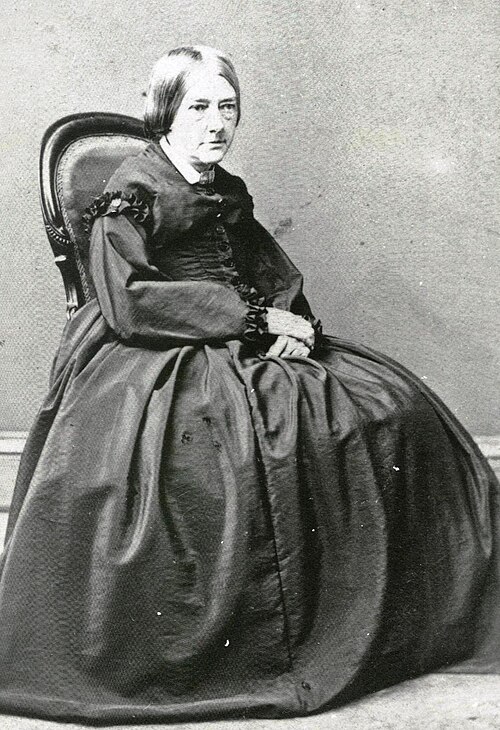
Fanny Palmer, ca 1876.
Fanny Palmer was born in Leicester, England, where she received her first training in art, specifically drawing, perspective and watercolor, at Mary Linwood’s academy for girls[1]. She ran a drawing school in Leicester for several years in the 1830s. Later, Fanny and her husband, Edmund Seymour Palmer, decided to get into the lithography business as well. Fanny trained as a lithographer with Louis Haghe, one of the founders of what was considered the best British lithographic firm of the time; meanwhile, her husband became as a professional printer.
The Palmers opened a lithography business in Leicester in 1842. In 1844, they immigrated to New York, where they opened a shop under the name F & S Palmer, Lithographers.[2] During this time, she produced a large and diverse body of work—including sheet music, cartoons and war illustrations as well as the better known prints for home decoration—and demonstrated a sophisticated use of the medium. When the business failed several years later, the Palmers sold it to the owner of another printmaking business, one Nathaniel Currier, the founder of what became the famous Currier and Ives firm, the most successful and prolific printmaking company in the United States.[3] (You see where this is going, right?)
Closing the business opened new opportunities for Fanny, who soon had a full-time position as an artist with Currier and Ives.[4] She was the only woman illustrator on the staff and one of the most skilled and prolific artist in the Currier and Ives stable: one of the small number of their artists whose works they issued with a signature. In print after print she gave form to the romanticized vision of American life that was part of the Currier and Ives brand.
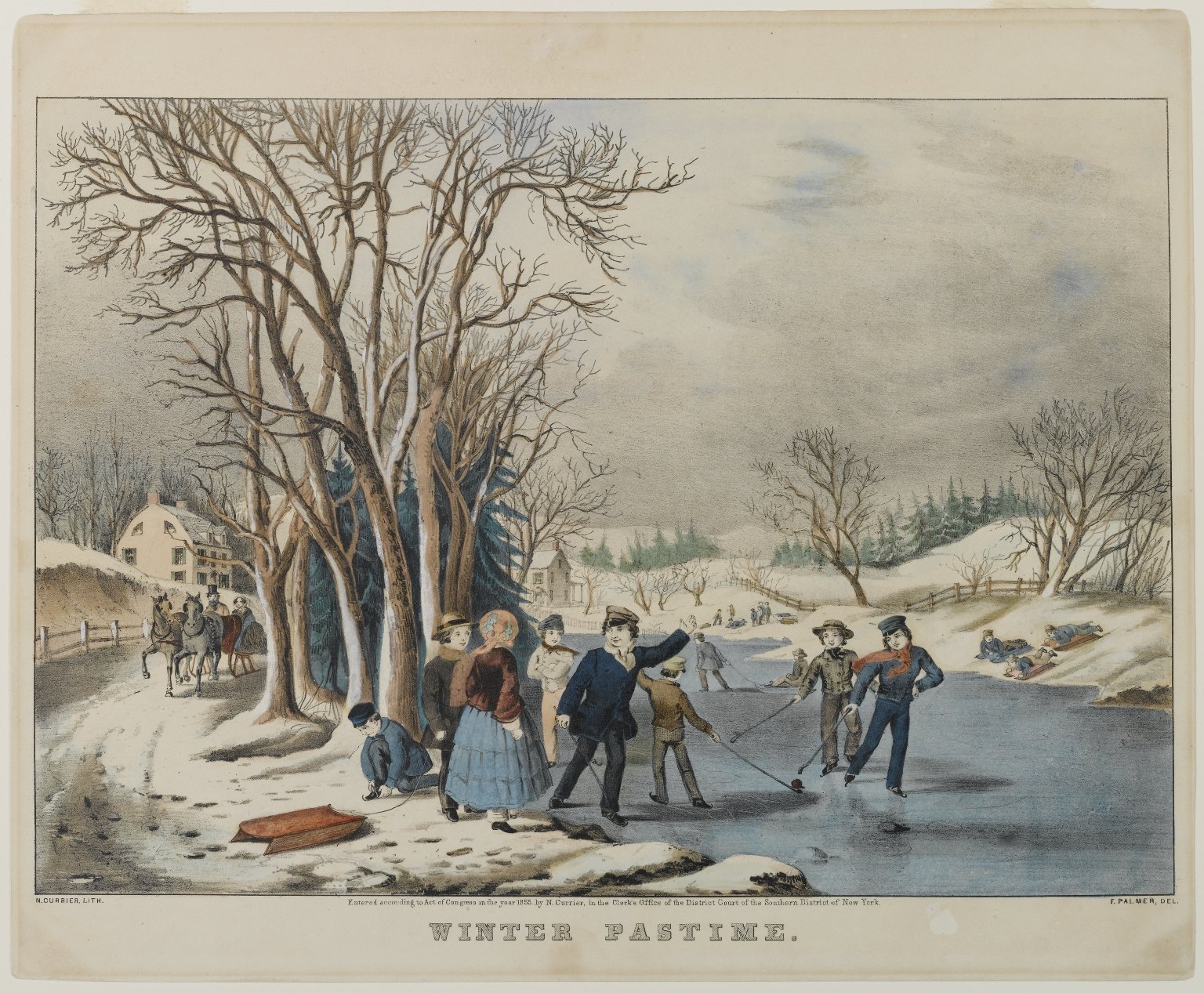
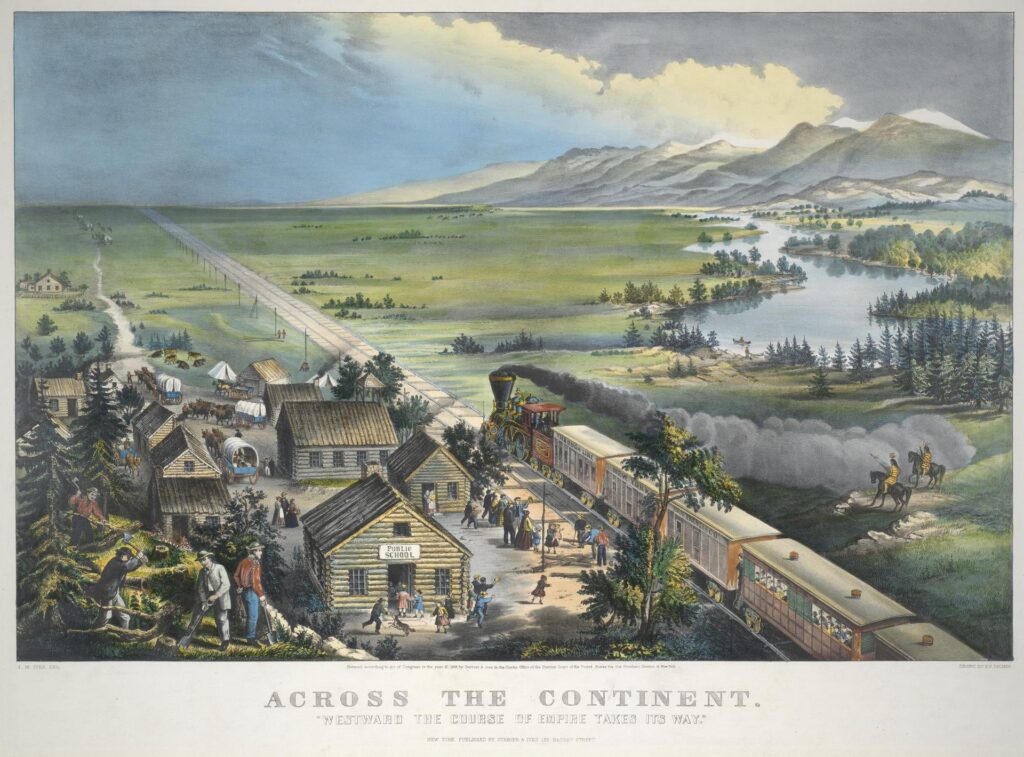
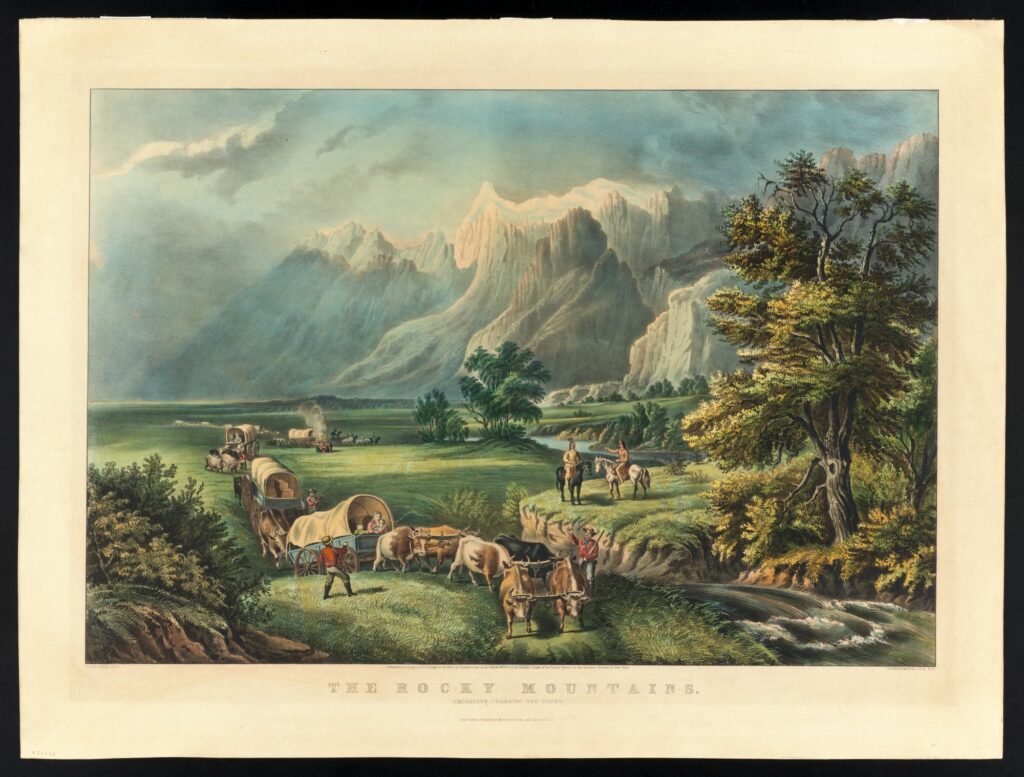
She created some two hundred [signed] lithographs for the firm, including two prints that became iconic representations of the United States’ westward expansion:Across the Continent. “Westward the Course of Empire Takes Its Way “(1868) and The Rocky Mountains. Emigrants Crossing the Plains (1866).[5] She is also known to have worked on many more that were released without a signature, including a large number of the firm’s still life prints.
In addition to holding a full time staff position with Currier and Ives, it appears that Palmer also ran a lithographic workshop in her home, where she trained several apprentices, several of whom went on to become innovative lithographic artists and found important lithographic studios of their own. In other words, she created a legacy in addition to producing a substantial body of work.
Palmer was not the only woman involved in the business of lithographic prints. Some were hired to transfer drawings to polished lithographic stones. Others were employed to hand-color printed lithographs. By mid-century, a few who had been trained at the Philadelphia School for Women[6], even found work as lithographers. But Palmer was the most successful and well-known. Her works were enormously popular. In fact, Currier and Ives expert. Ewell L. Newman claims “It is likely that during the later half of the nineteenth century more pictures by Mrs. Fanny Palmer decorated the homes of ordinary Americans than those of any other artist, dead or alive.” Wow!
[1] Mary Linwood (1755-1845) was a celebrated artist in the early 1800s, known for her full-scale embroidered versions of famous paintings. It appears that her work was in high demand in the royal courts of Europe (!) and she maintained a permanent exhibition of her work in London. Rabbit hole, here I come.
[2] I am intrigued by the fact that Fanny (F) got first billing.
[3] Currier and Ives billed itself as a “Publisher of Cheap and Popular Prints.” Truth in advertising.
[4] Her husband became a tavern keeper.
[5] It is interesting that Fanny, who grew up in England and was probably exposed to the rhetoric of British imperialism, uses the word “empire” to describe the push west.
Together, the two works can be seen as visual representations of the doctrine of Manifest Destiny. Across the Continent is an allegorical depiction of expansion, organized along a dramatic diagonal created by a train track. On one side of the tracks is a bustling American frontier town, with a small train of covered wagons departing into the background. On the other side is an image of a remarkably tame wilderness, occupied by a few Native Americans, two on horseback and two in canoes in the distance. The Rocky Mountains shows the next step in expansion: a wagon train winding its way toward the viewer with the mountains looming in the distance. Native Americans, again on horseback, watch the wagon train from a low ridge in the foreground, not quite as distant as before.
[6] Which we have seen several times before. The school is unavoidable if you are thinking about women artists in nineteenth century America.