




Attic Wife: A Q & A with Marcia Biederman
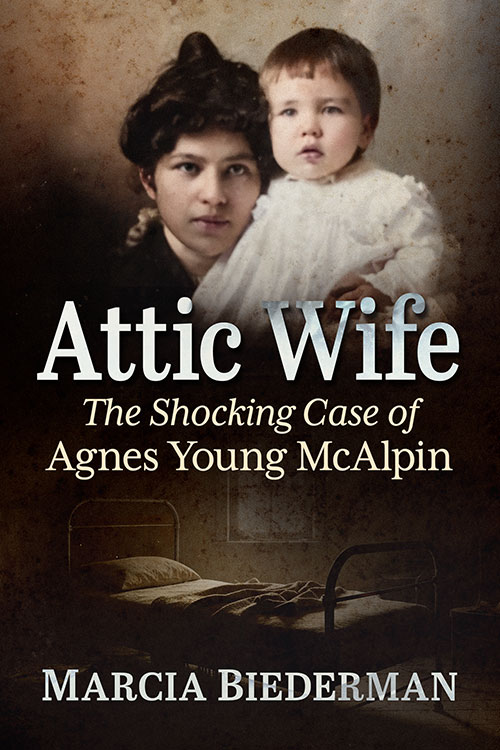
Attic Wife: The Shocking Case of Agnes Young McAlpin by Marcia Biederman is the true story of an Alaska Native woman who married a young white dentist’s apprentice during the Klondike Gold Rush. Soon regretting his choice, he brought her back to his Pennsylvania home, where his mother and sister, mortified by the interracial marriage, concealed her in an attic. She bore her husband three children even as he refused to be seen with her in public.
Yet, against all odds, Agnes Young McAlpin managed to alert next-door neighbors to her plight, rallying their support to rise up against her abusers. After escaping with her children to a safe house, she sued for divorce in a weeklong trial that made national headlines.
It’s an amazing story.
I’m delighted to have Marcia back here on the Margins to talk about the book and how she wrote it.*
Take it away, Marcia!
What brought you to the story of Agnes Young McAlpin? Why do you think it’s important to tell this story today?
For research related to another of my nonfiction books, I needed to look at early 20th-century Pennsylvania newspapers, and they were filled with coverage of Agnes Young McAlpin’s divorce trial. Much as I tried to put on blinders and get my work done, I kept getting distracted by the small photo of her and the caption identifying her as an “educated” Alaskan seeking divorce from a dentist in Butler, about an hour outside Pittsburgh. “News of Her First-Born’s Death Was Withheld by Butler Family,” declared a subheading, while another added, “Baby’s Grave Is Hidden.”
Obviously, this was quite a story. A glance at other papers published around the same date showed that it was getting widespread coverage. Moreover, the press seemed to empathize with this woman, whom they identified as an Alaska Native—she was Haida—but one sufficiently assimilated to meet their approval. The Butler Eagle said it had expected Agnes McAlpin to be an Indian, Eskimo, or other “low-bred person,” only to find she was a “refined and cultured lady,” whom Kenneth had met in Alaska during the madness of the Klondike gold rush.
Then there were the villainous relatives: the mother- and sister-in-law from hell, who welcomed Agnes by showing her to a stark, unheated attic room, giving her the silent treatment, and concealing her from visitors. They told close friends they felt disgraced by Kenneth’s marriage to a woman they accurately described as “nearly a full-blooded Indian.” Instead of taking Agnes’s side, the husband spent most of his time away from home, ostensibly looking for work, but seldom finding any and never writing to Agnes. She bore him two children, but he refused to be seen with her in public. When she discovered she was pregnant a third time, he conspired with his female relatives to try to abort her against her will, forcing her to flee to Alaska in fear for her life.
Agnes’s story encompasses themes of colonization, racism, and domestic abuse that are relevant today. But I was drawn to it largely because, as one reader of my book put it, “Agnes did stuff.” Ignoring the McAlpins’ objections, she returned to Alaska twice, sometimes without money to buy food on the arduous journey. In Butler, she refused to stay in the shadows. Never mind that the McAlpins did their best to confine her to the attic. Running after her children, or intercepting visitors in her in-laws’ absence, Agnes managed to meet and charm the neighbors. Many were longtime friends of the McAlpins, but Agnes recruited them to her side. When she was ready to sue for her divorce, they offered her a safe house and free legal services, which made her freedom possible.
Writing about a historical figure like Agnes Young McAlpin requires living with her over a period of years. What was it like to have McAlpin as your constant companion?
It’s interesting that you ask. One of her neighbors, a so-called society matron, testified that Agnes was “good company,” and I agree. I was especially fortunate to find dozens of letters written by her, her husband Kenneth, and her in-laws, beautifully preserved and organized in a family collection. This gave me a window into Agnes’s thoughts and feelings, particularly the letters in which she unburdened herself to a young brother-in-law, Victor McAlpin, whom she thought she could trust.
Kenneth’s letters to Agnes and Victor were also preserved, affording me a look at the spouses’ differing views of the same events, with Kenneth always perceiving himself as the victim. These and other missives from the mother-in-law, the sister-in-law, and the “other woman” who eventually entered the picture helped me bring these key players to life. I’m indebted to the descendants of Kenneth’s oldest brother, Archie, who kept the letters and allowed me access to them.
What type of sources do you rely on in writing about a non-elite woman from the past?
I’ve already mentioned newspapers and correspondence. I also made liberal use of the usual genealogical records: censuses, birth and death certificates, etc. For that, and to find clippings from Butler newspapers, which exhaustively covered the divorce trial, I relied on the staff and volunteers of the Butler Area Public Library.
Like everyone else, I also use search engines, and in this case Google was enormously helpful. Agnes had a father-in-law, Volney McAlpin, who felt sympathy for her and may have protected her, had he not died shortly after she arrived in Pennsylvania. A historical Alaskan newspaper told me that Volney had preceded Kenneth to Alaska, taking several trips there during his lifetime. Googling his unusual name, I learned that Volney had assembled a formidable collection of Haida and Tlingit artifacts, some of which his descendants donated to the American Museum of Natural History in 1945. Just a few years ago, one of these items ended up in an exhibit at the Bard College Graduate Center here in New York.
As a former journalist, I don’t hesitate to reach out to living people who might know anything, however peripheral, about someone from the past. I emailed the Bard anthropology professor who’d put together the exhibit. He referred me to a former graduate student of his who’d done extensive research on the Volney McAlpin Alaskan Collection at the natural history museum. He also told me the exciting news about the cache of letters, including some about a “Native girl” who had married into the family.
Through that connection, I contacted the family guardians of the letters, who invited me to come to Indiana and read them. I learned that the descendants were appalled to learn of Agnes’s mistreatment (which a grandson of Kenneth, related to him through his second wife, discovered in a genealogical search) and were willing to share her story. Indeed, since I began my project, that grandson has reached out to his Indigenous relatives in Alaska, and they’ve stayed in touch.
Agnes Young McAlpin had both Haida and European ancestry. You describe her as a “code switcher”: she had a European-style convent education but was also deeply aware of her Haida traditions. Were there special difficulties in writing about a woman with cultural roots so different from your own?
There were definitely special responsibilities. Taking my cue from art historian Emily L. Moore, who has written about the New Deal totem pole restoration projects that employed one of Agnes’s sons, I made sure to identify myself as non-Native in all communications with potential sources.
Early on, I presented my project to the Central Council of the Tlingit and Haida Indian Tribes of Alaska, asking their opinion on whether I should proceed with a project, then tentatively supported by a Butler pastor, to memorialize the death of Agnes’s firstborn son by erecting a plaque in the cemetery where his grave is unmarked. The council made clear that, for questions like that, I had to talk to the family. For all my projects, I try to locate descendants, not always successfully. For this book, I saw that it was not optional.
With the help of the then-mayor of Ketchikan, AK, who is also a journalist and poet, I found that at that time, 2022, one of Agnes’s grandsons was alive at 93, although seriously ill. His family, the Alaskan McAlpins, generously invited me to visit them, and I did, twice. The time I spent with them was a delight, and the grandson, who has since died, understood the basic outlines of my project and welcomed me. He’d always known that his grandmother went to Pennsylvania and had to free herself of some sort of intolerable situation. The family was pleased that I could fill in the details. I returned with scans of family photos and useful information. Best of all was spending time with them.
In California, I met two grandchildren of Agnes’s maternal aunt, Cecilia Baronovich Balenti, who was a few years younger than her niece. The two had been close before Agnes married and moved to Pennsylvania, and they revived their friendship later. Cecilia’s grandchildren shared with me photographs, news clippings, and their grandmother’s unpublished writings about her childhood memories of visiting relatives in a traditional Haida village, an experience that Agnes shared with her. The grandchildren also led me to a book, Alaska Silver, written by a white man once smitten with Cecilia, in which he describes Cecilia multiple times and mentions Agnes without naming her. That book deepened my understanding of Cecilia and filled in blanks about a period of Agnes’s life when, while still married, she experimented with living independently.
I also relied heavily on an extensive oral interview about Agnes’s family that one of her brothers, Walter Young, recorded in 1971. By then, Agnes had long been dead, but her brother mentioned her several times in the interview, which focused on their parents, the houses and fishing camps where they spent their childhoods, and the way their father, a hereditary clan chief, melded Christian and Haida traditions. The person conducting this interview—a Canadian anthropologist who was then in grad school—is still active in the field and remembers Walter. Agnes’s other brothers left other descendants whom I’ve talked to or texted, but these first-hand recollections, guided by an anthropologist’s questions, gave me the confidence to write about Agnes’s childhood.
What was the most surprising thing you found doing historical research for The Attic Wife?
That Americans of that eraweren’t as buttoned up as we think. From researching my previous book, The Disquieting Death of Emma Gill, I already knew that abortion, though strictly criminal, was then commonplace. However, I didn’t expect to find abortion playing an important part in this book as well. Her sister-in-law, a licensed physician, had participated in a criminal abortion, for which she evaded legal consequences. She also oversaw the forcible attempts to abort Agnes, which sent Agnes fleeing to Alaska.
On a lighter note, I was delighted to find Agnes complaining in a letter that her husband thought “I’d be contented to sit on my ass the rest of my days.” Well said, but the phrasing surprised me!
What is your favorite research tip for people who want to write about obscure historical women?
Well, I can’t give advice about medieval times, but for American women alive in the late 19th or early 20th century, you’ll probably be using newspapers, vital records, and, if you’re lucky, letters and diaries. To organize those, I’ll share some nuts-and-bolts tips about naming files. Attach a date to every one of your files in the format YYYY MM DD. Then alphabetizing them in File Explorer or Finder will put them into chronological order. It’s amazing how often this reveals cause and effect: earlier events set later ones into motion.
I often use very long file names. In addition to the date, I might include the title of a newspaper (to compare different reports on the same events) and a fragment of a quote you might use, so you don’t go nuts later searching for it. For example, to answer the question about things that surprised me, I searched File Explorer for “on my ass,” and voila!

Marcia Biederman is the author of five nonfiction books about remarkable American women, as well as three mystery novels. A former journalist residing in Brooklyn, New York, she has written more than 100 pieces for the New York Times on subjects ranging from ice dancing to automobile wheel repair, and her guest essays have appeared in the New York Daily News and the Hartford Courant.
For more information about Marcia and her writing, check out her website: https://marciabiederman.com/
*You can read other interviews with Marcia here and here: