




The Radar Girls, aka the Women’s Air Raid Defense of the Hawaiian Islands
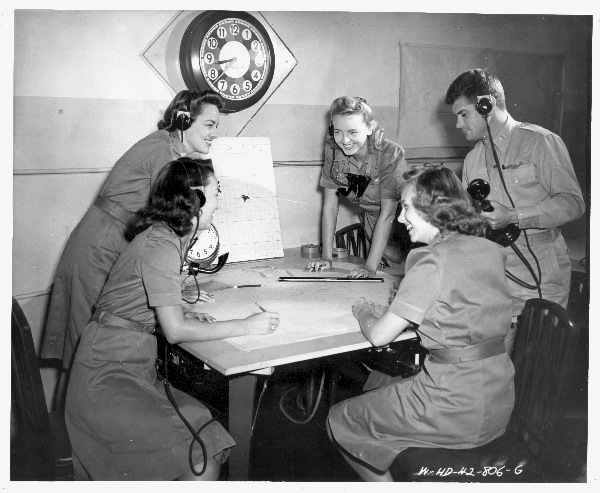
When I visited the Harold C. Deutsch World War II History Round Table in the Twin Cites back in March, one of the members introduced me to a women’s military auxiliary unit. I had never heard of the Women’s Air Raid Defense of the Hawaiian Islands (WARD). It was rabbit hole time!
WARD was formed soon after the bombing of Pearl Harbor. Most of the existing staff of the Air Defense Command’s Information and Control Center (ICC) on Oahu were being reassigned throughout the Pacific. The Air Defense Commander, Brigadier General Howard C. Davidson decided the answer was to recruit women to staff the control center. He met with the first group of 20 women on December 26, the day after President Roosevelt signed an executive order allowing one hundred women to be recruited for a military auxiliary unit assigned to the 7th Fighter Wing of the U.S. Army Signal Corps. The young women had been through the trauma of Pearl Harbor and were eager to help defend their homes.
The first group of WARD recruits was inducted into the service on January 1st. Many of the volunteers were military spouses who had been scheduled to be evacuated to the mainland; Davidson was given the authority to remove those who wanted to become WARDs from the evacuation list. As the need for volunteers grew, women were recruited from the mainland, subject to FBI background checks and loyalty tests.
The WARDs’ job was to help defend the islands from further attack by coordinating and tracking airplane movements. They were given a ten-day crash course in plotting airplane positions as they were reported from radar[1] units around the island. Training over, they went to work in a bomb-proof tunnel known as Lizard, which was located under Fort Shafter in Honolulu. Radar units throughout the islands, with the collectively code-name Oscar, sent reports to the ICC, code-named Rascal, giving the location, number, and speed of any aircraft that had been spotted. WARDs plotted the information on a huge table with a map of the islands superimposed with coded grids. Because the information was constantly changing, they marked the locations with colored markers topped with flags that noted identifying details, which could be moved as needed with plotting rake with similar to a shuffleboard stick.[2] (It was perhaps inevitable that they were given the nickname “Shuffleboard Pilots.” ) They compared the reported aircraft with the known flight schedules of military and civilian aviation in the islands. If they noted an anomaly, they passed it up the chain of command
ICC operated 24/7, with the “radar girls” working six hours on, six hours off, with a 32 hour break after eight days.
The Women’s Air Raid Defense unit was disbanded at the end of the war. Over the course of the war, more than 650 women had served as WARDs. Always a small, top secret unit, it was largely forgotten after the war. (Does this surprise anyone?)
[1] Radar was still experimental at the time. In fact it was so new that most people who used it knew the word was an acronym for Radio Air Detection and Ranging. Something I didn’t know until I got into this rabbit hole.
[2] The description of this work reminded me of the British Navy’s use of Wrens and a room-sized board game to create anti-U-boat tactics in the Battle of the Atlantic. More about that here.