




Hippomania in Victorian England
Long before the baby pygmy hippo named Moo Deng was born in a zoo in Thailand and became an on-line sensation, another hippo captured the hearts of zoo-going visitors in Victorian London.
Obaysch (c. 1849-1878) was captured on an island in the White Nile, from which he took his name, when he was less than one year old and sent to London as part of an agreement between Abbas Pasha, the Ottoman Viceroy of Egypt, and Sir Charles Murray,[1] the British consul general, to exchange “exotic”[2] animals for greyhounds and deerhounds from Britain[3] . He was sent down the Nile to Cairo, accompanied by his keeper, an Egyptian named Hamet, and a herd of cows to provide him with milk—a detail that makes it clear he was indeed still a baby and for me underscores the cruelty of the arrangement, something that is often left out of accounts of his “stardom”.[4] After wintering in Cairo,[5] he traveled from Cairo to Southhampton on a P & O steamer that was outfitted with a special pool to accommodate its unusual passenger. Obaysch arrived at the Zoological Gardens in Regent’s Park in London on May 25, 1850; once there, he followed Hamet and a trail of dates into a cage with a heated pool.
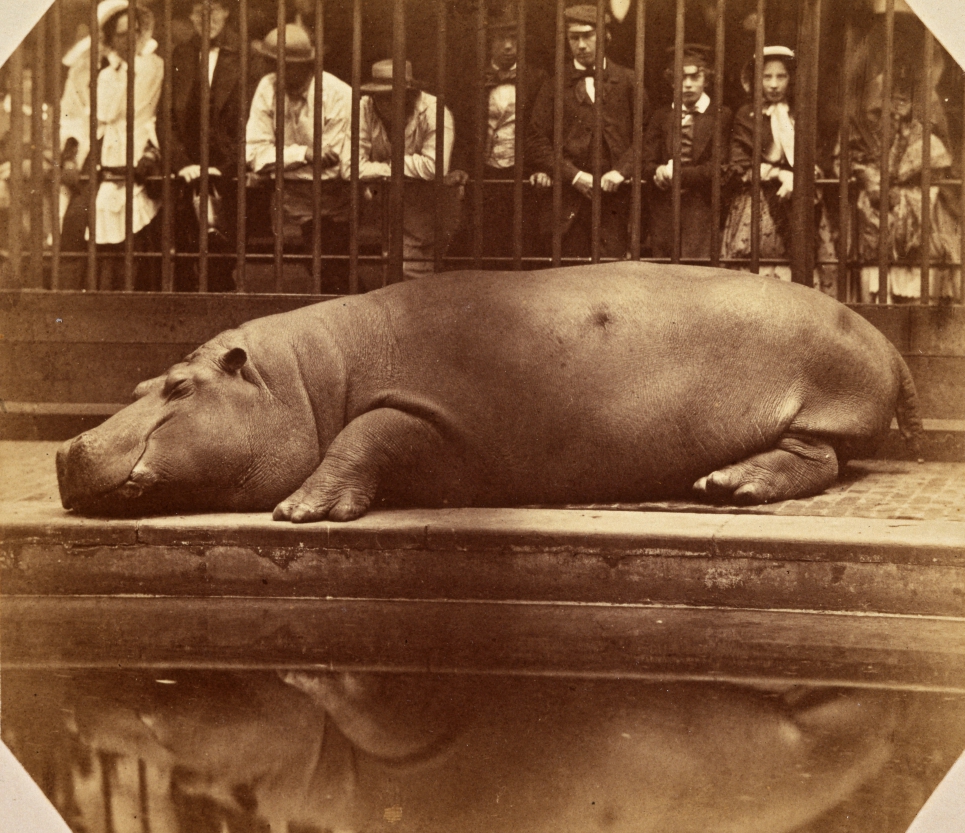
Obaysch ca. 1855
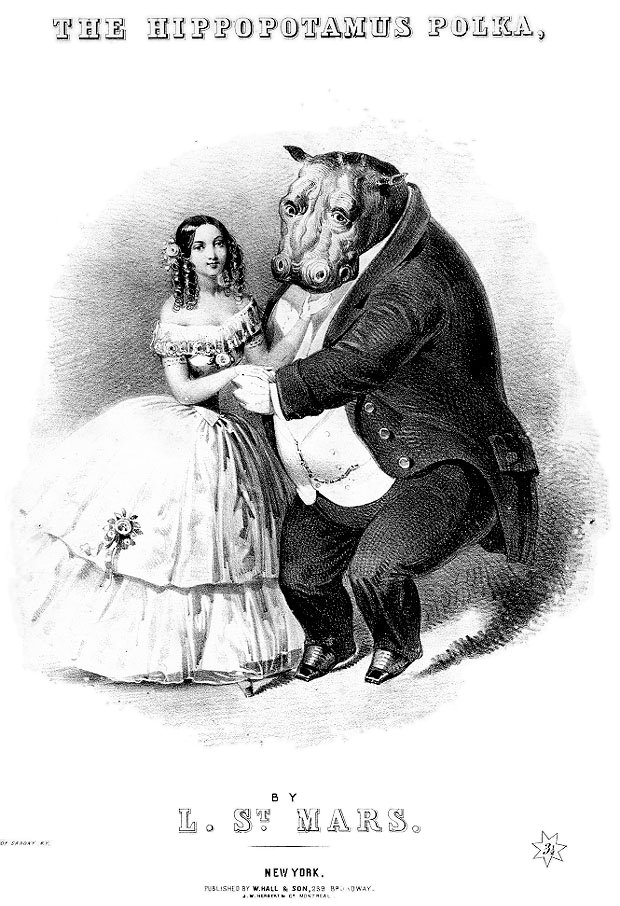
Only those Londoners who had traveled to parts of the world where hippos were native would have seen a live hippo before Obaysch’s arrival. He was the first hippo in Europe since Roman times. (His predecessor was tormented in the amphitheater in Roman London—another kind of spectacle.) He was immediately a star attraction. On June 6, the Times carried a long account of his first experiences in the zoo. Other journals took up the story, including the comic journal Punch. Soon he was drawing up to 10,000 visitors each day, including Queen Victoria and a passel of her children[6] —doubling the number who had visited the Zoo the previous year. The press dubbed it “hippomania.”[7] His popularity led to an active trade in hippo memorabilia, including silver models of Obaysch—merch is not a new concept. He even was the inspiration for a dance tune, the “Hippopotamus Polka.”
Murray described Obaysch as being “as tame and playful as a Newfoundland puppy,” but in fact the hippo could be ferocious with humans. (And who could blame him?) On one occasion, he escaped from his enclosure. The zoo’s superintendent at the time arranged for a keeper that the hippo seemed to hate to act as bait. Once he had caught Obaysch’s attention, the keeper ran into the enclosure and then scrambled up a ladder to safety. The hippo ran after the keeper, and zoo employees slammed the gate behind him.
Abbas Pasha sent a second hippo to the zoo in 1854—a female named Adhela. Sixteen years later, the two produced a calf. It died two days later. A second calf, born in January of the following year, also died. A third baby hippo survived. She was named Guy Fawkes in honor of her birth on on November 5, 1872, Guy Fawkes Day.[8] She was the first captive-bred hippo to be reared by its mother Like her parents, she was wildly popular with zoo goers until her death in 1908.
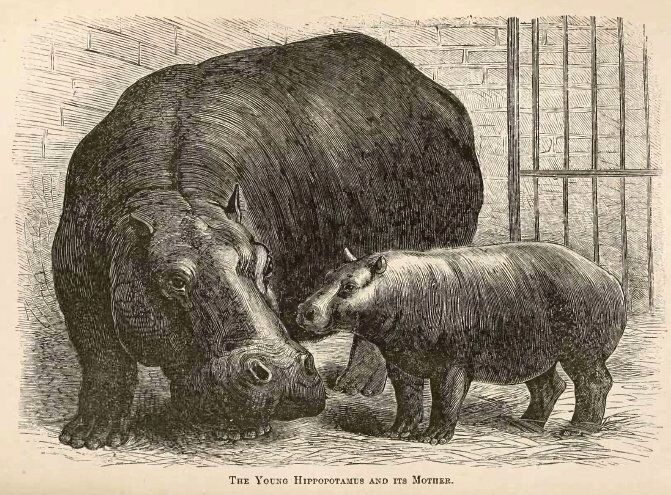
Adhela and Guy Fawkes
****
If you are interested in learning more about Obaysch and how he fits into the larger history of animals in zoos and the natural history of hippopotumi in the wild, John Simons’s Obaysch: A Hippopotamus in Victorian London (2019) got good reviews when it came out.
If you want to learn even more, the ever fascinating Futility Closet offers a long list of related readings as an addendum to its podcast episode on Obaysch: https://www.futilitycloset.com/2021/07/26/podcast-episode-352-a-victorian-hippopotamus/
[1] Sir Charles became known as “ Hippopotamus Murray” for his role in the exchange, the main thing for which he is remembered despite a long and productive diplomatic career.
[2] As I mentioned in a recent blog post, exotic is is problematic term. I see a newsletter topic in my future.
[3] Ironic since greyhounds, or at least greyhound-like dogs, appear to have originated in the Middle East.
[4] In case it is not clear, I have mixed feelings bout zoos.
[5] Where he is said to have caused a milk shortage.
[6] The Queen compared his swimming to that of a porpoise—which seems really odd. Not that I have seen a porpoise swim in real life.
[7] A reporter may have thought he coined a clever new phrase, but the term dates from the late-eighteenth century. It referred to a passionate enthusiasm for horses and all things equestrian, and continues to be used occasionally with this meaning. The two-dollar word version of being horse mad.
[8] A British holiday commemorating the failure of the Gunpowder Plot of 1695, one of whom was named Guy Fawkes.