




Florence Mendheim: Librarian Against the Nazis
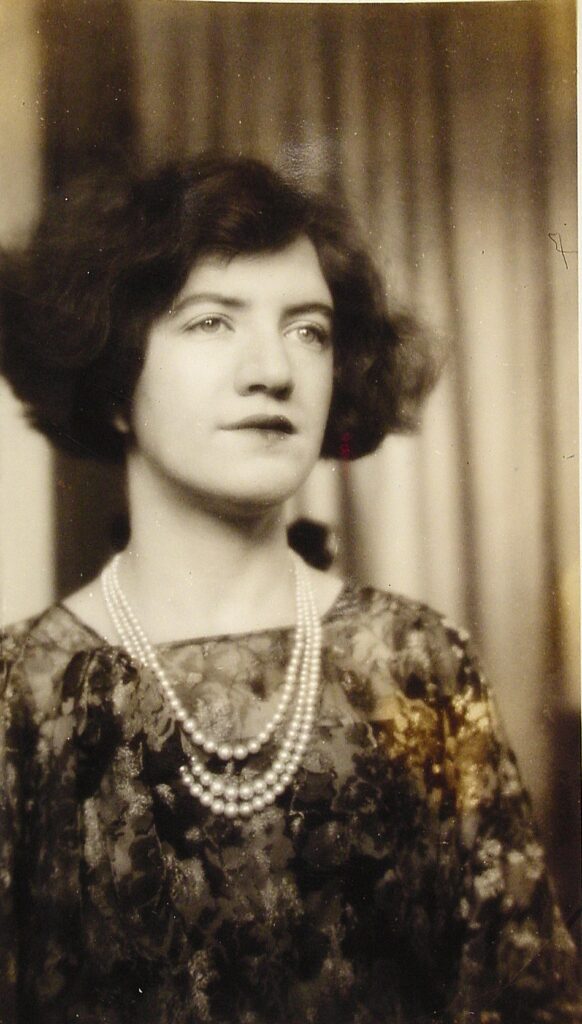
Florence Mendheim (1899-1984) was the daughter of German-Jewish immigrants had moved to the United States in the 1880s and still had close contact with their family back in Berlin. She worked as a librarian in the Washington Heights branch of the New York Public Library for 25 years, from 1919 to 1944. In 1933, she learned that Rabbi J.X. Cohen of the American Jewish Committee wanted volunteers who were not obviously Jewish to infiltrate the growing American Nazi movement, she did not hesitate. Cohen provided her with a fake address, a fake name, and a Nazi party pin. For the next five to six years, she spent her evenings spying on American Nazis.
Under the pseudonym Gertrude Mueller, she attended meetings and rallies of the pro-Nazi group Friends of New Germany and its successor organization, German American Bund. She gathered names, took notes as a secretary for the groups, and accumulated pro-Nazi and antisemitic propaganda and literature. Sometimes at the end of the meeting, another participant would offer to drive her home, making that fake address valuable indeed. It was terrifying. She could never be sure whether the offer was made as an act of politeness or because someone suspected her.
She used two other pseudonyms as well as Gertrude Mueller. She signed her reports to the American Jewish Committee with the random initials KQX. She used the name Anna Hitler as a cover for doing research on Hitler at various academic institutes under the guise of doing genealogical research.
Mendheim appears to have quit spying in 1938 or 1939. The need for such work ended several years later. When United States entered the war at the end of 1941, they cracked down on pro-Nazi organizations, perhaps with help of reports from Florence Mendheim and others who had been brave enough to spy on pro-Nazi meetings.
From the Archives: A Brief History of the Pencil
In yesterday’s newsletter (1), I went down a research rabbit hole, looking for the difference, if any, between using blue pencils and red pencils as an editing tool. (Plus the pencil’s use by military and authoritarian censors, which is the place where I leaped into the rabbit hole.) In the process, I went back to to this brief history of the pencil, which originally ran in February, 2020.
(1) For those of you who missed the memo, I write a newsletter in addition to this blog. It comes out roughly twice a month. I generally write about thinking and writing about history, with an occasional foray into stray bits of research. It’s also the first place to find news about my books, speaking gigs, etc.
If that sounds like your cold glass of lemonade, you can subscribe here: http://eepurl.com/dIft-b I’d love to see you there.
And now, back to our regularly scheduled program:
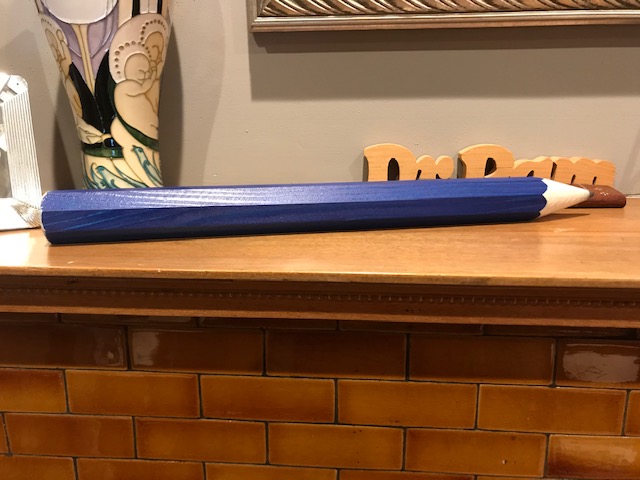
A giant pencil that I received as a Christmas present in Nuremberg. Thanks, Christopher!
One of the unexpected things I learned during our visit to Nuremberg over the holidays is that the city was the home to the first mass-produced graphite lead pencils, beginning in 1662.
Before we visited Nuremberg, I hadn’t given the history of pencils much thought.* In fact, the only piece of pencil history that I knew was that Thoreau invented a better pencil, and then got bored with the whole thing and went off to do something else. But I would have been hard pressed to tell you what made Thoreau’s pencil better. (We’ll get there in a moment.)
As those of you who have hung around here on the Margins for a while know, I can’t resist tracking down the story behind a bit of history trivia. Here’s some of what I found:
- The roman stylus is the immediate ancestor of the modern pencil: a thin metal rod that was used to make a light mark on papyrus. Some styluses were made of lead, which why we still call pencil cores leads even though they have been made of graphite ever since the stylus became a pencil.
- In fact, graphite is the reason styluses became pencils. In 1564, someone discovered a large graphite deposit in Borrowdale, England. Graphite makes a darker mark than lead, but it is too soft and brittle to use without something to hold it. At first, people wrapped graphite sticks in string, but eventually someone inserted a graphic stick into a hollow piece of wood. Poof! A pencil.
- The new industry/craft of pencil making was transformed in Nuremberg. As I’ve mentioned before, the Nuremberg council kept tight control over craft processes in the city. Pencil-making was seen as a two-step process, requiring craftsmen from two different trades to create a single pencil: a lead cutter to shape the graphite and a carpenter or knife handle maker to put the graphite in a wooden case. A storekeeper named Friedrich Staedtler, who was not a member of either skilled trade, figured out how to make a better pencil from start to finish. Pencil makers became a recognized craft category by the 1730s.
- I was astonished to learn that Thoreau didn’t just invent a better pencil; he revolutionized the American pencil industry. American graphite was less pure than British graphite and pencils made from it smudged. Thoreau worked for a time in his father’s pencil factory and was determined to create a better product. After hitting the books at the Harvard Library, he came up with a method of blending graphite and clay that solved the problem. The Thoreau pencil factory took off. Shortly thereafter, Thoreau also took off for Walden Pond. (FYI: He went back into the pencil business occasionally when he needed cash.)
That’s all I’ve got. If you’re interested in learning more about pencil history, everyone seems to agree that the book to read is The Pencil: A History of Design and Circumstance by Henry Petroski. I must admit, I’m tempted. **
*On the other hand, I’ve spent a lot of time reading about the history of paper, which was invented in China and then spread to Europe via the Islamic world—making it exactly the kind of thing I’m fascinated by.
**In fact, I’m tempted by several of Petroski’s books.
Shin-Kickers from History: Mary Heaton Vorse

In a recent blog post, I introduced you in passing to activist and journalist Mary Heaton Vorse. As is so often the case, Vorse is worth a closer look.
Born to an upper-middle class family in Amherst, Massachussets in 1874, Vorse was a prolific and high-profile novelist, labor journalist, and activist.*
In 1896, after a period of studying art in France,* she continued her studies at the Art Student’s league in New York City, which had a reputation for progressive teaching methods and radical politics. She soon discovered that she had no real talent for art and took up progressive causes, including women’s suffrage, in place of painting.
Vorse was married twice—to journalist Albert Vorse in 1898 and radical journalist Joseph O’Brien in 1912—and widowed twice. Both Vorse and O’Brien supported her writing and shared her progressive values.
Her career as an activist and journialist blossomed after O’Brien’s death in 1915.
That year she joined with a group of left-wing writers, including John Reed, Susan Glaspell, Eugene O’Neill, Theodore Dreiser and Edna St Vincent Millay, to found the Provincetown Theater Group., which was dedicated to showcase new American talent outside the rules of the commercial Broadway theater.
In the early years of the First World War, she and other progressives formed the Women’s Peace Party, with the goal of bringing the war to an end. She was one of the party’s delegates to the 1915 International Conference of Women in the Hague.
More importantly, at least in terms of the impact she made, she also turned to serious journalism. She already supported herself as a writer of short stories for women’s and general interest magazines and of romantic fiction novels, which she later dubbed “lollypops.”** Beginning in 1916, she traveled across the United States and Europe reporting on social justice issues, with an emphasis on the impact of events on woman and children that was unusual in labor journalism at the time. Her work appeared in a wide range of mainstream publications including the New York Post, Harper’s Weekly, Atlantic Monthly, New Republic, McClure’s Magazine and even McCall’s.
Her biographer Dee Garrison summed up her journalism career: “Across the space of half a century, wherever men and women battled for a wider justice, she was apt to have been there.” She reported on striking miners in Michigan and striking textile workers in New Jersey and South Carolina.She covered the Scottsboro Boys’ trial in Alabama and the battle between coal bosses and miners in Harlan County, Kentucky, where she was run out of town by thugs working for the bosses. She reported on the United Auto Worker’s strike in Flint. Michigan, in 1937 and on the steel workers’ strike in Youngstown, Ohio, where she was grazed by a bullet fired by company guards. She reported on conditions in Stalin’s Russia and Hungary under Béla Kun—experiences that led her to write in her diary “I am a communist because I don’t see anything else to be, but I am a communist who hates Communists and Communism.” In 1952, she wrote an extensive and hard-hitting investigation of dirty politicians and organized crime on the New York and New Jersey water front.

Her career as a journalist ended in 1959, at the age of 85, when she suffered a stroke on her way home from reporting on a textile workers’ strike in North Carolina.
* I am fascinated by the number of privileged children of the Gilded Age who devoted themselves to social change.
**Much like novelist Graham Greene, who dubbed his thrillers “entertainments,” as opposed to what he believed were his more serious novels dealing with issues of faith and politics. Subjects that also play an important role in his thrillers.