




From the Archives: City
My editor has come through with revision notes for Sigrid Schultz and I am deep in the eternally fascinating process of seeing my book through someone else’s eyes. (And since I’ve had a couple of months away from the book, I’m also seeing things I want to revise that she hasn’t called out.) I’m making structural changes, taking stuff out, and adding stuff back in. I’m stepping back to get the big picture and focusing in at the sentence level. (In one case I have two succeeding sentences with the same, very specific format. My editor didn’t point it out, but it jumped out at me as I read. Frustrating because there is nothing inherently wrong with the sentences qua sentences and my brain is not letting them go without a struggle. I keep chanting “Kill your darlings,” but it isn’t helping.)
As a result, I am having trouble writing a new blog post. So, here’s one more from the archives:a book review that originally ran in 2012. As you can no doubt tell, I really liked the book. In fact, I just pulled it off my shelf for a little re-reading.
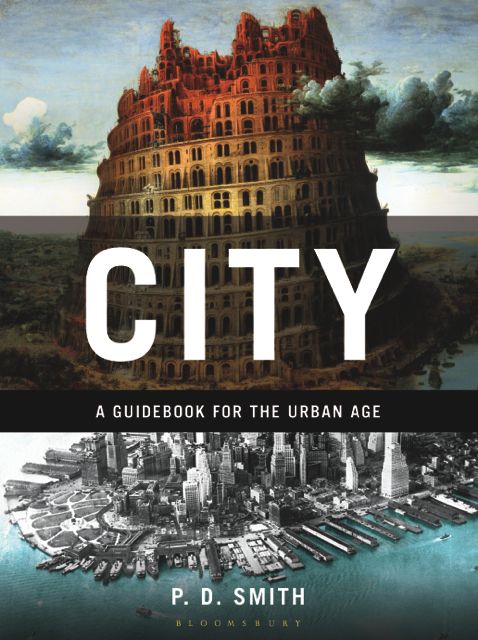
Cultural historian P.D. Smith argues that the city is humanity’s greatest creation. After reading City: A Guidebook for the Urban Age, it’s easy to believe it’s true.
City is not a simple chronological history of urban areas from their first appearance in ancient Mesopotamia to modern megacities. Instead, Smith organizes his work around elements of city life that “have become part of our urban genetic code”: cemeteries, street protests, slums, suburbs, markets, street food, graffiti. He draws illuminating parallels and unexpected connections. The chapter titled “Where to Stay”, for example, begins with the growth, death and rebirth of downtown, looks at immigrant neighborhoods in nineteenth century America in the context of Jewish ghettos in Europe, makes a sharp turn to slum cities in the developing world, considers the allure of garden suburbs beginning in ancient Babylon, and ends with a brief history of the hotel.
The book is punctuated by sidebars that go off at right angles to the main text. A brief history of the parking meter accompanies the section on commuting. The hanging gardens of Babylon are discussed in the context of urban parks.
Smith’s range of material is breathtaking, but he wears his erudition lightly. The prose of City is smart and fast-paced, with a nice balance between big picture history and close-up details. The book is full of “aha” moments and occasional humor. I can’t imagine a history fan who won’t find at least one section fascinating.
Women’s Magazines and Political Reporting

In 2016, Teen Vogue made media news with its shift from a glossy high fashion magazine aimed at teenage girls to a glossy high fashion magazine that covered feminism, social activism, identity, and politics. The change generated stories, and academic articles, with titles like “A Politics of Snap,” “Ok, Seriously,”and “How Teen Vogue Got Political” I followed the coverage, which ranged from condescending to celebratory, with a certain amount of envy. Teen Vogue would have appealed to past me in a way that Seventeen, Tiger Beat, and the like did not.
Analysts discussed the long-standing division between “ladymags” (a category that stretches from Good Housekeeping to Cosmopolitan, some of which are less ladylike than others) and the much smaller category of women’s magazines with a political bent, most notably Ms. But none of them, or at least none that I saw, noted that it wasn’t the first time that women’s magazines covered the news of the day in addition to their usual subjects.
In the years between the two world wars, American women’s magazines printed articles dealing with international issues. The Delineator, the magazine published by Butterick Patterns, published a report on Russia’s battalions of women soldiers in March, 1918. McCalls* in particular had a history of commissioning well-known women reporters to write pieces on international politics. The magazine’s editor, Otis L. Weise, sent muckraking journalist Ida Tarbell to interview Mussolini in 1927 and to report on conditions in Germany in the early 1930s. At much the same time, he sent journalist, novelist and labor activist Mary Heaton Vorse* to report on the Soviet Union.
When the United States entered the war in 1941, American women’s magazines quickly looked for ways to make their content relevant for their readers in a time of national emergency. They went beyond their core subjects of fashion, homemaking, and romantic fiction to produce stories about topics such as dealing with war-time scarcity and rationing and the importance of women taking war-time jobs outside the home. McCall’s once again led the pack, hiring Sigrid Schultz to work as a war correspondent, with a view to reporting on the war from a woman’s perspective.
When the war ended, women were pushed out of their wartime jobs to make room for returning soldiers. (It is only fair to remember that many of them were willing to go.) Women’s magazines responded by returning to covering their readers’ traditional interests, minus the international news. I wonder if readers missed it.
*Also published by a pattern company.
**Coming soon to a blog post near you.
The Dashing Floyd Gibbons
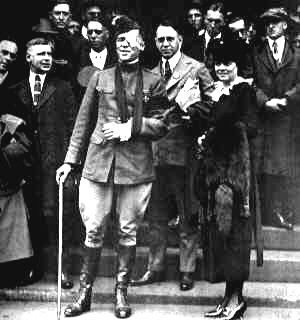
Floyd Gibbons welcomed home in 1918.
Floyd Gibbons was one of the twentieth century’s most swashbuckling reporters, complete with a trademark eye patch, worn because he lost an eye in while advancing with the Fifth Marines on the battlefield of Belleau Wood in June 1918.
Gibbons began his career as a reporter in Minneapolis, but he gained a national reputation as a reporter for the Chicago Tribune. During the fifteen years he worked for the Tribune, he made the news as well as reporting on it. Assigned to cover General John Pershing’s troops in the Mexican Punitive Expedition in 1916,* he instead chose to travel with Mexican leader Pancho Villa, filing exclusive stories from the other side of the conflict. He was on board the liner RMS Laconia en route to London as a war correspondent when a German submarine sank the ship in February 1917—and immediately filed a dramatic eyewitness report on the experience as soon as the rescued passengers reached shore in Ireland. He covered the arrival of American troops in France, the first American artillery shots fired in the war, and the first American offensive of the war at Cantigny. ** His heroics at Belleau Wood, where he lost his eye attempting to rescue a Marine officer, earned him the French Croix de Guerre and turned him into a celebrity back home: he was greeted in New York by a Marine honor guard and a crowd of shouting reporters.
As the war drew to an end, Robert McCormick and his cousin and partner Joseph Patterson, decided to build a European presence for the Chicago Tribune and Patterson’s New York Daily News. They already had a structure in place in the form of the “Army Edition,” the newspaper McCormick produced for soldiers during the war. In November, 1918, a week after the Armistice, McCormick gave Gibbons the job of creating two overlapping news organizations that built on the Army Edition framework: the Tribune’s Foreign News Service*** and the European Edition of the Chicago Tribune and the New York Daily News, known to both its staff and readers as the “Paris Edition.”
Gibbons not only ran the Tribune’s Foreign News Service, he worked as its chief “roaming correspondent,” following stories across Europe, Asia, and Africa. He was fired in 1927, after running up a $20,000 expense account bill on a safari to Timbuktu. (He told fellow Tribune reporter George Seldes that it was worth it: he had always wanted to send his mother a card postmarked Timbuktu.)
Back in the United States, Gibbons became active in the new forms of media that were developing. He was one of the first radio news commentators, becoming known for a fast-talking style of delivery that was the verbal equivalent of his prose. He narrated newsreels, for which he received a star on the Hollywood Walk of Fame, a documentary titled With Byrd at the South Pole and a series of short films called “Your True Adventures.”
Gibbons returned to foreign correspondence in the 1930s, reporting on Mussolini’s invasion of Ethiopia in 1935 and covering both sides of the Spanish Civil War in 1936.
His death on September 24, 1939, cut short his plans to return to Europe, where Germany had invaded Poland only weeks previously.
*A side show in the Mexican Revolution of 1910, and not a shining hour for the United States. It probably warrants a blog post in its own right one of these days since I’ve been stumbling across it regularly for several years now. Until then, here’s a link to an old post that involves Pancho Villa’s army and the Mexican Revolution of 1910: Petra Herrera Wanted to be a General.
**Gibbons’ boss, the owner and publisher of the Chicago Tribune, Robert McCormick was also at Cantigny, where he earned the rank of Lieutenant-Colonel.
***The organization for which Sigrid Schultz worked in Berlin.