




From the Archives: Word with a Past- Vaudeville
Over the last week I’ve spent some time thinking about vaudeville, cabaret, and music halls. I was about to plunge down a research rabbit-hole in service of one throw-away sentence, but historian and writer friend Sunny Stalter-Pace pulled me back from edge. (Sunny is currently working on a book a group biography called Backstage at the Hippodrome: The Show People Behind New York City’s Most Spectacular Playhouse. If that sort of thing is your bottle of sarsaparilla, you would enjoy her research blog.)
All of which reminded me of the one thing I already knew about vaudeville, from a post first published in 2014.
 In 1648, revolution broke out in the streets of Paris. Known at the time as the Fronde ,* it was in many ways a rehearsal for the French Revolution(s) that would follow. Barricades went up in the streets. Aristocrats were pulled out of their carriages and shot at. Militias paraded in the public squares. There were threats of pulling down the Bastille.
More important for the purposes of this blog post, the Fronde was fought in the media as well as in the streets. Printed placards were put up in public places and distributed door-to-door. Small notices, called billets (tickets), were strewn around the city streets. Peddlers sold political pamphlets on street corners like newspapers.** And satirical political songs, known as vaudevilles, became popular.
A contraction of the the phrase voix de ville (the voice of the town), vaudevilles were well named. Writers took popular tunes and wrote new lyrics to them about current events. Singers were paid to roam the streets and sing the latest tunes. Rich and poor alike would hum them as they went about their day. The songs became so popular that collections of greatest hits were compiled.
In eighteenth century France, vaudevilles became a way to get around restrictions on the theater. Theaters presented vaudevilles in conjunction with pantomime and comic sketches. Tap shoes optional.
* Slingshot, a name with a David and Goliath feel appropriate for a revolution that was, at base, about privilege.
** Almost a historical reference in its own right.
Mark Twain Wasn’t the Only Famous Person in Hannibal, MO, Part 3: The Unsinkable Molly Brown
To recap: a small local history museum in Hannibal, Missouri, introduced me to Hannibal-born celebrities who weren’t Mark Twain. Two were totally new to me. One I knew. Or at least I thought I did.
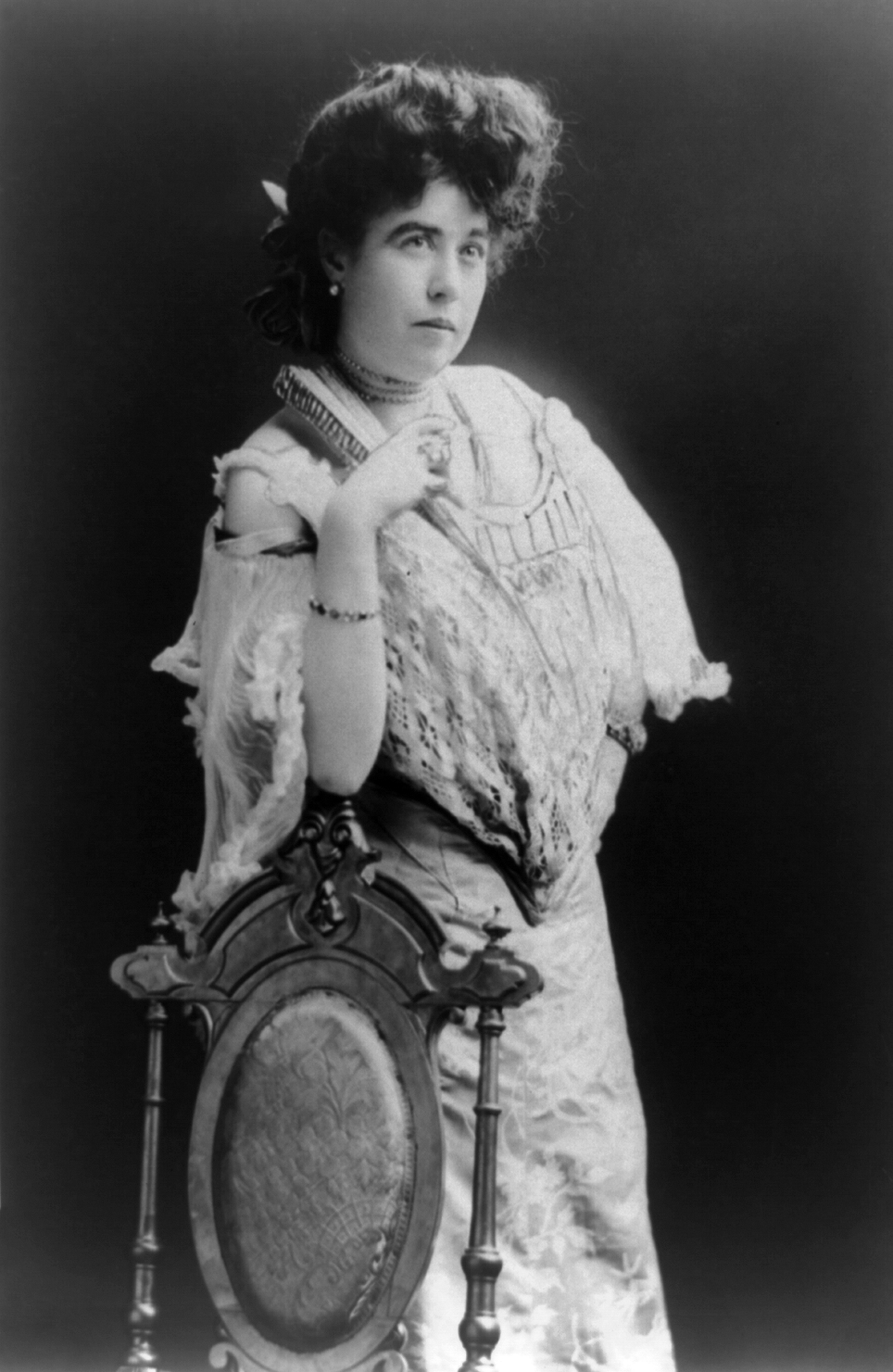
Margaret Tobin Brown was born in Hannibal, Missouri to poor Irish-immigrant parents in 1867.* And after that, it turns out that almost everything I “knew” about her was wrong.** She wasn’t even called Molly in her lifetime. Her friends called her Maggie.
Instead trying to tell her real story, I’m going to send you an episode of the What’s Her Name podcast, in which two of my favorite women’s history people talk to Jamie Melissa Wilms of the Molly Brown House Museum in Denver. Believe me, it’s a doozy.
*The three-room cottage where the Tobin family lived is now a museum, which we didn’t even try to visit. ( Like many visitors in Hannibal, we wore ourselves out on Mark Twain. ) Her much grander home in Denver, where she lived after the Brown mining interests made them wealthy, is also a museum. I’m putting it on the list.
**Which is something of a relief because I never liked the musical that claimed to be based on her life.
Mark Twain Wasn’t the Only Famous Person from Hannibal, MO, Pt. 2: Lester Gaba and the “Gaba Girls”
As I mentioned in my last blog post, a small local history museum in Hannibal, Missouri, introduced me to Hannibal-born celebrities who weren’t Mark Twain. One I knew. Two were totally new to me.
Next up, Lester Gaba, who parlayed a talent for carving soap into an unlikely career, and stumbled into celebrity in the process.
***
Lester Gaba was born in Hannibal in 1907. He was an artistic child and when he was ten he entered a soap carving contest sponsored by Proctor & Gamble.* He didn’t win, but he continued to carve soap.
After graduating from art school in Chicago, he went into the advertising business. His soap carvings began to appear on magazine covers and in ads. He wrote books on the subject. Soon he was making a living carving soap.
In 1932, Gaba took soap carving one-step further. He carved a lifelike, full-sized mannequin he named Cynthia for use in a Saks Fifth Avenue window displays. Based on New York socialite Cynthia Wells, she was the first of a series of mannequins known as “Gaba Girls,” each of which was modeled on a real life New York society woman. It was a game-changer for window displays. Mannequins had previous been made of wax—both creepy and prone to melting in the windows in the summer.
Gaba decided to use Cynthia as marketing scheme for the line of mannequins and his own career. He took her as his date to events. Visitors to his apartment would encounter her “hanging out” with a book or a cup of coffee. (Or a cigarette. Cynthia was definitely a smoker.) She began to show up in the society pages.
Cynthia took on a life of her own after Gaba posed with her (it?) in a humorous Life Magazine photo shoot with Alfred Eisenstaedt in 1937. Suddenly she was a celebrity, and just like modern influencers, swag began to roll in Tiffany and Cartier sent her jewelry. Lilly Daché designed hats for her.** Courtiers sent her their latest designs and furriers sent her minks. Cynthia had a credit card from Saks, season tickets to a box seat at the Metropolitan Opera, a newspaper column and a radio show. (I assume Gaba did all the talking, but I don’t really know.) She appeared in a movie with Jack Benny in 1938
The joke ended in 1942, when Gaba was conscripted into the army. He shipped Cynthia home to his mother in Hannibal, with instructions that she continue to be treated like a “real girl”*** One day Cynthia accompanied Mrs. Gaba to the beauty salon, where she fell off a chair and shattered into a million pieces, give or take a thousand. The press reported that Gaba was distraught at her death. Gaba rebuilt her after the war, but the magic was over.
Gaba continued to be force in what the trade called visual merchandising.
*There is a certain brilliance to this as a merchandising campaign: Proctor and Gamble got “feel good” publicity and sold kids lots of soap.
**I must admit I had to look up Lilly Daché. Turns out she was a big deal in the fashion world of the 1930s and 1940s.
***Pinocchio reference, in honor of Ukulele Ike.