




Road Trip through History: The George M. Verity Riverboat Museum
 I will admit that I had my doubts about the George M. Verity Riverboat Museum in Keokuk Iowa. We have visited, and enjoyed, riverboat museums in the past and I didn’t expect that we would learn anything new about the boats and their relationship to the river. Besides, it was the end of the day and it looked like a storm was brewing over the river.
But if we have one rule of the road, it is that we leave no historical marker unread* and no museum unvisited.* (Okay, two rules.) So I huffed a little and changed my shoes for a pair that would be safer on a wet metal deck. And I am glad we did. It was fascinating. (We have that “no museum left behind” rule for a reason. You never can tell.)
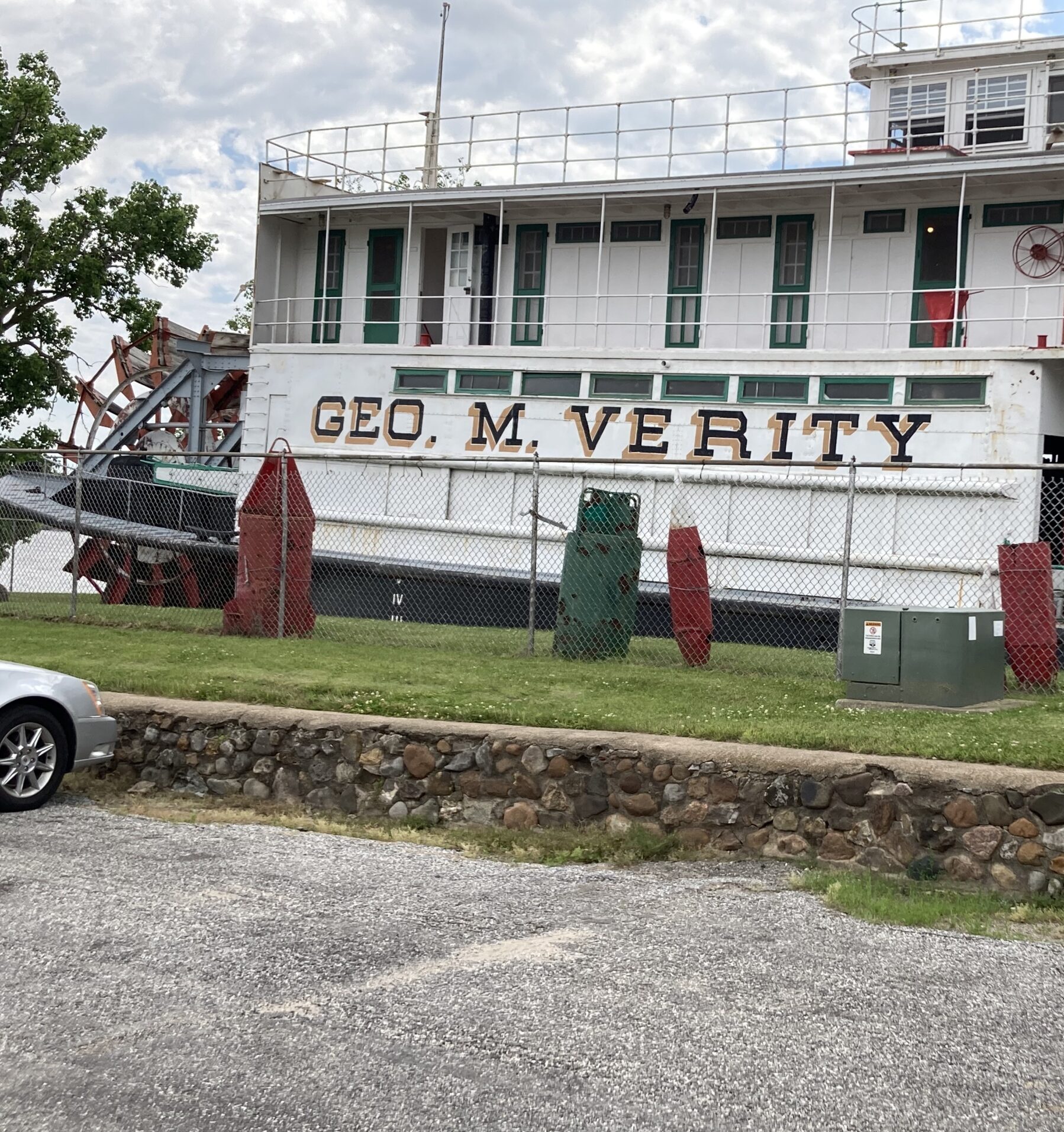
In 1927, the United States government built four new steamboats, including one then known as the S.S. Thorpe, to revive barge traffic on the Mississippi*** As the S.S. Thorpe, the boat moved barges between St Louis and St. Paul. In 1940, the boat was sold to Armco Steel and renamed after the company’s owner and founder, George M. Verity. (According to the tour guide, he liked to put this name on things.)
For the next twenty years, the boat plied the Ohio River, carrying coal from the mines in West Virginia to the steel mills in Cincinnati. But technology changed. In the 1950s, diesel replaced steel and the steamboats were scrapped. The Geroge M. Verity remained in operation until 1960, when the city of Keokuk bought it for a dollar.
While some of the material was familiar, the museum explored two topics that I had not seen before: the life of the crew on the boat and the workings of the steam engine. I was particularly taken with the explanations of how the steam engine worked not only to power the boat but to make life easier for the crew. (You might not find this as interesting as I did. I have a nerdy interest in steam boilers left over from the days when I managed old buildings with steam heat. But it was, honestly, very well done.)
Here are the bits that stayed with me:
• The 17 person crew included three women: two cooks and a laundress. My impression was that someone was eating pretty much all the time.
• The boat distilled its own water from the river, which was used for hot and cold showers, laundry, and drinking water.
• The boat created its own ice, which was used to send cold air into a walk-in cooler. (They carried lots of food supplies because, ahem, someone was eating pretty much all the time.)
• The boat included passenger cabins that were available for the families of the crew.
If you are interested in how people live and work in small spaces, mechanical stuff, or riverboats in general, put this one on your list. (A word of advice if you poke around on the internet looking for more information about the boat or the museum: www.geomverity.org does NOT have the info you are looking for. Trust me on this.)
*Assuming we can find it.
**Assuming that it is open. One of the costs of taking a road trip with no particular schedule is that sometimes we miss the one day a week that a small museum is open.
***My notes say 1297, but I’m pretty sure that’s wrong. (Perhaps we could call it a writo—like a handwritten typo.****)
****Having written this, it occurred to me that names for such errors probably exist in the context of medieval manuscripts. Which led me to wander off from the topic at hand for a moment or ten. Turns out there are technical names for entire categories within the larger universe of “scribal errors.” Two of my favorites: eyeskip, when the scribe missed an entire line, and dittography, when the scribe copied a section. Alas, my own scribal error above goes by the dull name of transposition. Perhaps I’ll stick with writo.
Road Trip Through History: Old Fort Madison
And now, back to the Great River Road after a brief detour to South Africa at the end of the nineteenth century:
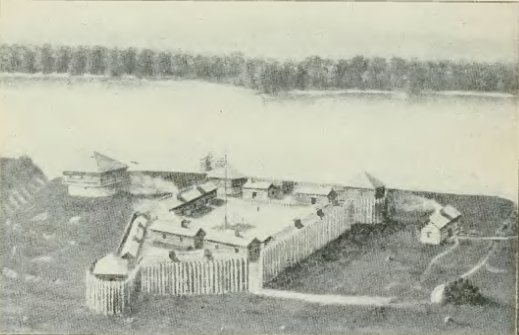
We got to Old Fort Madison, outside what I suppose would be called new Fort Madison Iowa, shortly before the site closed. We had driven past the town where we planned to stay the night because the fort was going to be closed the next day and we didn’t want to miss it. We had to backtrack and dead-reckon our way through road construction, which all took time. And it was so very worth it.*
The fort that you visit today is a reconstruction of the historic fort, which was built by inmates of the Iowa State Penitentiary in the 1980s. (There has to be a story behind that !)
The original fort was built in 1808 as a government trading post, partial payment for the lands “ceded” to the United States in the infamous and illegal treaty of St. Louis in 1804. It was part of a government system of trading posts (called factories at the time) that ran from 1795 to 1822, on the theory that fairly priced goods and access to services such a a blacksmith to repair rifles would build good relations with Native American nations and counter British influence.** It was the third highest grossing factory in the system between 1808 and 1811. (Neither of us had heard of this government-trading system before. It was the big take-away of the stop.)
The War of 1812 ended the fort’s existence as a trading post. INative Americans allied to the British attacked it in March, 1812, and again that September, when it was one of three forts attacked by simultaneously Tecumseh’s confederation.*** The besieged fort held out for four days, but the trading post was burned down.
With the trading post destroyed, the primary purpose of the fort no longer existed. Instead the fort served as a forward defense for settlements along the Salt River and an intelligence gathering outpost for the army. The fort was attacked twice more in July, 1813. At the same, the fort’s supply system failed. By November, the garrison’s supplies were reduced to rotten pork and potatoes. With winter on the horizon, the fort’s commander ordered his men to burn the fort and withdraw to Saint Louis.
*Another stop that turned out to be better than we had any reason to expect, in large part because of a knowledgeable and and enthusiastic docent—a recurring theme of this trip.
**Though honoring treaty agreements would have worked better. Congress ended the system on May 6, 1822, in response to lobbying pressure from the American Fur Trade Company. Fairly priced trade goods became a thing of the past.
***I could have sworn I had written a blog post about Tecumseh and the Shawnee Prophet. Evidently not. Here’s the thumbnail version: Around 1805, a member of the Shawnee nation named Tenskawatawa began to preach a message of religious and cultural revival. Claiming to have seen a vision from the Great Spirit, he taught that if the Native American peoples abandoned the ways they learned from the Europeans and returned to their traditional customs, they could overcome the settlers who were stealing their land. (Am I the only one who sees similarities to Joan of Arc?) Tenskawatawa became known as the Shawnee Prophet, and his message spread through the Great Lakes region.
Under the leadership of the Prophet’s brother Tecumseh, the religious movement because political. Tecumseh wanted to create a confederation of Native American nations that would be strong enough to prevent the movement ofAmerican settlers into the western territories. Not surprisingly, Tecumseh’s confederation and the United States soon butted heads—a conflict that played out against the background of the War of 1812 and ended only with Tecumseh’s death on October 5, 1813.
From the Archives: And Speaking of the Siege of Mafeking…
…as I believe we were just the other day, I was recently introduced to a vision of the siege that is very different from Lord Baden-Powell’s casually stiff upper lip.
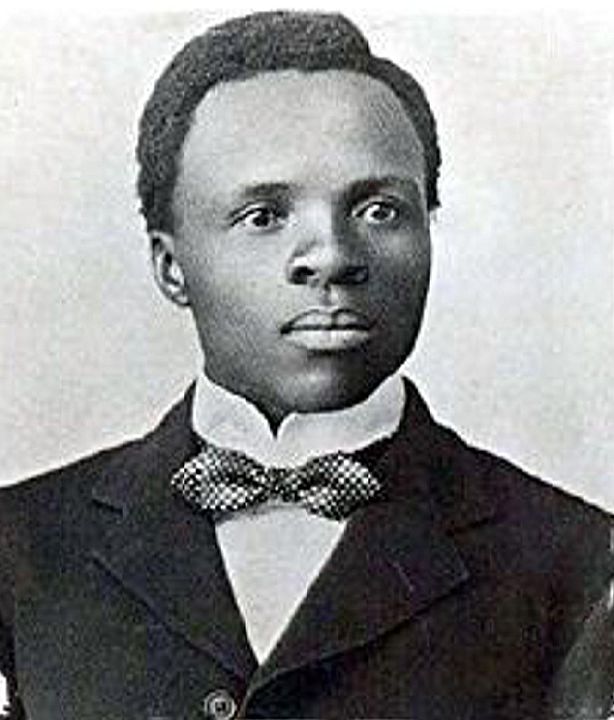
Sol Plaatje, ca. 1915
Sol T. Plaatje was a twenty-three-year-old African court interpreter for the Resident Magistrate when the Boers besieged Mafeking, and its African older sister, the adjacent township of Mafikeng, in October 1899. (Yes, I know. It looks like a typo.)
Plaatje was uniquely placed to comment on the progress of the siege in both towns. As an accomplished linguist who was fluent in English and Dutch as well as several African languages, Plaatje worked with the English authorities during the siege. He expanded his translation work to include two new courts that were established following the imposition of martial law. He served as the liaison between the British authorities and the local African population. He organized African spies and dispatch runners, and wrote up their reports. He sold his secretarial services to the British war correspondents who were stranded in Mafeking.
And in his spare time he kept an English language diary. (At least he wrote most of it in English. He also played with language, using words and phrases from Dutch, Sotho, Tswana, Xhosa, and Zulu. Make you feel like an under-educated slacker? Me, too.)
First published in 1973, Sol T. Plaatje’s Mafeking Diary gives us a different picture of the siege than those that appeared in the flood of English memoirs and diaries published soon after the war. Wry, humorous, and often self-deprecating, Plaatje details the day-to-day experiences of the African population during the siege. A population that is too often invisible in traditional accounts of Mafeking. (Possibly because they concentrate on Mafeking, not on Mafikeng, now that I think about it.)
Plaatje’s later career was a cross between Benjamin Franklin and the young Gandhi. In the years after the war, he became an important newspaper editor, the first General Corresponding Secretary of the South African Native National Congress (later the African National Congress), and one of the first modern African literati. His published works include the historical novel Muhdi, the first novel in English by a black African. Plaatje never tried to publish his diary.
Plaatje was largely forgotten for several decades after his death. With the official end of apartheid in May, 1994, Plaatje resumed his rightful place in South African history.
This post first appeared on June 28, 2011.