




From the Archives: Word with a Past–Two Bits
In every book I write I reach the point where I am so deep in the work that I have to stop writing blog posts and newsletters. I always hope to avoid it. That somehow I’ll be smarter, or faster, or more organized, or just more. This time I’ve managed to avoid hitting the wall for several months by cutting back to one post a month. But the time has come. For the next little while, I’m going to share blog posts from the past. (This one is from 2013. Time flies.) I hope you enjoy an old favorite, or read a post that you missed when it first came out.
There will be new posts in March no matter what: we celebrate Women’s History Month hard here on the Margins. (I have some fascinating people lined up.)
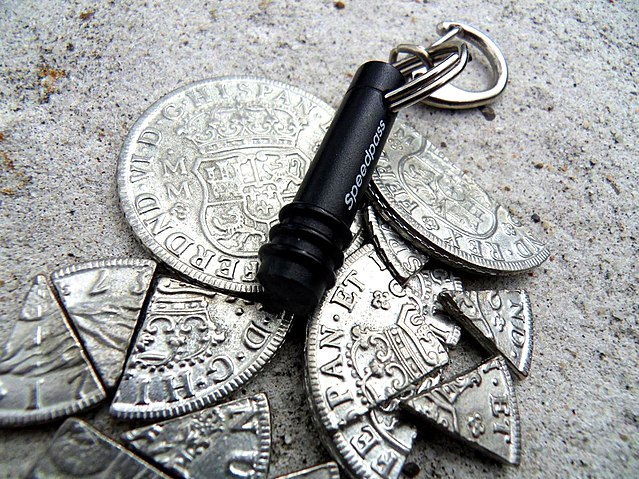
One of the favorite cheers for my junior high school’s football team went “Two bits, four bits, six bits, a dollar, all for our team stand up and holler.” It made no sense to me, but neither did football. When the rest of the Trojan fans stood up and hollered, I stood up and hollered. When they said glumly in the stands, I sat. By high school, my best friends were all in marching band, I was therefore freed of my weekend football obligation, and I knew that “two bits” meant a quarter–I just didn’t know why.
Turns out the phrase has its roots in the Spanish conquest of the Americas and the river of silver that flowed from the mines of Potosí to the royal coffers in Madrid. (1)
In 1497, their Most Catholic Majesties Ferdinand and Isabella introduced a new coin into the global economy as part of a general currency reform. The peso (literally “weight”) was a heavy silver coin that was worth eight reales.(2) In Spanish it became known as a peso de ocho(3); in English it was a “piece of eight”.
The peso quickly became a global currency. It was relatively pure silver, it was uniform in size and weight, and it had one special characteristic: it could be divided like a pie into eight reales. In English, those reales became known as “bits”. Two bits were a quarter of a peso. After the new American Congress based the weight of the American dollar on the peso in 1792(4), “two bits” also referred to a quarter of a dollar.
Now I need to figure out what “Two in ten, let’s do it again” means.
(1)And flowed right back out again to pay for spices, textiles and other luxury goods in the India trade.
(2) The important word here is EIGHT, not reales. The story would be the same if it were eight goats, eight marbles, or eight football fans.
(3) For those of you who never had to count to ten in Spanish, ocho means EIGHT.
(4) Choosing to base American currency on the peso rather than the pound was a not-so-subtle way to spit in Great Britain’s eye. The peso remained legal tender in the US until the 1850s.
From the Archives: Word With a Past-Silhouette
In every book I write I reach the point where I am so deep in the work that I have to stop writing blog posts and newsletters. I always hope to avoid it. That somehow I’ll be smarter, or faster, or more organized, or just more. This time I’ve managed to avoid hitting the wall for several months by cutting back to one post a month. But the time has come. For the next little while, I’m going to share blog posts from the past. (This one is from 2013. Time flies.) I hope you enjoy an old favorite, or read a post that you missed when it first came out.
There will be new posts in March no matter what: we celebrate Women’s History Month hard here on the Margins. (I have some fascinating people lined up.)

I’m poking around in the long eighteenth century these days and stumbling across lots of surprising tidbits.
Take silhouettes. I had long known that charming likenesses cut from black cardstock became a popular and affordable alternative to oil portraits in the mid-eighteenth century. To the extent that I thought about the word at all, I assumed it was the name of a clever scissors-wielding artist who started the new fashion.
Wrong.* The art form, originally called “shades” or “profiles”, pre-dated the name.
Étienne de Silhouette was a French attorney with intellectual leanings and political ambitions. He wrote treatises on this and that, translated Alexander Pope into French, made friends with Madame Pompadour, and earned a name as a garçon fort savant** for a book he wrote on the English taxation system. That book would get him in trouble.
In 1759, halfway through the Seven Years War, he was appointed Controller-General of France. The war was expensive and Silhouette had the thankless job of balancing a budget with a shortfall of 217 million livres.*** To make things harder, more than sixty years of almost constant warfare, had left France with a shortage of metal money and a budget crippled by existing debt. Silhouette issued some long-term debts and cut some expenses, but he realized that the long term answer was raising tax income. He took the not-unreasonable position that the easiest people to raise money from were the people who had money–especially true in the Ancién Regime, where the nobility and the clergy were exempt from taxes. He took away their tax exemptions and cancelled a range of pensions, sinecures, and handouts. With the wealthy and powerful already in an uproar, he then instituted new taxes on luxury goods, from jewelry and carriages to servants and windows. The marquise du Deffand, writing to Voltaire, complained “they are not taxing the air we breathe, but apart from that, I can’t think of anything that’s escaped.”
Less than nine months after his appointment, Silhouette was out on his ear and the term à la Silhouette was applied to anything cheap, including the profile portraits known as shades.
* In more ways than one, it turned out. Evidently there were two schools of silhouette artists, cutters and painters. The things you find out when you follow a fact down a rabbit hole.
** Bright kid
***Roughly 459 billion dollars today ****
****Very roughly, since I had to work from livres to francs, then calculate it forward to 1800 and convert it into dollars before I could plug it into this currency converter.
From the Archives: The Museum of Memory and Human Rights
In every book I write I reach the point where I am so deep in the work that I have to stop writing blog posts and newsletters. I always hope to avoid it. That somehow I’ll be smarter, or faster, or more organized, or just more. This time I’ve managed to avoid hitting the wall for several months by cutting back to one post a month. But the time has come. For the next little while, I’m going to share blog posts from the past. (This one is from 2014. Time flies.) I hope you enjoy an old favorite, or read a post that you missed when it first came out.
There will be new posts in March no matter what: we celebrate Women’s History Month hard here on the Margins.

The Bombing of La Moneda (the Chilean equivalent of the White House) on September 11, 1973, by the Junta’s Armed Forces.
My Own True Love and I went to Chile over the holidays for a family wedding and a spot of adventure. We set off knowing where we needed to be when and no idea about the details. We discovered strawberry juice, pisco sours, enormous holes in our knowledge of Chilean history, and the amazing kindness of strangers. We spent two nights in a cabin that looked like a hobbit hole, walked in the foothills of the Andes, and stayed up much later than we are used to.
Along the way we visited a truly powerful museum: the Museo de la Memoria et los Derechos Humanos (The Museum of Memory and Human Rights).
The museum documents the events of the military coup of September 11, 1973, the subsequent abuses of the Pinochet years, the courage of those who stood against the regime, and the election in which Chile voted Pinochet out of power in 1988.* The exhibits are an assault on the senses, using contemporary film clips, music, photographs, and recordings. Photographs of the regime’s victims “float” against a glass wall that is two-stories high. Interviews with survivors of the coup were fascinating; interviews with survivors of the government’s human rights abuses were almost unbearable. A recording of President Allende’s final speech, broadcast under siege from the presidential palace shortly before his death, was awe-inspiring. In short, the museum shows humanity at its best and its worst.
In many ways, the Museo de la Memoria resembles Holocaust museums we’ve visited, not only in its insistence on memory and celebration of survival, but in its message of “never again”. A quotation from former Chilean president Michelle Bachelet Jeria is engraved at the entrance that sums up the museum’s purpose: “We are not able to change our past. The only thing that remains to us to learn from the experience. It is our responsibility and our challenge.” Statements about and explanations of the universal declaration of human rights, passed by the United Nations in 1948, are interwoven throughout the historical exhibits.
I cannot say we had a fun morning. My Own True Love and I left the museum drained. We also were very pleased we made the effort. If you are lucky enough to have the chance to visit Chile, make the time to visit. If you don’t see Chile in your future but would like to know more about Chile under the Pinochet regime, these two books come highly recommended: Andy Beckett’s Pinochet in Piccadilly: Britain and Chile’s Hidden History and Hugh O’Shaughnessy’s Pinochet: The Politics of Torture. I haven’t read either of them yet, but I’m putting them on my need-to-read list.
*I don’t know of any other instance in which a dictatorship allowed itself to be voted out of power. Do you?
Photograph courtesy of the Library of the Chilean National Congress