




From the Archives: Kepler’s Mother (A Scary Story for Halloween)
Sometimes life makes it impossible to write blog posts on a dependable basis. This is one of the those times. For the next little while, I’m going to run pieces from years past. I hope you enjoy them, and I’ll be back as soon as I can.
Next up, a post from October, 2017:
The seventeenth century was a period of scientific revolution. Astronomers, like Galileo, worked out the motions of the planets and stars in the sky, and overturned the concept that the earth stood at the center of the cosmos.* Galileo, Newton and others created a new science of mechanics that applied the laws of mathematics to motion. Physicians explored the structure of the human body. The development of scientific instruments allowed students to see new worlds in a drop of water and scan the skies with a clarity not possible with the naked eye. Natural philosophers (the name used by scientists at the time) began to perform experiments in a way that could be verified by others.**
The seventeenth century was also the height of the European witch trials. Black magic, maleficum, was a capital crime, clearly defined by law. Between 1570 and 1680, roughly 110,000 people were tried for witchcraft in Europe and between 40,000 and 60,000 were executed. Most of the accused were women. One of the women accused was Katharina Kepler, the 68-year-old mother of German astronomer Johannes Kepler.

The charges against Katharina will sound familiar to anyone who has read accounts of the Salem witch trials. (And probably to anyone who has read accounts of European witch trials as well.) A woman who suffered from a chronic illness accused Katharina of poisoning her. The local schoolmaster reported that the illiterate Katharina constantly pestered him to read letters from or write letters to her famous son, and that on one occasion she entered his house though the doors were locked. A local matron reported, second-hand, that a young seamstress told her that Katherina had roamed the house late at night*** and offered to teach her (the seamstress) witchcraft. She was accused of killing various local animals by magic and of turning herself into a cat. Katherina vehemently denied the charges. The only charges she couldn’t plausible deny were 1) being old and 2)being difficult.**** Obviously prime witch material.
Her trial lasted six years.

In 1620, five years after Katharina’s ordeal began (!), at the height of his career, Johannes Kepler packed up his family, moved to the city where his mother was on trail, and took over her defense. He dissected the charges in a powerful, and groundbreaking, legal document. He attacked the reliability of many of the witnesses. He pointed out the fact that many of the accused acts–like entering someone’s house uninvited–could not necessarily be attributed to witchcraft. And that to do so would make any difficult old woman vulnerable to attack.***** He discussed the differences between natural and unnatural illness in scientific detail, with the authority of one of the great scientists of his age. He pointed out inconsistencies in the testimony. It took almost a year, but he ultimately succeeded in getting his mother acquitted.
Katharina died six months after her acquittal, no doubt worn down by her ordeal
At base, Kepler wasn’t that different than the men who tried his mother.**** He believed in magic. The division between magic, religion and science was not clear. Sir Isaac Newton spent as much time studying alchemy and interpreting biblical prophecies as he did on the scientific theorems for which he is famous. William Harvey, who discovered how blood circulates in the body, dissected a witch’s toad familiar, looking for the source of its supernatural power. Most witchhunters and demonologists were scholars and rationalists who believed in the importance of direct observation and were concerned with the question of what constituted reliable evidence . The investigation of witchcraft, magic and miracles was a much a part of the scientific revolution as the study of gravity and electricity.
Small comfort for cranky old ladies who liked cats and annoyed their neighbors.
*Or at least shoved it off balance. It takes a while for new ideas about the nature of reality to work their way through society. Consider the existence of the Flat Earth Society.
**It is only fair to point out that many of these breakthroughs had been anticipated by Islamic scientists during the Golden Age of Islam, most notably Alhazen, whose work laid the foundation for the scientific method.
***There is a reason they call them the witching hours.
****In her trial Johannes himself admitted that she “disturbs the whole of her town, and is the author of her own lamentable misfortune.”
*****As indeed they were.
******Except for that small detail of being a scientific genius.
From the Archives: Before Rosie the Riveter
Sometimes life makes it impossible to write blog posts on a dependable basis. This is one of the those times. For the next little while, I’m going to run pieces from years past. I hope you enjoy them, and I’ll be back as soon as I can.
Next up, a post from October, 2018:

A generation before Rosie the Riveter, munitionettes “wo-manned” Britain’s factories and mines, replacing the men who volunteered for General Kitchener’s New Army in 1914 and 1915.
Women were initially greeted in the work force with hostility. Male trade unionists argued that the employment of women, who earned roughly half the salary of the men they replaced, would force down men’s wages.** Some argued that women did not have the strength or the technical skills to do the work.
When universal male conscription was passed in 1916, need out-weighed social resistance. By the 1918, 950,00 women worked in Britain’s munitions industry, outnumbering men by as much as three to one in some factories.
The hours were long and the work was dangerous. Munitionettes were popularly known as “canary girls” because prolonged exposure to toxic sulfuric acid tinged their skin yellow. Deadly explosions were common.
Munitionettes were not the only women to enter Britain’s work force in World War I. Another 250,000 joined the work force in jobs that ranged from dockworkers and firefighters*** to government clerks, nurses, and ambulance drivers. The number of women in the transport industry alone increased 555% during the war.
At the end of the war, most of the munitionettes and their fellow war workers were replaced by returning soldiers. Many of them were probably glad to go. But the definition of “women’s work” had been permanently changed. The thin edge of the wedge had been inserted.
* Evidently the simple solution of negotiating for women to be paid an equal wage for equal work did not occur to male-dominated unions. As a consequence, women’s trade unions saw an enormous increase in membership during the war.
** Imagine fighting a fire in a long skirt and petticoats.
From the Archives: Daughters of Chivalry
Sometimes life makes it impossible to write blog posts on a dependable basis. This is one of the those times. For the next little while, I’m going to run pieces from years past. I hope you enjoy them, and I’ll be back as soon as I can.
Next up, a post from October, 2019:
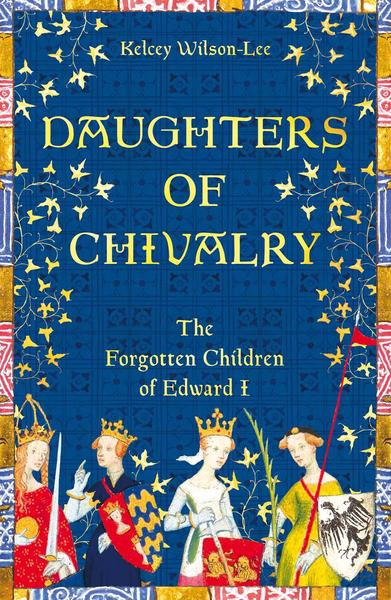
In Daughters of Chivalry: The Forgotten Princesses of King Edward Longshanks, historian Kelcey Wilson-Lee tells the stories of the five daughters of Edward I of England and his first wife, Eleanor of Castile, who survived into adulthood: Eleanora, Joanna, Margaret, Mary, and Elizabeth.
I’ve got to say the book has a shaky start. Wilson-Lee sets up a questionable and unnecessary straw woman in her introduction: a “popular” vision of medieval princesses as powerless and passive that she describes as built on “an empire of fairy stories, Hollywood films, theme parks and cheaply produced ball gowns.” Personally, I’m not sure anyone believes in the powerless princesses she describes–not the little girls who wear those ball gowns with attitude* and certainly not anyone who would chose to read a book titled Daughters of Chivalry. Maybe that version of princesses existed once upon a time, but my own memory of fairy tales includes a fair number of princesses who used every ounce of power they held to control who they married–something only one of the real-life medieval princesses in Daughters of Chivalry managed to control.
That quibble aside, Daughters of Chivalry is an excellent book.
Like even the most elite medieval women, Wilson-Lee’s princesses left a spotty trail in the historical record, most often appearing in official chronicles in the context of their relationship with one of the men in their lives. She fleshes out the picture of their lives using a variety of sources—most notably the account records for the various royal households**—plus a certain amount of informed speculation.
Wilson-Lee uses her sources to good effect. She creates portraits of five clearly defined individuals. Joanna, for instance, frequently defied her father and took full advantage of the opportunities accorded to a young, wealthy widow in medieval society. Mary, who entered the convent of Amesbury at the age of six, had a taste for luxury and a gambling habit at odds with her vow of poverty. She also places the sisters within the larger context of royal women in the late medieval period, exploring questions of education, marriages (political and otherwise), widowhood, property, travel, and the role of royal women as political intercessors. Like the women she describes, Wilson-Lee never loses sight of the fact that what power these women enjoyed was derived from their relationship to the king, but she fully explores the nature of that power and how they used it.
*A year or two ago, I saw a little girl stomping through the aisles of my local grocery store wearing hiking books with a princess gown and carrying a sword. I’m pretty sure she didn’t share Wilson-Lee’s “popular” vision of princesses.
**The nature of her sources means there is a lot of description of real-life princess dresses. This is not a complaint. Just an observation.
The guts of this review previously appeared in Shelf Awareness for Readers.
********************
For several years now in March I celebrate Women’s History Month here in the Margins with a series of mini-interviews with people who are involved in creating and studying women’s history. A lot of you seem to enjoy it. (I know I do.) I plan on doing it again in 2022; in fact, two interviewees have already accepted. If there is someone you think would be a good fit, or if you think you would be a good fit, let me know.