




The Puckle Gun (Not to be Confused with Pickleball)
Recently My Own True Love and I were discussing machine guns over breakfast. (What, you’ve never discussed armaments over an omelet and an order of hash browns?)
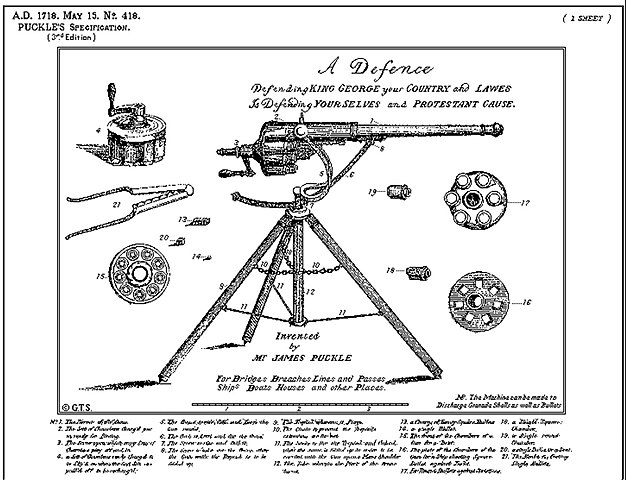
In the course of settling the question of whether the Gatling gun or the Maxim gun was the first machine gun,* we discovered an ancestor of the machine gun that neither of us had heard of before. The Puckle gun, also known as the Defence Gun, was invented by British solicitor James Puckle in 1718. Down the rabbit hole I went.**
The Puckle Gun was designed to defend British ships against attack by Ottoman pirates, who attacked larger ships using small maneuverable boats. British ships were equipped with broad ship cannons designed for naval combat against ships of similar size. They could blow a Turkish ship out of the water, but only if they could hit it. They didn’t have the speed or flexibility needed to engage a moving target.
The Puckle Gun was repeating rifle, rather than a true machine gun. Mounted on a tripod, it was a single bore cannon with a flintlock firing mechanism and a revolving cylinder that could be loaded with round bullets, square bullets or powder and shot.*** Like the Gatling gun, the shooter operated the gun by hand-cranking the cylinder; unlike the Gatling gun, it fired one chamber at a time. Depending on its configuration, the cylinder could fire between six and eleven rounds before it had to be removed from the gun and reloaded. By eighteenth century standards, it was lightening fast. When it worked, the Puckle Gun could fire nine shots a minute, compared to the average musketeer’s rate of two to five shots per minute.
“When it worked” being an important point, apparently its flintlock mechanism was not only clumsy but unreliable. And while it could deliver roughly the same fire power as three men in the same time period, it required two to three men to handle. Not a net gain.
British officials did not jump to add the Puckle Gun to the armory. In addition to being unreliable, it was more difficult to make than a simple musket, requiring multiple complex parts and assembly that placed it well beyond the skills of most gunsmiths. (Personally, I don’t think the unintentionally humorous name Puckle Gun helped sell it as a serious armament.)
*Turns out that I was right. The Gatling gun was invented in 1862. The Maxim gun was invented in 1884. Not that I am gloating.
** Much to the confusion of Google, which thought sites about pickleball were a much better idea.
*** “Square bullets?” you ask. So did I. Puckett believed square bullet do more damage and designed this option specifically for use against Ottoman Turks. He reserved the more “merciful” round bullets for Christian enemies.
When Women Ruled the World
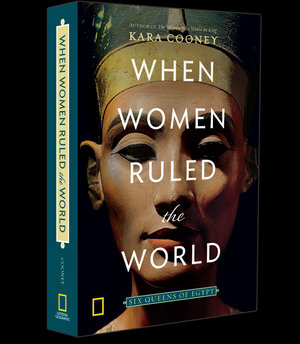
For some reason, I resisted reading Kara Cooney’s When Women Ruled the World: Six Queens of Egypt the first seven or eight times it crossed my path. I should have been all over that book. I’d been fascinated by ancient Egypt since I was about nine. Hatshepshut was the subject of the first adult biography I remember reading. But I dug in my heels * Not even Cooney’s engaging episode on the What’s Her Name podcast convinced me to, well, engage.**
I have now seen the light. I recently watched Cooney give a presentation on the material in the book on One Day University *** and started reading the book soon thereafter.****
When Women Ruled the World is a fascinating and accessible read, written in an informal style that in no way detracts from Cooney’s serious academic credentials.
Cooney begins with the question of why women have been and still are excluded from the highest levels of political power. (She points out that some of the most powerful women in American society are erased or forgotten in a very short time. In fact, I am embarrassed to admit that I had to look up one of her examples. None of us are innocent in this regard.)
She moves on to present ancient Egypt as an anomaly, where women were repeatedly called upon to rule in times of crisis. She introduces the reader to six women who ruled—five of them as kings in their own name. (I had only heard of three of them, and only knew that two of the three had ruled.) She traces the political crises that lead to each woman’s rule, and her accomplishments once on the throne. She considered the ways in which their names were (sometimes literally) erased from monuments and king lists by the men that followed them. The memories of those who couldn’t be erased were traduced. (I’m looking at you, Cleopatra.) And Cooney acknowledges that the same social structures that allowed them to take power, generally as placeholders for a “rightful” male ruler who was unable to rule, limited their authority: women rulers didn’t follow women rulers.
In short, I don’t know what took me so long. I guess it’s time to check out Cooney’s podcast, Afterlives.
* This is not the first time I’ve avoided a book for reasons that I can’t articulate—and that almost always turn out to be erroneous.
**It is possible that I got so wrapped up in the story she told that I didn’t connect it with the book.
*** A rabbit hole for history buffs and other passionate learners. Be warned.
****In all honesty, even if I had purchased the book the first time I heard about it, there is no guarantee that I would have gotten to it any earlier. Books come in faster than I can read them, as the piles in my office attest.***** I recently whittled my “must read immediately” pile down from 40 to 15—not including books that are research adjacent.
*****I recognize that my sentence construction suggests that I have no agency in acquiring those books. (Books come in. Mistakes were made.) But sometimes it feels like that is, in fact, true. At least that’s my story.
And speaking of women left out of history:
Those of you who are watching THE HARDER THEY FALL on Netflix may not realize that the character of Cuffee is modeled on that of a real-life woman, Cathay Williams, who disguised herself as a man and enlisted in the United States Army as William Cathay. I wrote about her in Women Warriors. You can read her story here: https://www.beaconbroadside.com/broadside/2021/11/gender-conceal-when-cathay-williams-went-to-war-in-disguise.html
Road Trip Through History: Chickamauga and Chattanooga
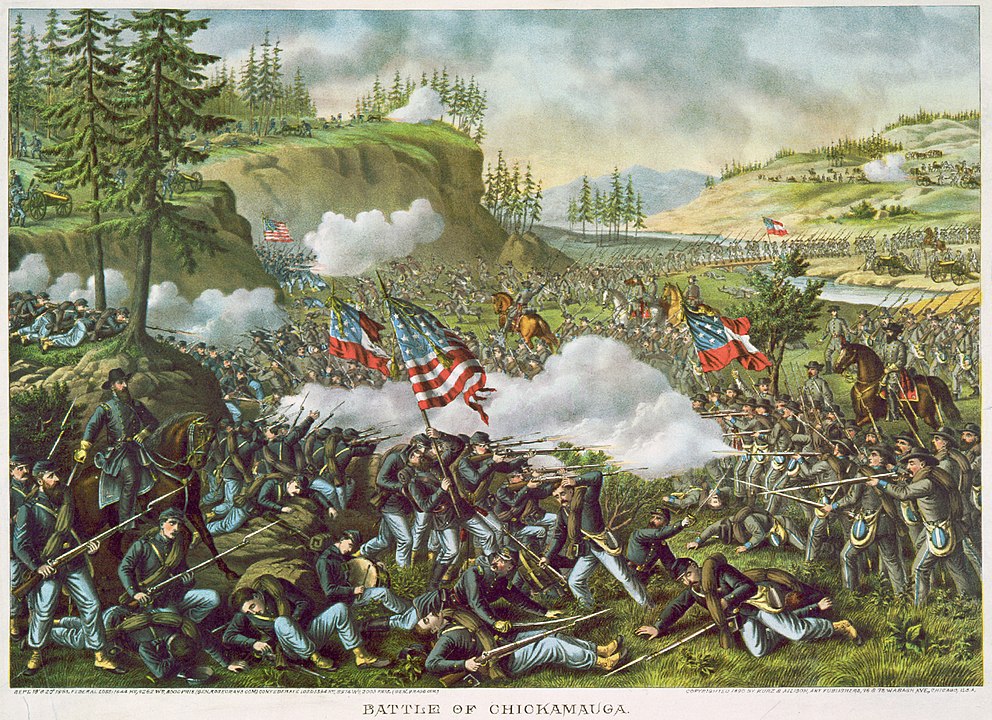
Recently My Own True Love and I made a difficult trip from Chicago to Atlanta and back. Normally, we would have flown, but with the continuing threat of Covid we chose to drive. And since we were driving, we decided to make a couple of history nerd stops to soothe our souls. After all, the Chickamauga and Chattanooga National Military Park (in the northwest corner of Georgia, near the Tennessee border) and its smaller sister park of Lookout Mountain (in Tennessee) were more or less on the way.
The National Park Service did not disappoint.
We stopped at the Chickamauga and Chattanooga National Military Park on the way down and at Lookout Mountain on the way back. For purposes of this blog post I’m treating them as one park because they are all part of one big story.
Before we visited the parks I knew two things about the Civil War battles for the control of Chattanooga:
- Chattanooga was an important railway center and the gateway to the Confederacy from the West. Control of Chattanooga would give the Union greater control over its supply chain and access to the industrial centers of the Confederacy.
- The battle of Chickamauga was one of the bloodiest battles of the war. (I knew this thanks largely to reading this short story by Ambrose Bierce in high school. (1) )
Both of those things are, in fact, true. (2) Our visit to the park added story, depth and color to those dry bones.
We began our visit by joining a caravan tour of the Chickamauga battlefield led by a park ranger/historian.(3) He was a good story teller and brought the battle to life. He didn’t just recite troop movements, though he did give a clear description of what men did at each step of the battle and why. He put the battle into historical context. He told stories about the people who fought, and about civilians whose lives were affected by the battle. (5) He ended the program with a discussion of the subsequent battle for Chattanooga, in which the Confederate general snatched defeat from the jaws of victory.
An excellent short film at the main park and exhibits at the visitors’ centers at both parks reinforced and expanded on the ranger’s talk. (The film made me cry.)
I’m not going to recap the action of the battles here. There are plenty of places where you can get that information. Here are the things, large and small, that caught my imagination:
- The Confederates, led by Gen. Braxton Bragg, won the battle of Chickamauga but that victory didn’t accomplish anything. At the end of the battle, the Union army, led by Gen. William Rosencrans, retreated to Chattanooga–which was the prize the two armies were fighting to control. Instead of attacking the battered Union forces, Bragg chose to besiege Chattanooga at a distance. The idea was that the cold, tired and hungry Confederate army would starve the cold, tired and hungry Union army into submission. After a month, General Grant arrived with reinforcements and set up a supply line into the city. The soldiers called the trains that brought in the supplies the Cracker Train, after the hardtack that was one of their main provisions. My guess is I will remember the Cracker Train long after I’ve lost all the other details of the battle.
- One of Abraham Lincoln’s brothers-in-law, Benjamin Hardin Helm, was a Confederate general who died at Chickamauga. (In fact, Lincoln had five brothers-in-law in the Confederate army.) Helm was a West Point graduate. Lincoln had urged him to remain in the Union army and greatly mourned his death. After his death, Helm’s wife lived for a time in the White House at the invitation of her sister, Mary Todd Lincoln. This must have been uncomfortable for all concerned. After several months, Emilie Todd Helm returned home to Kentucky. The ranger made the point that Mary Todd Lincoln suffered loss after loss in her years as the First Lady, with Lincoln’s death being the last and most devastating. Beyond that, I was struck by the fact that the truism that the war divided families went all the way to the White House.
• The ranger and the various exhibits all described generals Bragg and Rosencrans as being eccentric, but they never said in what way. There are so many ways to be eccentric. I want to know more.
• The Battle of Lookout Mountain–which became known as the Battle Above the Clouds–ended with a frenzied charge by Union troops up the fog-enshrouded mountain. Looking down the side of the mountain, I could not imagine how they did it.
• The Chickamauga and Chattanooga National Military Park was the first national military park to be created, at the instigation of veterans from both sides of the battle.
Definitely worth a stop if you are a history buff.
1) Unlike Stephen Crane, who wrote The Red Badge of Courage, Bierce actually fought in the war. But I digress.
2) This is not always the case with the things I think I know going in.
3) In case you haven’t done one of these, the ranger leads a caravan of people driving their own cars through the battlefield, like a weird funeral cortege. (4) At critical points, everyone piles out for a brief lecture.
(4) Not entirely inappropriate here given the breathtaking number of deaths that occurred on the battlefield.
(5) As far as I’m concerned, that’s the way military history should be told. Otherwise you’re just moving tin soldiers around on a topographic model of a battlefield.
Note: Thanks to sharp-eyed reader, Jack French, who pointed out that I didn’t tell you what states the parks are in. I’ve added the info, and I offer you this link to the NPS website that includes information about both parks: https://www.nps.gov/chch/index.htm