




Deja Vu All Over Again: The Fort Snelling Concentration Camp, 1862

Benjamin Franklin Upton. 1863. From the collection of the Minnesota Historical Society
Back in August, My Own True Love and I spent a History Nerd Holiday in the Twin Cities. I came back with a lot of stories, but I left an important one for later: the concentration camp the United States government built at Fort Snelling at the end of the U.S. -Dakota War of 1862. I didn’t have a firm grasp on the details of the war itself[1] and, quite frankly, I found it difficult to write about. I think it’s time to tell the story.
The U.S. – Dakota War of 1862 was a short-lived, violent conflict between white settlers and the Dakota people in the Minnesota River Valley that was a precursor to the later so-called “Indian Wars” in the west. Tensions between the settlers and the Dakota were already high, as happens when two different peoples claim the same land. Then the U.S. Government failed to keep its treaty obligation to send annuity payments, leaving the Dakota to starve. The attempt by a small band of the Dakota to take some eggs from a homestead escalated into violence and then war. During the six weeks of the war, hundreds of white settlers, American army soldiers, and the Dakota people died.
More Dakota died after the war was over.
After the Dakota surrendered, a military commission tried 392 Dakota men for their participation in the war. They were not allowed legal representation and most of the trials were brief. Some lasted less than five minutes. More than 300 of the defendants were sentenced to death. Even at the time, people questioned the legal authority of the commission and the procedures it used, publicly and loudly.[2] As a result, President Lincoln personally reviewed the convictions. He decided that only those men who had killed civilians should be executed. He allowed the death sentence to stand for 38 of the convicted men. They were executed on December 26, 1862—the largest single execution in American history. The rest of the men received commuted sentences and were interned at Camp Kearney in Iowa for four years.
Meanwhile, almost 1700 Dakota non-combatants—most of whom were women, children and the elderly—were removed to a river bottom below Fort Snelling. Soon after they arrived, the army enclosed the area with a twelve-foot tall wooden stockade, which they patrolled to control movement in and out. Several hundred people died that winter due to disease and harsh conditions.
In February, 1863, Congress passed an act that annulled all existing treaties with the Dakota people and stated that their lands and all annuities still due them were forfeit to the United States. A bill passed in March called for their removal from the area that was their ancestral homeland. The surviving captives at Fort Snelling, along with 2000 members of the Ho Chunk nation, who were not involved in the war, were put on steamers and taken to a desolate reservation in the Dakota Territory. [3]
Today a major immigrant detainment center[4] stands on the site of the camp. In a particularly ugly echo of the past, members of the Lakota nation are reported to have been held there in recent weeks.
[1] A pivotal event in American history that neither My Own True Love or I had heard of prior to our visit to Fort Snelling.
[2] As far as I’m concerned, this is the only point of light in this story. Even in the midst of the Civil War,which presumably took most of America’s bandwidth, people stood up and questioned actions of questionable authority taken by men in power.
[3]I wish I could say this was an isolated incident in American history, but we all know that is not true.
[4] The official description, not mine.
Tiny Broadwick: “First Lady of Parachuting”

Georgia Ann “Tiny”[1] Thompson Broadwick (1893-1978) fell in love with aviation in 1907 at the age of 14 when she attended an aerial show at the North Carolina State Fair. The show featured pioneering balloonist Charles Broadwick (c. 1875-1943), who went up in a hot air balloon, climbed over the side and parachuted down. Tiny later told a reporter “When I saw that balloon go up, I knew that’s all I ever wanted to do.”
The sight of that balloon rising into the air may have looked like freedom to Tiny. She had married one William A Jacobs two years earlier[2] and had a daughter within a year. Jacobs abandoned them soon after the girl was born. With her husband gone, she worked in a cotton mill to support herself and her daughter.
When the show was over, she went straight to Broadwick and asked to join the act. He thought adding a young, pretty girl to the act would be a draw. After sorting out the complicated issues of her life, she joined Broadwick’s World Famous Aeronauts and the Johnny J. Jones Carnival, leaving her daughter with her mother with the promise that she would send part of her earnings home for her daughter’s support.[3] Soon thereafter, Charles Broadwick adopted Tiny.

A year later, back at the North Carolina State Fair,[4] Tiny made her first jump in a performance. Charles emphasized her size and youth, dressing her in girlish clothes, curling her hair into ringlets, and billing her the “Doll Girl.” When interviewed later in life, she said she hated being dressed up like a doll—she had been a tomboy her whole life—but she loved jumping. It was “the most wonderful sensation in the world! From up in the air I can appreciate the beauty of the earth from a new perspective and felt that I was in the presence of God.”
Tiny was soon the star attraction of the show. She sat on a trapeze that hung from the bottom of the balloon and jumped when she reached the correct altitude. (This sounds terrifying.) Newspapers described her as the most daring female aeronaut[5] ever seen, though she was definitely not the first.
In 1912, Tiny went from jumping out of balloons to jumping out of planes at the suggestion of Glenn L. Martin, an early barnstormer and aviation pioneer. (He was the Martin in Lockheed-Martin.) No woman had jumped out of a plane before and he thought the addition of a woman to his aerial act would spice things up. The two men developed a new type of parachute for her to use jumping from the plane. She sat on a seat behind the wing and outside the cockpit that worked like a trap door. (Even more terrifying.)[6] When the plane reached an altitude of two thousand feet, she released a lever next to the seat and dropped. A rope was fastened to the fuselage and woven through the canvas cover of her parachute; when she dropped, the rope pulled off the cover so the parachute filled with air.

Two years later, the Army Air Corps, which was looking for ways to improve pilot safety. asked Tiny to demonstrate jumping from a military plane to its pilots. She made four jumps in one day.. Everything went smoothly on the first three jumps. On the fourth, Tiny’s parachute line became tangled in the plane’s tail. She wasn’t able to get back into the plane because the wind was flipping her back and forth. She cut the line, leaving a short length attached—essentially improvising what would become known as a ripcord. As she plummeted to the earth, she opened the parachute by hand with the remaining line. She was the first person to self-deploy a parachute. It was a game-changer. Her quick thinking demonstrated that it would be possible for a pilot to bail out of a damaged airplane and survive.
Tiny Broadwick made more than 1100 jumps from balloons and airplanes over the course of her career, making her last jump in 1922[7]. She served as an advisor to the Army Air Corps throughout World War I. During World War II she worked at Rohr Aircraft Company on the assembly line making aircraft parts. She was also asked to speak to young paratroopers about her experiences as the “First Lady of Parachuting”

In later years, she received important recognition from the aviation world. She received the U.S. Government Pioneer Aviation Award in 1963 and the John Glenn Medal in 1964. In 1970, NASA invited her to watch the Apollo 13 launch. In 1976, she was made an honorary member of the 82nd Airborne. She was posthumously inducted into the Skydiving Hall of Fame.
When she died in 1978, members of the Golden Knights, the US Army’s elite parachute team, served as her pallbearers.
[1] She was was nicknamed Tiny for a reason. As an adult she stood a little over four feet tall and weighed 80 pounds
[2] Yes. At the age of 12.
[3] And at this point the daughter disappears from the story as reported in the sources I read. Which makes me sad and angry on her behalf.
[4] I’d like to think she visited her mother and daughter.
[5] Both aeronaut and balloonist came into use to describe someone who flies in a balloon in 1784, a year after the Mongolfier brothers launched the first successful manned hot air balloon flight.
[6] For some reason, I find the idea of hanging outside an airplane more frightening than the idea of jumping. (Which I have no intention of doing.)
[7] Or possibly 1923. Sources disagree.
Neysa McMein: Illustrator and Jazz Age Icon
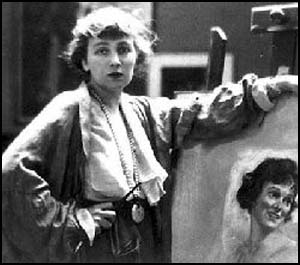
Illustrator Neysa McMein (1888-1949) was born Marjorie McMein in Quincy, Illinois in 1888. She left Quincy and the name Marjorie behind as soon as she could.
After high school, Marjorie left Quincy for Chicago where she studied commercial art at the Art Institute of Chicago. In 1913, she moved to New York, where she changed her name to Neysa, reportedly on the advice of a numerologist. (She chose the name of a racehorse she admired.) Neysa tried her hand at acting for a short time–she worked occasionally as an extra at the Metropolitan Opera at a pay rate that kept her in popcorn and not much else. But she didn’t have the passion or the talent to succeed and soon returned to art. She paid for studies at the Art Students League by working as a sketcher and clothing designer for Ebenezer Butterick, who, as we recently learned, is one of the contenders for the title of the first person to mass-produce paper sewing patterns.[1]
Neysa sold her first commercial illustration to the Boston Star in 1914. A year later, she sold a cover illustration to the Saturday Evening Post, which was a really big deal for any illustrator .
When the United States entered World War I, she created posters for the United States and French governments and the American Red Cross. In 1918, she went to France where she entertained the troops, drew cartoons for them and painted insignia on the airplanes of the 93rd Bomb Squad.
Back in the United States after the war, Neysa flung herself into Jazz Age life, complete with homemade wine made in her studio bathtub.. She became part of the Algonquin Round Table, thanks in part to her close friendship with Alex Wolcott. She kept open house at her studio, issuing casual invitations to stop by to friends and strangers alike. On any given day Jascha Heifetz would be pounding out music on one of the two pianos that stood back to back in the corner, egged on by Irving Berlin; members of the Round Table would be playing poker on a rickety table; and aspiring actresses would be screaming to make themselves heard over and contributing to the general noise. Through it all, Neysa stood at her easel in the middle of the chaos, creating one of the pretty-girl magazine covers for which she was known, using the pastel sticks that were her favorite medium.
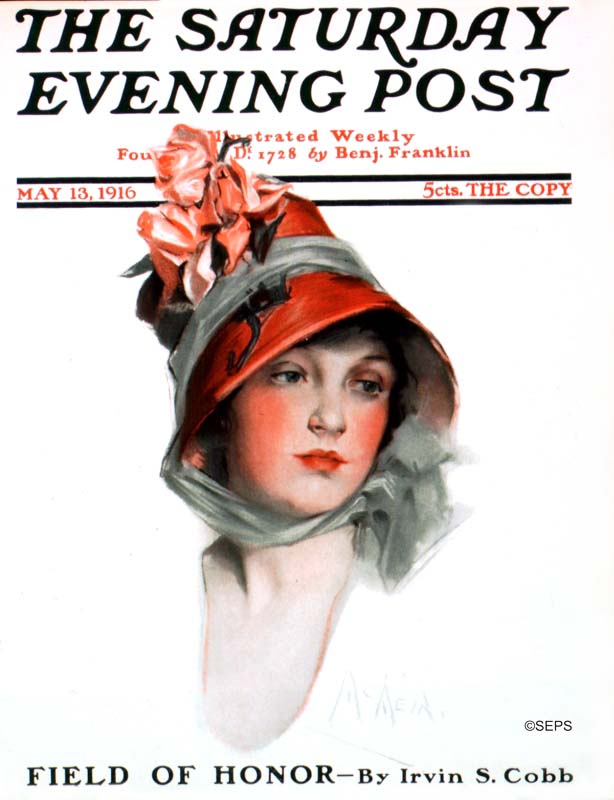
May 13, 1916
Neysa was considered one of the most beautiful women in New York and the subject of plenty of attention as a result. Although she was married in 1923 to successful engineer, Jack Baragwanath, whom she met at a party at the home of Irene Castle, she had numerous affairs with prominent men, and earned a reputation for promiscuous behavior. Harpo Marx quipped that “the biggest love affair in New York City was between me—along with two dozen other guys—and Neysa McMein.”[2]
Her public persona aside, Neysa was a highly successful commercial artist, known for drawings of chic young women that graced the covers of, and illustrated stories in, magazines such Collier’s, McClure’s, Liberty Magazine, Women’s Home Companion, Photoplay, Liberty, and most notably the Saturday Evening Post, for which she created almost sixty covers between 1916 and 1939, and McCall’s, for which she painted all the covers from 1923 and 1937. (Unlikely as it seems, she also served as the McCall’s film reviewer in 1932 and 1933.) The “McMein Girl” was as distinctive as the Gibson Girl had been several decades earlier. She also illustrated ads for products like Palmolive soap[3], Lucky Strike cigarettes, Cadillac, Colgate and Coke. Probably her most influential drawing was the first image of the fictional Betty Crocker, which General Mills commissioned her to create in 1921 and which she updated several times over the years. ( Ironic, given that the Betty Crocker brand was based on middle-class domestic values —as far away from McMein’s personal style as it was possible to be.)
McCall’s canceled their contract with Neysa in 1938. New four-color printing technology allowed magazines to use color photographs for their cover art at a much lower cost than expensive illustrations. As it became harder to get illustration jobs, McMein pivoted to painting portraits, a difficult transition which she made largely with the help of her famous friends including Dorothy Parker, Charlie Chaplin, Ferdinand von Zepplein, who she met during the war, and Janet Flanner.
Neysa died in 1949 from an embolism that occurred during surgery for cancer.
[1] The man appears to be tracking me down. If I stumble across him one more time I may have to give him a blog post of his very own.
[2] It’s only fair to point out that her husband also had a number of extramarital affairs, but the double standard being what it was his affairs don’t seem to have generated the same public commentary.
[3] I just realized that the name tells you what the original bar soap was made from: palm and olive oils! Rabbit hole!