




Lord Macartney’s Embassy to China
In my last blog post, I mentioned Lord Macartney’s embassy to China in 1793. It was an aside to a post that was itself not much more than an aside, but, as so often happens around here, one story led me to another.
A beautiful copy of the journal Macartney kept about his time in China has been sitting unread on my bookshelves for a long, long time. (Roughly twenty years. Yikes!) I pulled it off the shelf to see if I could find any details about John Crewe’s role in the expedition.[1] You will not be surprised to hear that I was immediately sucked in. The journal now has a place on the ever-growing stack of partially read books next to my reading chair.[2] It will take me a while to get through it. But that doesn’t mean that you should have to wait to hear the story of the embassy and its consequences.
In the eighteenth century, China was a hot market from the European perspective, the source of luxury items such as silk, tea, and porcelain.[3] The Chinese were not interested in European merchandise or European ideas. In 1760, the Chinese emperor declared that all foreign trade would be limited to the port of Canton (now Guangzhou). Even within Canton, European merchants were only allowed to trade in Canton for five months of the year, and were limited in where they could live, what they could trade and who they could trade with.
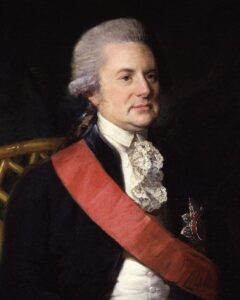
In 1793, the British government sent Lord George McCartney (1737-1820) on diplomatic mission to China with the goal of establishing a British ambassador at the Court of Beijing, improved trading conditions in Canton, and access to additional trading ports.. Macartney seemed like the perfect man for the job. He had previous diplomatic experience, having served as a special envoy to the Empress Catherine of Russia, and as the governor of British possessions first in Grenada and then in Madras. When he was home in England, he was an active member of The Club, the group of intellectual and scientific men who gathered around Samuel Johnson[4]—making him well suited to the intellectual complexities of the assignment. James Boswell summed up The Club’s opinion of Macartney’s assignment when he described it as a “magnificent, dangerous embassy.”
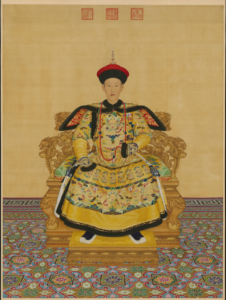
The embassy was doomed to failure. Britain and China came to the table with very different, and mutually exclusive, ideas about what the meeting entailed. Macartney believed he was there to negotiate with the emperor as the representative of an equal power. He carried British-made products intended to impress the Chinese: clocks, watches, carriages and pottery.[5] The Qianlong emperor (r. 1736-1796) and his court saw Macartney’s goods as tribute presents from a lesser power—and not very impressive ones at that. The difference in their viewpoints were summed up in the courtly ritual known as the kowtow, or prostration. Macartney was expected to prostrate himself before the emperor, and touch his head to the ground multiple times. Instead he went down on one knee and bowed his head, as he would bowed to the British king.
Not surprisingly, the Chinese refused all of Britain’s requests. The Chinese Emperor sent a condescending note to King George III explaining his refusal: “I set no value on objects strange or ingenious, and I have no use for your country’s manufacture.”
The Macartney embassy was the first of several diplomatic failures that led to the Opium Wars
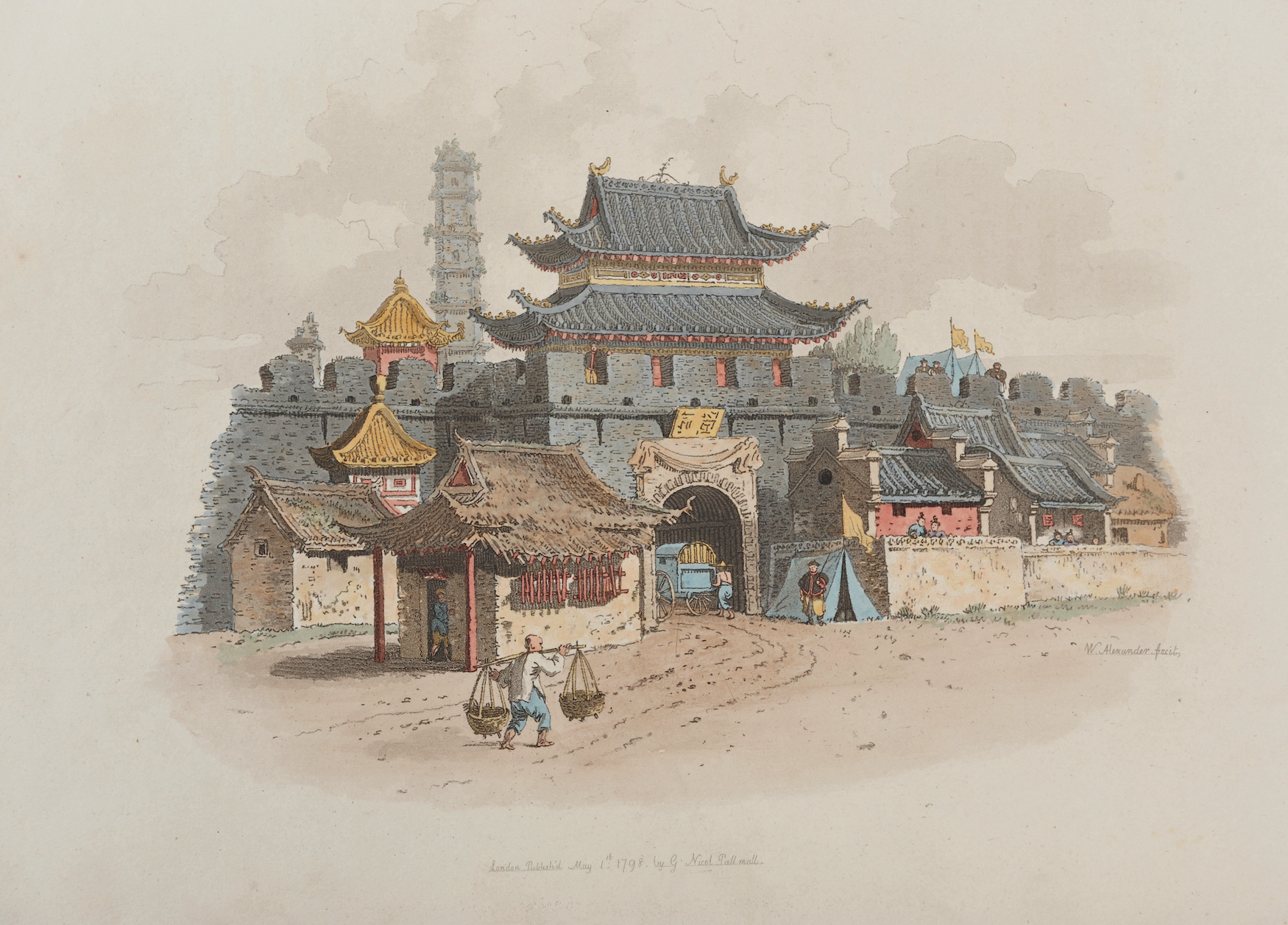
[1] No luck, other than confirming that Lt. John Crewe was indeed a member of the small military escort that accompanied Macartney’s ambassadorial “suite”: a group that included a painter, a watchmaker, a gardener/botanist, a natural philosopher (scientist) a mechanic/mathematical instrument maker (also a scientist of sorts), and a draftsman, one William Alexander, who recorded their experiences in over 1000 watercolor sketches. These were published in two books in 1805 , The Costume of China and Dress and Manners of the Chinese. A number of his sketches illustrate my copy of the journal, and they are lovely indeed.
But I digress
[2] Some of which have been in that pile for a while now. I am easily distracted.
[3] They also imported zinc, which was not technically a luxury product. It was, however, a was a critical element in making brass, and hence necessary for a whole range of scientific instruments and consumer goods that were being developed in Europe. None of which interested the Chinese.
[4] A group I have long wanted to know more about. Also the Lunar Society of Birmingham, which was more heavily scientific and industry-oriented than The Club
[5] Bringing pottery, even Wedgwood’s finest, to the home of fine porcelain is an example of how little the British understood about the people they were negotiating with.
Master Crewe as Henry VIII
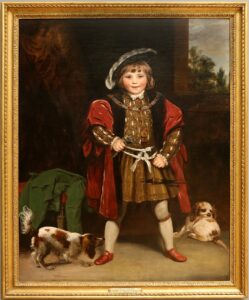
A recent rabbit hole in the peculiar world of “Cute Studies” led me to this unlikely and delightful eighteenth century painting by Joshua Reynolds (1723-1792),[1] which was inspired by Hans Holbein’s sixteenth century portrait of Henry VIII.
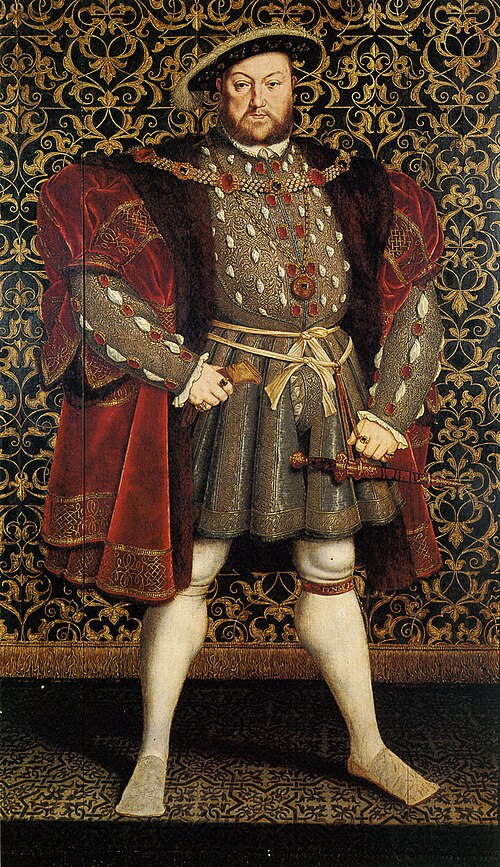
I was temped to share the two images with no commentary, but one rabbit hole led to another.
Reynolds painted Master John Crewe, three-year-old son of a British politician named John, 1st Baron Crewe , in the costume his parents had ordered made for him to wear to a children’s costume party.[2] Copies of Holbein’s portrait were widely available at the time. The tailor faithfully reproduced the details in Holbein’s painting, right down to the Order of the Garter on the king’s leg. Master Crewe faithfully reproduced the king’s stance.
The work was displayed in the Royal Academy’s annual exhibition of 1776[3], where it was an enormous success. Writer and connoisseur Horace Walpole, who was eighteenth century England’s equivalent of an influencer, praised the way Reynolds had taken “the swaggering and colossal haughtiness” of Holbein’s original and created the “boyish jollity of Master Crewe.”
Master Crewe grew up to become a soldier and took part in Lord Macartney’s embassy to China[4] in 1793. He succeeded his father as Baron Crew, though he was estranged from his family for reasons that my rabbit-holing did not reveal.
[1] For those of you who are unfamiliar with art history, Joshua Reynolds was one of the most important portrait painters of the eighteenth century.
[2] And I thought my neighbors created some elaborate Halloween costumes for their children!
[3] Not quite as big a deal as the annual Paris Salon, but still a big deal in the world of British art.
[4] A story for another time
From the Archives: The Swans of Harlem

As I mentioned in a recent post, I have been fascinated by ballet and its history for most of my life. So when I began to see notices for a book about the forgotten Black ballerinas who danced for the Dance Theatre of Harlem I was eager to get my hands on it. It lived up to my hopes.
Karen Valby’s The Swans of Harlem: Five Black Ballerinas, Fifty Years of Sisterhood and the Reclamation of a Groundbreaking History is more than simple dance history. As its subtitle openly declares, it about how Black women’s stories are doubly erased from history and about the efforts of a group of women “to write themselves back into history.”
The Swans of Harlem begins in 2015, when Misty Copeland became the first Black woman to be promoted to principal dancer at American Ballet Theater. Stories about her undoubted accomplishment ignored those of Black ballerinas before her. Five of those women formed the 152nd Street Black Ballet Legacy Council, named after the home of the Dance Theatre of Harlem (DTH) where they danced fifty years before Copeland. Their goal was to bring their story back to light; they succeeded with the help of Karen Valby. The extent to which the book is a collaboration between dancers and author is demonstrated by the fact that there are two acknowledgement pages, one for Valby and one for the Swans.
It would have been easy to tell the history of DTH as the creation of one heroic (male) figure, its founder Arthur Mitchell, who was determined to make art in general and ballet in particular accessible to black children—an impulse born from the assassination of Dr. Martin Luther King, Jr. in 1968. And, indeed, Mitchell strides across the pages of the book just as he strode through the lives of the dancers who worked for him—brilliant, beautiful, imperious, obsessed, generous, difficult, and angry. But he is the background against which Valby shares the stories of five important dancers, the paths they took to DTH, their experiences as dancers, their lives after DTH, and the legacies they have created. Their names: Lydia Abarca, Gayle McKinney-Griffith, Sheila Rohan, Marcia Sells, and Karlya Shelton.
The Swans of Harlem is alternatively instructive, heartbreaking, and inspiring. It demonstrates how easily groups of women and people of color are removed from history in favor of stories of individual exceptionalism. Not just for ballet fans. Honest.