




Lady Duff Gordon, aka Lucile
I honestly thought I had written my last post on changes in ladies’ lingerie. Then Lucy, Lady Duff-Gordon (1863-1935) floated across my path in one of the romantic and subtly sexy gowns with which she wowed the fashionable world at the turn of the twentieth century. I was already familiar with Lucile’s trademark tea gowns and evening dresses. It never occurred to me that her (relatively) insubstantial dresses would need something different in terms of underwear. But of course they did.

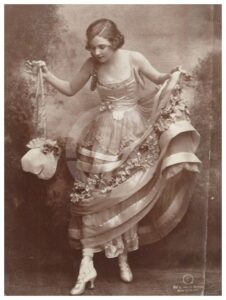
Lady Duff Gordon, ca. 1919
Lucile, then Lucy Wallace (née Sutherland), entered the “rag trade”in 1890 because she was desperate for money when her alcoholic husband, James Stewart Wallace, abandoned Lucy and their daughter. Lucy moved in with her mother and she began supporting herself as dressmaker. When one of her dresses was a hit at a weekend house party, her career took off. In 1894, after divorcing James Wallace, that nice little dressmaker Lucy Wallace turned herself into the mononymous Lucile, owner of the exclusive Maison Lucile, which catered to a wealthy clientele that included aristocracy, socialites and stars of the film and stage, such as Lily Langtry, Ellen Terry, Sarah Bernhardt, Mary Pickford, and Irene Castle. A few years later, Lucile married, Scottish baronet Sir Cosmo Duff-Gordon. Already a celebrity as a couturier, her new title added additional cachet to her career.
Lucile was best known for her tea gowns, evening dresses, and luxurious lingerie. She dubbed her evening gowns “Gowns of Emotion”, and gave them evocative, if not very descriptive, names like “Give Me Your Heart” and “The Sighing Sounds of Lips Unsatisfied.” The gowns were made with floating layers of diaphanous fabrics in pale colors, soft drapery, and dramatic asymmetrical effects. They had low necks, and slit skirts, daring and scandalous at the time. The lingerie that went under her dresses was sheer, trimmed with tiny hand-made silk flower, and provocative—no boned corsets under a Lucile gown!

Lucile made more innovations in the world of fashion than just her dresses. She was the first couturier to train lovely young women as professional models. She originated the “mannequin parade” as a technique for displaying her gowns and luring women into placing orders. Invitation-only, the parades were important social events. * For most of the year, the parades were held at Maison Lucile, but in the summer Lucile held the fashion shows in her garden, where models walked pedigreed dogs with jeweled collars and leashes.
Over time, Lucile transformed Maison Lucile into the first successful international couture business, Lucile Ltd., with houses in London, New York, Chicago and Paris. Beginning in 1910, she wrote weekly columns for the Hearst newspapers and monthly columns for Harper’s Bazaar and Good Housekeeping. In addition to creating gowns for famous actresses, she designed costumes for theatrical productions, including the operetta The Merry Widow, several productions of the Ziegfeld Follies, and more than eighty movies. For a brief time she also had a successful mail-order business with Sears, Roebuck, offering a lower-priced, mass-produced line with her name.
During World War I, Lucile closed her couture houses in London and Paris and based herself in New York. Her business did not revive after the war. Fashions had changed and Lucile’s trademark romantic style seemed old-fashioned compared to the bold new fashions of the flapper era. Lucile Ltd. closed in 1922, though Lucille herself continued to design for private clients in London.
A few odd tidbits:
Lucile was the older sister of novelist, screenwriter and film producer Elinor Glyn, who popularized the terms “It” and “It Girl.”
Together with her husband, her maid, and nine other people, Lucile survived the sinking of the Titanic in boat designed for forty. The Duff-Gordons were cleared of charges of having bribed crew members to not allow others on the boat, but Sir Cosmo’s reputation was permanently smeared. Lucille seems to have gotten off more lightly in the public eye: on the day that she testified at the public hearing about the disaster , the room was packed with society women wearing their Lucile creations in support of their favorite designer.
*Women came to look at their dresses. Unattached young men—ostensibly escorting their mothers, aunts, grandmothers, and old family friends—came to look at the models.
A Light in the Northern Sea: A Q & A with Tim Brady
I am fascinated by stories of the resistance in World War II. (My guess is that comes to no surprise to those of you who have been hanging out here in the Margins for a while.) And I have slowly come to realize that the resistance took different forms in different places. All of which explains why I said yes with no hesitation when I was offered an advance copy of Tim Brady’s A Light in the Northern Sea: Denmark’s Incredible Rescue of Their Jewish Citizens During WWII. (This despite the fact that I have been turning down most of the books publicists offer me because life is short and the To-Be-Read piles are tall.)
I’m glad I did: the story is amazing.
I’m also glad Tim Brady agreed to answer some questions. Take it away, Tim

What path led you to the story of the Danish resistance movement in World War II? And why do you think it is important to tell this story today?
After finishing Three Ordinary Girls, which told a story about the Dutch Resistance during WW II, I was looking for another resistance story to tell. I knew vaguely of what had happened in Denmark—the story of the rescue of the Danish Jews—but only at a surface level. When I decided to dive into research, I quickly realized what a powerful story it was. These early efforts were occurring just as Russia was invading Ukraine, which seemed like a very timely example for what happens when a powerful, authoritarian nation occupies a lesser power with democratic traditions.
The resistance in France and the Netherlands has been the subject of many books in English over the last few years, including your own Three Ordinary Girls. How did the Danish resistance differ from these better know experiences?
The Danish resistance was slow to begin. The German occupation began in April 1940, but as a consequence of the agreement signed by the Danish government at the time, the German takeover was less oppressive than occurred in other Western European nations, and a majority of Danes were not moved to resistance by the presence of Germany in their daily lives. It would take three years before an effective resistance evolved in Denmark.
Why do you think people are drawn to these stories today?
I think readers have grown more interested in the nooks and crannies of the history of World War II. While the great sweep of the war remains a powerful focus of its history, many are looking into lesser-known aspects of the conflict to get a better sense of what happened to a wide variety of its participants.
You introduce your readers to individual members of the resistance, who come to the work by different paths and carry out different missions. Do you have a favorite among them?
Jurgen Kieler and the whole of his family are great heroes of mine, and of much of the Danish nation. The Kieler’s alignment with and participation in the resistance grew out of a deep moral conviction that the German presence in Denmark could not be tolerated. They struggled within the family, particularly Jurgen and his older sister, Elsebet, in how best to respond to the oppressive nature of the occupation, before ultimately siding with a violent resistance. They paid deeply for their decision; four siblings, and their father, all spent time in concentration camps before the war ended.
Was there a story you were sad to leave out?
There was no one story that I was sad to leave out, but collectively I wished I had more opportunity to delve deeper into the story as a whole: more history of Denmark, extending back before the 20th century; more depth about the nature of the Danish character—what were the roots of their collective decision to come to the aid of the nation’s Jews? More understanding of the Danish monarchy and how it worked with the country’s democratic institutions. More details about particular aspects of the resistance like the rescue of the Jews through Bispebjerg and other hospitals in Copenhagen. More about the White Bus rescue— how it was organized and how it worked.
What was the most surprising thing you learned working on this book?
I would say the most surprising thing was the fact that I found the story was essentially as true as its reputation. I’m by nature, and probably by profession, skeptical when it comes to history stories that promise heroics and good deeds across a wide swath of a nation’s populace. While there are many footnotes and asterisks to go along with this story, I think it lives up to its reputation; the Danish people deserve a tip of the cap for what they did to rescue 95% of the country’s Jewish population from capture by Nazi Germany.

Tim Brady is an award-winning author whose books—Twelve Desperate Miles, A Death in San Pietro, His Father’s Son, and Three Ordinary Girls—have received wide critical acclaim. He has contributed to PBS history documentaries and has written frequently for the History Channel Magazine. He lives in St. Paul, Minnesota, and is a graduate of the Iowa Writers’ Workshop.
From the Archives–Word with a Past: Gerrymander
This post originally ran in 2018. Unfortunately, some stories never go out of date.

If Elbridge Gerry (1744-1814) had played his cards right, he could have been a minor but respected figure in American history. He signed the Declaration of Independence, helped draft the Bill of Rights, served two terms in Congress, and was the fifth Vice President of the United States. His contemporaries thought him intelligent, gentlemanly, quirky, and a bit of a hot-head.
Instead his name is permanently linked to the practice of re-drawing political districts for partisan advantage. In 1812, Gerry was a member of the Democratic-Republican party and the governor of Massachusetts. Although he had called for an end to partisan bickering in his inaugural address in 1810, he came to believe that the Federalist party was too close to the British and wanted to restore the monarchy. Gerry went on a partisan power binge. He removed Federalists from state government jobs and replaced them with Democratic-Republicans. He had his attorney-general prosecute Federalist newspapers editors for libel. He even seized control of the Federalist-dominated Harvard College board–presumably recognizing the college as the source of future American political leaders. (Though he may have just gotten carried away. Power is an addictive and intoxicating beverage.)
To put the cherry on the partisan sundae, his fellow Democratic-Republicans, who controlled the legislature, redrew the state’s Senate districts in a way that would benefit their party. Previously, Massachusetts’ senatorial districts followed country boundaries. The new senate map twisted and turned in irrational patterns to insure a Democratic-Republican victory. Gerry may not have been responsible for the map’s design, but he signed it into law in February, 1812.
The Federalist controlled Boston Gazette ran an illustration of the district map in the form of a salamander-like monster and ran it with the title “The Gerry-Mander,” claiming it had been born of “many fiery ebullitions of party spirit, many explosions of democratic wrath and fulminations of gubernatorial vengeance within the year past.”
There are better ways to have your name live on in the language: public toilets for example.
Gerrymander: To manipulate the boundaries of an electoral constituency so as to favor one party or class.