




In which I announce that The Dragon From Chicago is out in paperback, and then wander off topic

For historical reasons related to the business of publishing that I do not entirely understand, new (traditionally published) books almost always release on Tuesdays—that’s why my Q & A’s with other authors about their new books almost always run on a Tuesday. Today it’s my turn. The paperback edition of The Dragon from Chicago is now out in the world, and I couldn’t be more happy.
I wish I could claim that I took the way news books are released into account when I decided that my blog posts would appear on Tuesdays and Fridays.[1] But I wasn’t looking that far ahead. I’m not even sure I knew that books release on Tuesdays when I started History in the Margins back in May, 2011. I certainly didn’t understand the relationship between writing a blog and writing a book.
I calculate that over the last fourteen years and a bit I’ve written roughly 1350 posts. (Yikes!) At an average of 500 words a post, those posts add up to the jaw-dropping equivalent of eight medium-sized books.
[pauses to check math.] [checks math a second time] [Yikes!]
In theory, I could have used that time to write another book or two—or take tap-dancing classes, or learn another language, or read my way through the hundreds of books on my To-Be-Read shelves[2] or take a trip with My Own True Love. But the fact of the matter is that the blog feeds the books in important ways. Blog posts keep my writing muscles strong and limber. They give me a place to explore ideas. To grapple with bits of history, large[3] and small, that I need to understand to write the current book project.[4] To share the cool stories I stumble across that don’t belong in the book at all, but add texture to my understanding of a period.
Writing History in the Margins is also a way to stay in touch with all of you. Thanks for being along for the ride.
[1] Unless my schedule blows up on me. As it did last week. I try to have one or two posts in the pipeline and scheduled to go live. And in fact, I do have two posts in the pipeline. Both of which will run on Tuesdays in September to coincide with the publication of other writer’s books. Unfortunately, that did not help me when Friday’s post squirmed in my hands like a cat that doesn’t want to be held. But I digress.
[2] And piled on my study floor
[3] I wrote a five-part series back in the early months of working on The Dragon from Chicago in which I tried to wrap my head around the Weimar Republic. There’s no easy way to give you a link to the series, but you can find them in June and July, 2020.
[4] Just for the record, I do not have a current book project yet.
* * * *
It’s taken me fourteen plus years, but I finally figured out how to produce real footnotes on the blog. Next challenge: Can I make it work on the newsletter?
Road Trip Through History: Historic Fort Snelling
For anyone who missed the memo, My Own True Love and I spent last week in the Twin Cities, finishing up the last bit of our multi-year exploration of the Great River Road. It was wonderful. We enjoyed lots of history-nerdery, learned some amazing stories,(1) and danced to a local Cajun band(2)—a perfect way to link the two ends of the Great River Road on our final visit.

Painting of Fort Snelling by Col. Seth Eastman, ca. 1830
We spent our first day in Minnesota at Historic Fort Snelling, the place where the Twin Cities began. Fort Snelling was built between 1818 and 1825, as a frontier fort with the purpose of protecting American interests in the fur trade. It was in active use through 1946, with a brief pause between 1858, when Minnesota became a state and it was presumed that a frontier fort was no longer needed, and the U.S. Dakota War of 1862, an important event in Minnesota history which neither I nor My Own True Love had heard of. (3) Over the years, new buildings were erected and old buildings torn down. At the time the fort was decommissioned, only four of its original buildings were standing. Today, the fort has been reconstructed to its original 1825 appearance, with the help of extensive archeological research. (Both the reconstruction and the excavations continue.) The buildings house exhibits that include life in the fort, medical knowledge at the time, and archeological exhibits. Staff members are available to answer questions. (I was particularly interested by the representation of how soldiers’ lives and equipment varied from period to period.) Living history exhibitions occur. In short, it resembled many other historic American forts that we have visited, and enjoyed, over the years. (4)
But the fort itself is only part of the story told at the site, an experience summed up in the title of the excellent exhibit in the site’s new visitor center: “Many Voices, Many Stories, One Place.” The on-site interpreters and museum designers take that title seriously.
The main focus on other voices is the Native American presence. Both the brief introductory tour of the fort and the interpretive exhibit begin the story not with the decision to build a fort at the confluence of the Mississippi and Minnesota rivers, but with the importance of that location as a sacred place for the Dakota. Exhibits discussed Dakota and Ojibwe culture in the area, the United States’ repeated failure to honor the treaties made with those peoples, and the U.S. Dakota War of 1862.
Historic Fort Snelling also takes care to include the stories of African-Americans and women who were at the fort. Those stories are more than a performative aside. They provided a deeper picture of life at the fort. For example, even though slavery was illegal in Minnesota, Army officers brought enslaved people with them as servants. Two of those servants made history: Dred Scott and his wife, Harriet Robinson Scott, used their years in the free territory of Minnesota as the legal basis when they unsuccessfully sued their owner for their freedom. The landmark case went all the way to the Supreme Court, which effectively declared the Missouri Compromise unconstitutional—right up there in the list of really bad Supreme Court decisions. The course of the case increased tensions between north and south and brought the United States one step closer to civil war. (5) Two months after the decision, a subsequent owner of the pair emancipated them.
In short, an excellent start to our visit to the Twin Cities.
More stories coming in future posts. Don’t touch that dial!
(1)Don’t worry. I plan to share
(2) What? You don’t associate Cajun music with Minnesota? In fact, local musicians have been playing Cajun music in the Twin Cities and dancers have been waltzing and two-stepping to it since the 1970s.
(3) It is humbling how often I discover big gaps in my knowledge about our own history, let alone that of other places. I hope to fill a few gaps when I read my way through Native American heritage month in November. I own a lot of unread books on the subject . I have a list of others I want to read. I hope to make a small dent in both the To-Be-Read pile and my own ignorance.
(4) For example: Old Fort Madison, Fort Robinson, Fort Sumter, …
(5) It is telling that we know this only as the Dred Scott case. I’m not sure I even knew that he had a wife, let alone that she was part of the legal action. I certainly didn’t know her name. Moreover, the Scotts were not the only enslaved people who used their time at Fort Snelling to claim their freedom. Two enslaved women, known only as Rachel and Courtney, successfully sued for their freedom based on their time in Minnesota. I don’t think they showed up in my textbooks at all. Perhaps because they won.
Back for one last section of the Great River–and a post from the archives
In November, 2015, My Own True Love and I began what turned into a multi-year adventure, driving the Great River Road along the Mississippi from where the river begins in Minnesota to where it ends in Louisiana. * We envisioned doing the entire trip in three weeks—a totally unrealistic assessment given the fact that between us we are interested in just about everything. On our first trip we lasted the better part of three weeks: We spent two days in Memphis, three days in and around New Orleans, and then drove back again north without a schedule. We got as far Vicksburg, where the weather turned ugly and we gave up. On our next trip, we drove north to Lake Itasca in Minnesota and started to work our way back south. At the end of that trip, we had many miles left to travel and many things still to see. Last summer, we “finished” the project with a series of day trips out of Memphis.**
In fact, we had one piece of the road left: As we reached southern Minnesota, in 2018, we decided to skip over the Twin Cities and go back another time. There was so much to see in Minneapolis and Saint Paul that we knew we wouldn’t make any progress down the river if we stopped.
We finally made it back this year. By the time you read this, we’ll be back home.
Driving north, we decided to travel by U.S. highways rather than the interstate. As we went, we found ourselves reminiscing about places we had stopped on previous trips: the Froelich tractor museum, the lock master’s house in Guttenberg, the lumber museum in Clinton. The Great River Road became a trip down memory lane.
My guess is the entire adventure took us close to fifteen weeks, broken up in chunks of ten days and two weeks.
*Actually, we had intended to do the trip in 2014, but had to revise our plans due to an ailing elderly cat and an elderly house in the middle of extensive renovations. Instead of the big trip, we took a bite out of the middle on a four-day weekend from Nauvoo to Quincy in Illinois. It was a very good start.
**I didn’t write a single blog post about the experience. I was deep in the run-up to releasing The Dragon from Chicago Instead of chronicling our adventure, I was writing posts about women journalists. (Sorry. Not sorry.) However, I did write a newsletter looking at the trips as a whole. You can read it here.
_________________________
One of our most memorable stops in the stretch through Iowa and Minnesota was the Vesterheim Norwegian-American Museum in Decorah, Iowa. I was pleased to re-visit the post I wrote then. I hope you enjoy it, too.
*****
On the first day of our Great River Road adventure (1), My Own True Love and I veered about 45 miles off the Great River Road so I could sneak in a bit of a research for the book proposal I’m working on at the Vesterheim Norwegian American Museum and Heritage Center in Decorah, Iowa.(2) Sandy was a willing co-conspirator because 1)it would be a shame to have to come back if I sell the book and 2)it looked like a pretty fabulous museum.
And let me tell you, it IS a pretty fabulous museum.
The museum explores the story of Norwegian immigration to the United States, putting it in the context of nineteenth century Norwegian culture and the broader experience of nineteenth century immigration to America. It also celebrates Norwegian folk art, then and now. In fact, if you’re in Decorah for a longer period, you can sign up for classes in rosemaling, traditional embroidery techniques (3), folk music, flatbread baking (4), etc, etc, etc.
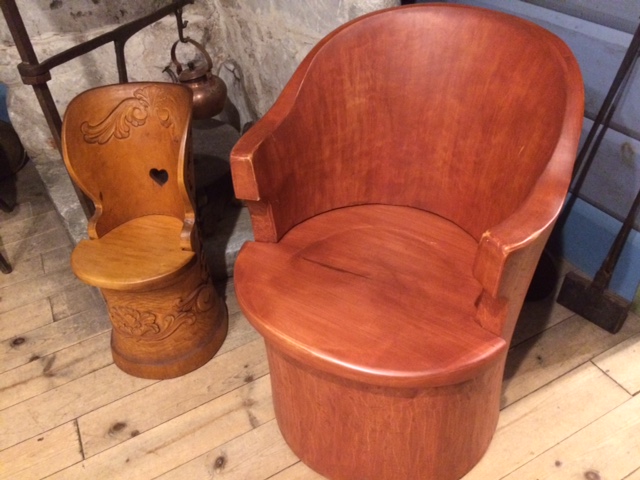
Kubbestol–Traditional Norwegian log chairs. More comfortable than they look!
The folk art exhibits are breathtakingly beautiful. Well-trained docents give tours of a campus of well-maintained historic buildings, ranging in size and complexity from a small log storage cabin (5) to a nineteenth century Lutheran church. And the exhibit on Norwegian immigration not only told me a portion of the story of immigrants to the United States that I had not heard before, but it made elements of the broader story of nineteenth century immigration to this country more vivid for me.
Here are some of the things that caught my imagination:
- The first group of Norwegians emigrants sailed from Norway on July 4(!), 1825. They were known as the “Sloopers” because their ship was a sloop that was tiny for ocean-going even by the standards of their time. Like so many early emigrants they were religious dissenters. Some of them were Quakers; (6) others followed the pietist teachings of Hans Nielsen Hauge. The official state church of Norway persecuted both groups.
- Norway was second only to Ireland in the percentage of its population it lost to emigration in the century between 1825 and 1930. Norwegians left their homes for many of the same reasons as the Irish: growing population, limited arable land (7) and the potato famine that swept Europe in 1845.
- In the mid-nineteenth century, emigrants provided their own food for the voyage and cooked it on the ship on open fires in long bins filled with sand.
- A “stove wood” house, built of pieces of wood cut to the length that would fit in a woodturning stove and held together with plaster. The walls were about one foot thick and well-insulated. Unlike log cabins, a man could build a stove wood house by himself.
I came away stunned by new awareness of just how hard it was for emigrants to leave their homes to travel to a new country. I was also stunned by the love of decoration pervasive in traditional Norwegian culture.
If you’re anywhere near Decorah, take the time for a visit.
(1)Part 3, or maybe Part 4, depending on whether you count our consolation prize four-day weekend in 2014. And you really should, because it was weird and wonderful.
(2) Yes, that’s a hint. But it won’t help you much.
(3) Personally, I’m tempted by the hardanger classes. (Autocorrect changed this to harbinger classes. Perhaps a good choice for Halloween weekend. Beware, beware….)
(4) Or Norwegian Christmas cookies
(5)The answer to the question of where people stored things in a one-room cabin.
(6) Norwegian Quakers, you ask? I did, too. According to our docent, Denmark/Norway fought on the French side in the Napoleonic Wars. (Brief pause while I check this.) Some Norwegian prisoners of war were taken to England, where Quakers and Methodists visited them in prison and managed to convert a number of them from the state-sponsored Lutheran church.
(7) In the case of Norway, the limits were imposed by the country’s geography. In the case of Ireland, they were artificially created by British policies.