




Pure Invention
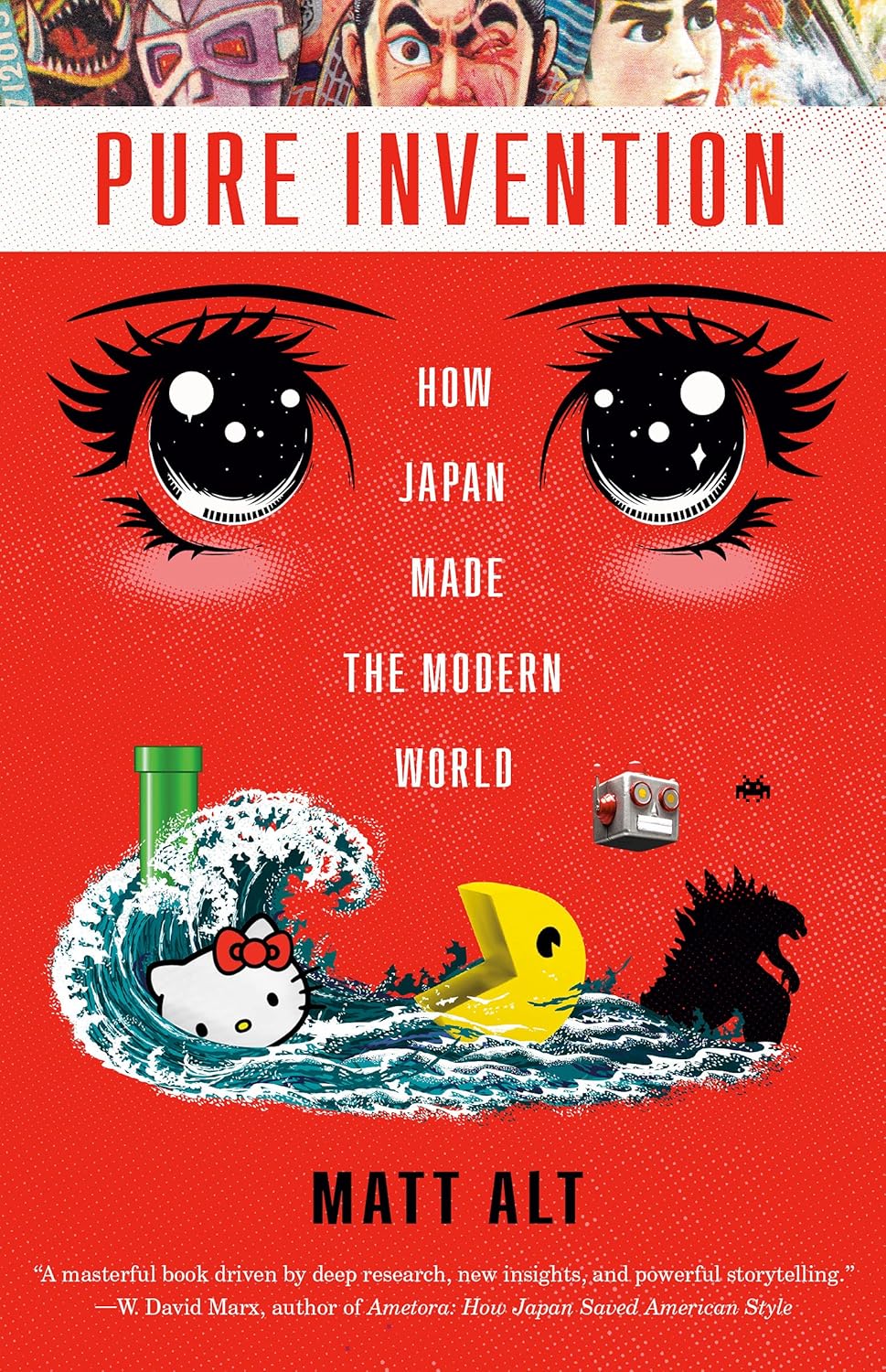
Those of you who also read my newsletter may remember that for the last few months I have been exploring the question of Japanese pop culture and the United States. It has been fascinating and frustrating. I know a lot more than I did when I began my quest in early February, but I still don’t feel like I have wrapped my brain around the particular question I’m trying to answer, or even the subject in general.
For anyone who might be interested in the subject, I recommend Pure Invention: How Japan’s Pop Culture Conquered the World[1] by Matt Alt, which is by far the best of the general books I’ve read, though not the most useful for my purposes[2]. As his title suggests, Alt argues that in the decades since World War II Japan’s “pop-cultural complex” has transformed “how we interact with the world, how we communicate with each other, how we spend time along with ourselves, how we shape our very identities.” I’m not sure I agree, but I found the discussion fascinating.
Alt sets the development of Japan’s pop culture creations solidly in the economic, cultural, and historical context in which they were created. He divides the book into two sections. The first deals with period from 1945 through the early 1980s, when Japan rebuilt itself from the literal ashes of World War II into an economic and technological powerhouse. The second deals with the so-called Lost Decades of the 1990s and first decade of the twenty-first century that resulted from Japan’s economic crash in 1990. He tells the stories of innovators and designers[3] and the corporations they founded. He sets the rise of manga and anime in the context of Japan’s increasing disaffected youth culture, connects the development of the karaoke machine in a tradition of bar sing-a-longs, and demonstrates the unexpected (at least to me) influence of Japanese schoolgirls in pioneering the use of digital communications. At each step, he discusses the way in which individual creations made their way to the United States, and why they succeeded.
I will admit that I found the first section more interesting than the second, though that says more about me than Alt’s work. If I owned the book, I would have filled the margins with exclamation marks, the occasional interrobang,[4] and many questions and comments.[5] Instead I have stuffed my library copy with sticky tabs,[6] as is my wont.[7]
If you are interested in Japanese popular culture, or modern Japanese history, this one’s for you.
[1] The title refers to a quotation from Oscar Wilde: “In fact the whole of Japan is pure invention. There is no such country, there are no such people…The Japanese people are, as I have said, simply a mode of style, an exquisite fancy of art.” The Decay of Lying. 1891.
[2] It’s amazing how often this turns out to be true when I’m in the initial stages of grappling with a question. It’s a puzzlement.
[3] None of whom I had heard of.
[4] A piece of punctuation that combines a question mark and an exclamation point into a single item:
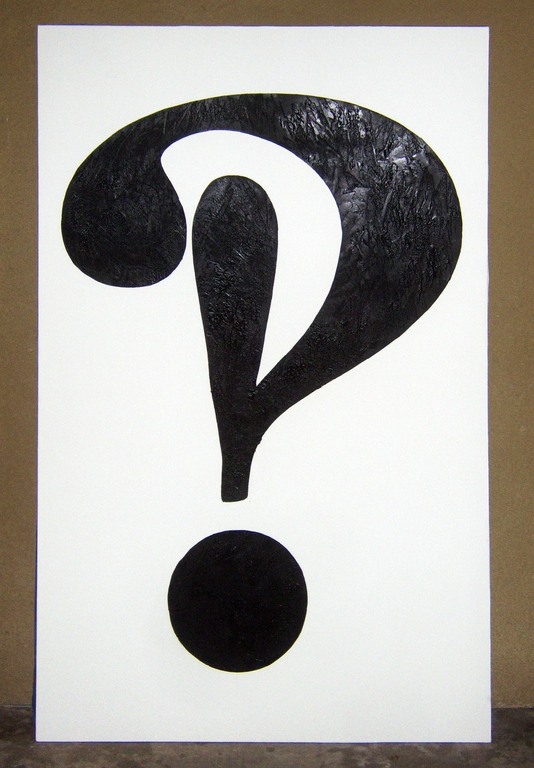
It was invented in 1962 by American advertising executive Martin K. Speckter, who believed it would make a a cleaner page than ending a sentence with both pieces of punctuation when you want to write something like “Who ate my cheese?!”.
I’m not sure it’s actually a useful change, particularly since many computer fonts don’t support it. On the other hand, it seems to embody the appropriate response to much of the news today.
But I digress. As I so often do.
[5] Yes, I literally write history in the margins.
[6] I am fond of a brand produced by a company called Semikolon—appropriate given the above punctuation diversion.
[7] Pro tip: I also use 4 “ by 6” lined sticky notes to write thoughts in the moment and keep them with the relevant text. This is true even with books I own, because sometimes I have more to say than the margins allow.
This makes me think about the Japanese jr. and sr. high students (all girls) who I taught in 1969-1971. I wonder how different that whole teaching experience would be now. Are cell phones allowed in Japanese classrooms? I couldn’t understand manga then either, and I don’t think anime existed (at least not that I noticed).
My guess is the teaching experience would be very different now, just as it is in the United States.
The first anime series, titled Mighty Atom, came out in 1963.