




Molly Pitcher(s?)
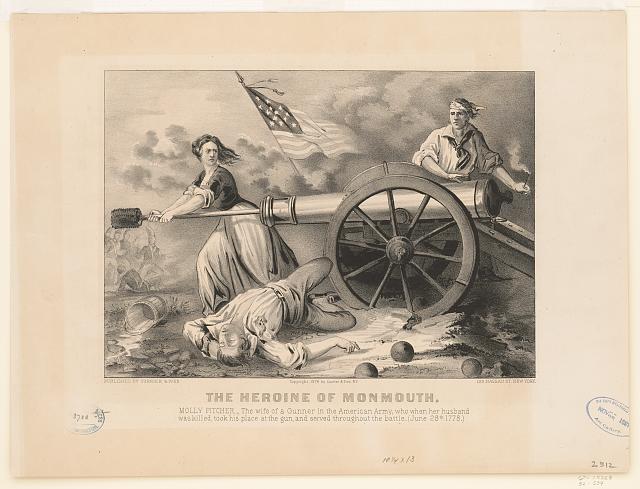
See footnote 1 below
In 1876, caught up in the patriotic excitement of the first centennial of the American Revolution, the people of Carlisle, Pennsylvania, raised a stone inscribed “Molly Pitcher” over the previously unmarked grave of a local resident, Mary Ludwig Hays McCauley (ca. 1754–1832). In the years before her death, Hays claimed to have served at the Battle of Monmouth, on June 28, 1778, carrying water to the artillerymen, including her husband, William Hays. When Hays was wounded and unable to continue, she stepped in as an impromptu member of the artillery team. A hundred years after the fact, she looked like a shoo-in for the legendary figure of Molly Pitcher.[1]
One resident of Carlisle, Jeremiah Zeamer, editor of the local newspaper, felt strongly that McCauley should not be so honored. He wrote to Congressman Marlin E. Olmsted that local townswomen remembered McCauley as “a vulgar, very profane, drunken old woman.”[2]
Despite Zeamer’s objections, there is no reason to think McCauley’s account wasn’t true. A similar story appears in the memoir of Joseph Plumb Martin, published in the 1830s under the name Private Yankee Doodle. Writing about the Battle of Monmouth, Martin mentions
one little incident [that] happened during the heat of the cannonade, which I was eyewitness to. . . . A woman whose husband belonged to the artillery and who was then attached to a piece in the engagement, attended with her husband at the piece the whole time. While in the act of reaching a cartridge and having one of her feet as far before the other as she could step, a cannon shot from the enemy passed directly between her legs without doing any other damage then [sic] carrying away all the lower part of her petticoat. Looking at it with apparent unconcern, she observed that it was lucky it did not pass a little higher, for in that case it might have carried away something else, and continued her occupation.
He does not name this irrepressible artillery woman, and there is no direct evidence linking her with McCauley. (On the other hand, there is no evidence that Martin’s unknown woman wasn’t McCauley, either.) But there is a bawdiness to the story that seems in keeping with Zeamer’s later complaints. Moreover, the fact that the Pennsylvania legislature granted her a pension for her services during the war, which may well have included carrying water to the cannon, lends credence to the story.
But McCauley isn’t the only serious candidate for the title.
Margaret Corbin (1752–1800) is known to have wo-manned an artillery piece on the field at least once.[3] Corbin followed her husband, John, from one military camp to another during the American Revolution. They were both on the field at the Battle of Fort Washington in New York City, on November 16, 1776: John as an artilleryman and Corbin as a water carrier.[4] When enemy gunfire killed her husband, Corbin took his place at the cannon. She didn’t stop until she was wounded by a blast of grapeshot that mangled her shoulder and left breast. After the battle, the British captured Corbin near her cannon; both the British and the Americans treated her as a combatant prisoner of war. Released on parole, she was assigned to the Continental Army’s invalid corps until mustered out of the army in 1783—raising the question of whether she enlisted alongside her husband.[5] After the war, Congress awarded Corbin a wounded soldier’s pension.[6] In 1926, Corbin’s remains were transferred from Highland Falls, New York, to the government cemetery at West Point.
That should have been the end of her story. But confusion about identity is a central part of the Molly Pitcher name and legend. In 2016, workmen disturbed the remains. Examination by a forensic anthropologist revealed the bones to be those of an unknown middle- aged man. Corbin’s bones are nowhere to be found.
In addition to Hays and Corbin, there are accounts of an unnamed woman who fired a cannon at the Battle of Fort Clinton in the Hudson River Valley in October 1777. There may be at least one more Molly Pitcher whose story remains untold.
Excerpted from Women Warriors: An Unexpected History

[1] The first known use of the name is a painting titled Molly Pitcher, the Heroine of Monmouth, by Nathaniel Currier, of Currier and Ives fame, dated 1848, seventy years after the battle.
[2] Not that vulgarity, profanity, and/or drunkenness preclude heroism. Zeamer believed those qualities did, however, preclude being honored with public monuments when so many “Revolutionary heroes who led useful and respected lives” remained obscure.
[3] Known in the camps as “Dirty Kate,” she was no more respectable than McCauley. With the (possible) exception of officers’ wives, the women who followed eighteenth-century armies were rough around the edges, if not all the way to the core.
[4] The nature of eighteenth-century artillery is important to understanding the Molly Pitcher story. In order to be sure no sparks or hot embers remained in the breech, gunners swabbed out muzzle-loading cannons with wet sponges after each round was fired before they loaded the next powder charge—adding fresh powder before extinguishing embers from the previous round was a short path to “kaboom!” A well-organized artillery battery had casks of water nearby for the purpose of wetting the sponges. But not every team was well organized. Armies were taken by surprise. And casks ran dry over the course of hours of battle. Women in the army’s camp often performed the hazardous job of carrying water to the artillery line—in buckets, not pitchers. Firing a cannon was not a one-woman job—it took at least three people. When a gun crew lost a man, it’s a fair assumption that the woman who brought the water knew enough to step into the breach as a rammer or a sponger. (Though she probably didn’t know enough to perform the mathematical calculations required to place a cannonball on target. A difficult skill to pick up on the fly.)
[5] It’s possible. Some women’s names appear on the rosters of local militia.
[6] And a complete set of new clothes! Not a standard benefit for veterans of the time.