




Road Trip Through History: The Mother Jones Monument
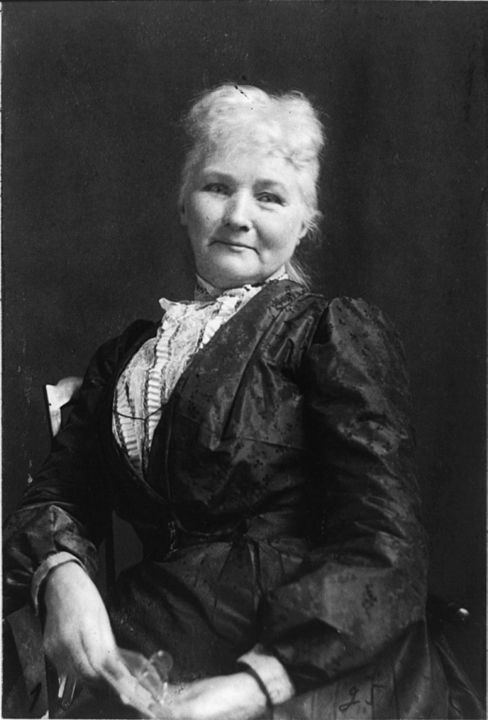
Driving from Chicago to the Missouri Ozarks and back over the last mumble years,(1) I have passed the sign for the Mother Jones monument many, many times. It is a plain, almost amateurish, sign, without the official imprimatur(2) of a brown tourist attraction sign(3) or the flash of billboard advertising a show in Branson. Nothing about it is designed to lure a curious history bugg off the highway. And up to now, we have not been lured.
That changed this year, thanks to an information panel in an Illinois highway rest stop.(4) My Own True Love and I were hooked.
I had been vaguely aware that Mother Jones was a union organizer, but I had no idea how important she was at her time.
Mother Jones was in some ways the Grandma Moses of union organizers: in fact, when she was testifying before a committee in the Senate on labor issues, a senator mocked her as the “grandmother of all agitators.” (She replied that she would someday like to be called the “great-grandmother of all agitators.”) At the point that she began her career as a union organizers, Mary Harris Jones was a poor, widowed, Irish immigrant. She had had survived the potato famine, the loss of her husband an four children in a yellow fever epidemic, and the Chicago fire,which destroyed her successful dressmaking shop.
After each loss, she reinvented herself. In the 1890s, she reinvented herself one more time, as “Mother Jones.” The name was subversive: playing against and with nineteenth century domestic stereotypes of women. Mary Jones cast herself as the mother of oppressed people everywhere. At a time when women were “supposed” to be quiet and stay home,(5) Mother Jones was a street orator with no fixed address, who traveled the United States for twenty-five years, moving from cause to cause. She had no interest in being “ladylike.” As she told a group of women in New York: “Never mind in you are not lady-like, you are woman-like. God Almighty made the woman and the Rockefeller gang of thieves made the ladies.”
Jones rose to prominence as an organizer for the United Mine workers, who paid her a stipend, but she went wherever she felt she was needed. She worked with striking garment workers in Chicago, bottle washers in Milwaukee breweries, Pittsburgh steelworkers, and El Paso streetcar operators, helping them fight against 12-hour days, low wages, dangerous working conditions, and the financial servitude of company housing and the company store.
Her motto was “Pray for the dead, and fight like hell for the living”—the world would be a better place if we all adopted it as our own.
****
When we got to the monument in Mt. Olive, Illinois, we learned there is a second part to the story. Illinois became a battleground for labor rights in 1898, when the Chicago Virden Coal Company challenged the miners’ contract. They brought in a train loaded with strikebreakers and armed guards to back them Miners from across the state joined together to stand their ground against the company. In the violent encounter that became known as the Battle of Virden or the Virden Massacre, thirteen people were killed, including six guards and seven miners. Thirty miners were wounded. Mother Jones considered the battle the birthplace of rank-and-file unionism.
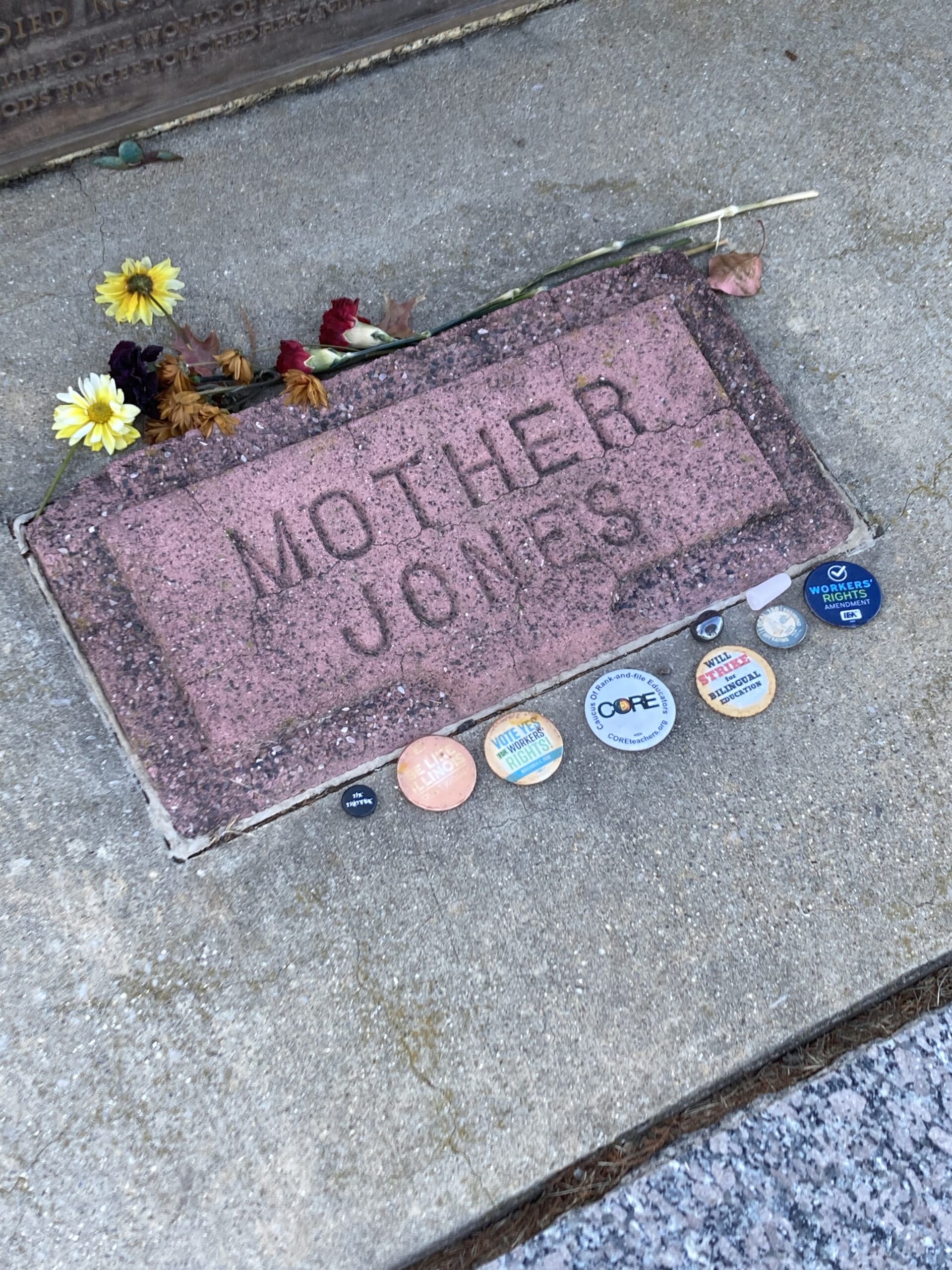
A Mt Olive church refused to allow the miners to be buried in their churchyard, fearing their graves would become a pilgrimage site for the labor movement. (This is what as is known as a self-fulfilling prophecy.) In response, the United Mine Workers built the Union Miners Cemetery in Mt. Olive, which in fact became a pilgrimage site after Mother Jones, at her request, was buried there in 1930. Personally, the union buttons that had been left at the foot of the monument choked me up.)

(1) And by years, I mean decades
(2)Is there such a thing as an unofficial imprimatur?
(3) I went down a small rabbit hole trying to discover who approves such signs. I didn’t get an answer, but I did learn that the signs originated in France.
(4) We’re seeing more and more historical markers at highway rest stops, and I for one would like to say “bravo!” Not only because I love a historical marker, but because it encourages the curious to spend more time at the rest stop. After all, the point of the stop is not just to use the restroom, but to stretch the legs, rest the eyes, and fluff the brain, thereby making the next stretch of driving a little safer.
(5) Or so the popular account of history tells us. If I have learned anything in writing this blog, it is that the ideal of the “angel of the household” applied only to members of the relatively prosperous middle-class and that even within that class many women didn’t fit that mold for many reasons. Just yesterday a friend sent me the story of the team of “gentlewomen who had experienced reverses” who created the restaurants in Marshall Field’s in downtown Chicago. A very different story than that of Mother Jones, but one that also stands outside what we are taught was the nineteenth century norm.
Heading Home for Thanksgiving
As I write this, My Own True Love and I are packing for the drive from Chicago to my hometown in the Missouri Ozarks to spend the holiday with my family. As usual, the list of things I wanted to accomplish before we hit the road is longer than the time available to do them. And as usual, I am editing the list down from things I want to do to things I need to do. One thing I refused to edit off the list was this blog post.
People sometimes ask me why I write this blog, especially when I’m under the gun with a book deadline. (Don’t get me started!) The answer is simple: all of you. You don’t just read my posts. You send me comments and ideas, ask hard questions, point out the typos, and cheer me on. Thank you for being on this journey with me, whether you’ve been reading me from the beginning or you’ve just found me. There’s a lot more history out there to explore and I look forward to sharing it with you.
—————-
And speaking of sending me ideas, I getting ready to send out invitations to my annual Women’s History Month extravaganza of mini-interviews.* If you “do” women’s history in any format, or know someone who does, or just have an idea of someone you would love to see in the series, let me know. (With the caveat that I may not be able to get a big name writer to respond without a connection of some kind.)
*Some of you who know me in real life are probably saying “Are you crazy???!!!” To which I say, “yes, I am crazy” and “yes, I am doing this.”
The Pirate’s Wife

A title like The Pirate’s Wife makes promises to the reader: adventure, danger, betrayal, romance, and especially pirate treasure. Daphne Geanacopoulos* more than keeps those promises in this deeply researched and richly imagined exploration of the life of Sarah Kidd,** the little known wife of one of history’s most infamous pirates.
Sarah’s marriage to Captain William Kidd stands at the heart of the book. Daphne tells the story of Kidd’s betrayal by his [non-pirate] business partner, capture, trial, and execution through the lens of Sarah’s experience of them. She discusses the world of pirates, the fine line between piracy and privateering, and the fact that being a pirate’s wife is not the same thing as being a female pirate.
And yet their marriage was only a short part of Sarah’s life.
Daphne uses a wide range of records to piece together the life of a woman who, like many women of her time, could not read or write and consequently could not leave her own account of her experiences. She demonstrates how Sarah reinvents herself across multiple changes in fortune and through four very different marriages at a time when a woman’s place in society was determined by that of her husband.*** (Captain William Kidd was her third marriage and the only one that was a love match.) I was particularly fascinated by her period as a successful “she-merchant”: with her first husband’s support**** she opened a shop where she sold high-end imported goods.
The end result is not only the previously buried story of one woman’s life—in itself a form of hidden treasure–but a detailed and sometimes surprising picture of women’s lives in colonial America.
If you’re interested in pirates, women’s history, or colonial America, this one’s for you.
*Who I am going to refer to as Daphne hereafter, both because we are writing friends and also because otherwise I will undoubtedly misspell her last name at least once.
**Who I am going to refer to as Sarah hereafter, because historians have attached Kidd to her more famous husband for a long time.
***A woman did not have a legal identity separate from her husband. She was literally his property, though not in the same way that a slave was property. (More than once, Daphne pauses to look at the role of slaves in Sarah’s life during her marriage to Kidd—powerful reminders that slavery was already embedded into American culture at the end of the seventeenth century.)
****See *** above. Without his support she could not have taken any of the legal or financial actions needs to open and run a business.