




Sister Novelists
Recently I was talking with a group of writer friends about the question of accuracy in historical novels and movies. It was an intense discussion that began with The Woman King* and ultimately found its way to the film adaptations of Jane Austen’s movies. In the course of that discussion, I heard myself saying “That’s something Jane understood in her bones.” Then I stopped and said “Or perhaps I should say Miss Austen. I don’t think I’m on a first name basis with Jane Austen.”
Except, of course, reading and movie-watching women today can be said to have an intimate relationship of sorts with Miss Austen. We have read her books (sometimes multiple times) and watched the countless film adaptations. We have enjoyed films like Clueless and Bride and Prejudice, which take the plots of Austen novels, and sometimes even their lines, and place them in contemporary settings. And in recent years, a sub-genre of novels that do the same thing has gained popularity. I am not a hard-core Austenite, but she is part of my cultural DNA.
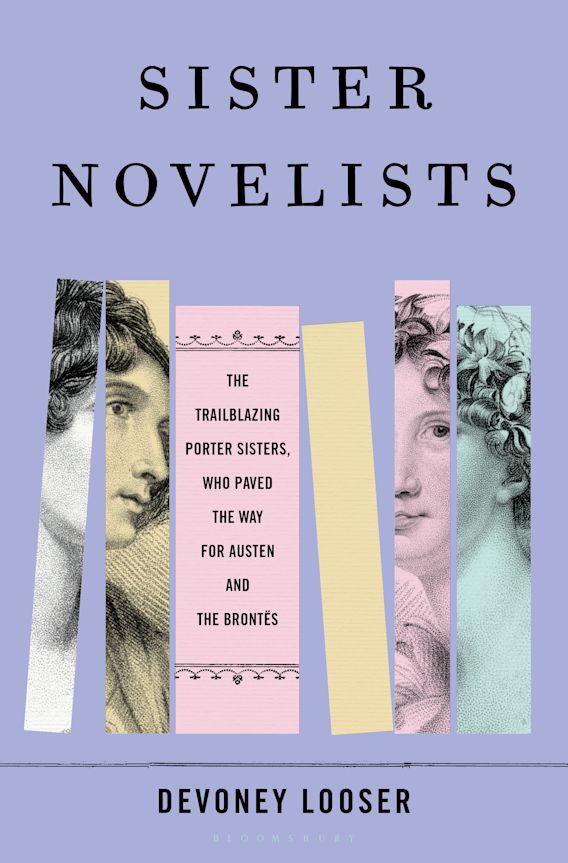
Jane Austen is often treated as a stand alone literary figure, followed a generation later by the Brontë sisters. (We should know better by now. The field of women doing anything at any point in time is always deeper than the story we’ve been told.) In Sister Novelists:The Trailblazing Porter Sisters, who Paved the Way for Austen and the Brontës, literary historian Devoney Looser introduces us to Jane and Anna Marie Porter, contemporaries of Austen’s who were best-selling novelists and literary lions. (Napoleon banned Jane Porter’s books.) They also created a new literary genre: the historical novel.**
Using the thousands of letters the sisters left behind, Looser tells the story of their rise to fame, their financial struggles, their social successes, their romantic failures, and the eternal Catch-22 of being successful single women in a society that had no clearly defined space for such women. The result is a gripping work of impeccable scholarship.
If you’re an Austen fan, or interested in trailblazing women in earlier times, this one’s for you.
* And speaking of The Woman King, if you are interested in learning more about the history surrounding the movie, I strongly recommend this self-study syllabus put together by a trio of historians with deep credentials on the subjects of the slave trade and African history: https://womankingsyllabus.github.io/
**Their childhood friend, Sir Walter Scott, was inspired by their work and history has subsequently given him the credit. This should surprise no one who has spent anytime looking at forgotten women in history, but I must admit it broke my heart—just a little. I developed a bit of a fan-girl crush on Sir Walter while writing my dissertation. I’m disappointed in him.
History and “A More Just Future”
Last December, My Own True Love and I stopped in Saint Louis on our drive from Chicago to my hometown in the Missouri Ozarks. We spent two hours at the Gateway Arch. The museum at the base of the arch had been completely renovated since our last visit, thirteen years previously. I was delighted to see that the story of westward expansion had been, well, expanded. Women and people of color were explicitly included,* as was the United States’ agressive actions against Native Americans in general and against Mexico in the 1840s. The exhibit told the story of lost rights and imperial actions alongside stories of material progress, courage, and growth.
I talked about the changes in the way the National Park Service tells the story in some detail in a blog post about our visit. What I didn’t share in that post was the way the exhibits made me feel. By the end of that two hours, my head throbbed, my stomach hurt, and my heart ached. Holding the two stories side-by-side was painful. History is my passion. But over the last few years, I’ve also learned that history is hard. And I’ve come to believe that it should be.
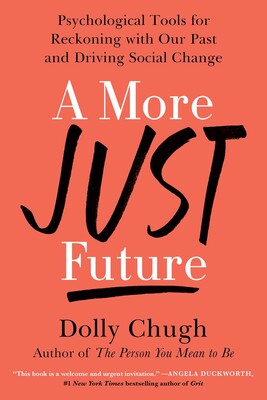
Which brings me to Dolly Chugh’s new book, A More Just Future: Psychological Tools for Reckoning with Our Past and Driving Social Change. Dolly deals directly, and brilliantly, with the discomfort increasing numbers of us are trying to come to turns with about the disjunction between the history we were taught and the history we weren’t taught. Her goal is to help us, and herself, “appreciate both the reality of our country’s mistakes and the grandeur of our country’s greatness”—a condition she defines as being a “gritty patriot”—and further, to understand the impact of our past on our present.
Dolly is a social psychologist, not a historian, so the focus of her book is not on the buried/forgotten/overlooked tales of our past,** though she uses some of those stories to illustrate her points. Instead she helps the reader understand why is it so difficult, emotionally and intellectually, to unlearn history—as individuals and as a country—and gives her (and by her, I mean me) tools for doing so.
A More Just Future is an important and wise look at confronting our whitewashed history and the emotional impact of doing so. It is also a delight to read. Trust me on this.
* A trend you’ve seen me applaud many times in these posts and in my newsletter over the last few years.
**Or more accurately, the stories left out of mainstream accounts of our collective history.

credit-Jeanne Ashton
Just so you know: Dolly Chugh is a Harvard-educated, award-winning social psychologist at the NYU Stern School of Business, where she is a expert researcher in the psychology of good people. In 2018, she delivered the popular TED Talk “How to let go of being a “good” person—and become a better person.” She is also the author of the acclaimed book The Person You Need to Be and the popular newsletter Dear Good People. [Both of which I strongly recommend.]
You can find out more at DollyChugh.com.
Rural Free Delivery

Every time we take a road trip, we miss one or two or twelve things we would like to see because they were closed for the season,* or we hit town on the wrong day, or we had the wrong directions,** or we just plain ran out of steam.
In the case of the Rural Free Delivery Postal Museum, in Morning Sun, Iowa, we made an attempt to set up an appointment, but the telephone number on the website was dead. And it was a little too far out of our way to take a chance and just stop by.
But the story the museum celebrates is just too good not to share:
Home mail delivery is something we take for granted in the United States .*** But in fact, it is a relatively new service. Free mail delivery began in cities in 1863. Rural postal customers—who made up the vast majority of the population at the time— weren’t so lucky. They paid the same amount for stamps as city folk, but they still had to pick up their mail at sometimes distant post offices or pay private companies to deliver it.
In 1896, after several years of advocacy by the National Grange**** and discussion by Congress, Postmaster General William L. Wilson agreed to test the idea of Rural Free Delivery. The service began on October 1, 1896, when five men on horseback set out to deliver mail along ten miles of mountain roads outside Charles Town, Halltown, and Uvilla West Virginia. (Perhaps it was not by chance that West Virginia was Wilson’s home state.) Within a year, the post office serviced 44 routes in 29 states. (The service was so new that regulation mailboxes did not exist. Farmers nailed improvised receptacles on fence corners, including old boots, tin cigar boxes, and shoe boxes.) Customers across the country sent more than 10,000 petitions asking for local routes.
In 1902, Rural Free Delivery became a permanent service of the Post Office. Farm families became a little less isolated.
On a related note: The RFD Museum wasn’t the only postal moment on our trip. When we stopped at the Pine Creek Grist Mill in Muscatine County, Iowa, we learned that the gentleman who founded the mill in 1834 was licensed to run the first post office in the county. The mailing address for any letters coming through the post office was the same: Iowa Post Office, Blackhawk Purchase, Wisconsin Territory. I had never thought about how letters would be addressed on the frontier. Suddenly it became clear to me just how amazing it was that people could send letters to someone who had left home and moved west.
*Word to the wise: If you take a road trip through Minnesota in late September you will miss a lot of stuff.
**As I mentioned in an earlier post, if you want to visit the New Philadelphia archeological site, do NOT put New Philadelphia, Illinois in your GPS. It will take you to an existing town in the other direction.
***Or at least we did until recently.
****For those of you who don’t know: The National Grange of the Order of Patrons of Husbandry, commonly known as The Grange, has been providing support for American farmers since 1867. Originally designed to help rural America recover from the devastation of the Civil War, “Grangers” fought discriminatory railroad pricing, established local buying cooperatives, and, yes, fought for rural mail delivery. Local Grange Halls were often the social heart of rural communities places and worked with Farm Bureaus, Extensions Services and 4-H clubs to educate farm families about the newest methods of farming and household management. Today the Grange is still an active advocate for family farms. Cooperative action at its best.