




Rock Island Arsenal, Pt 2 Taming the Mississippi
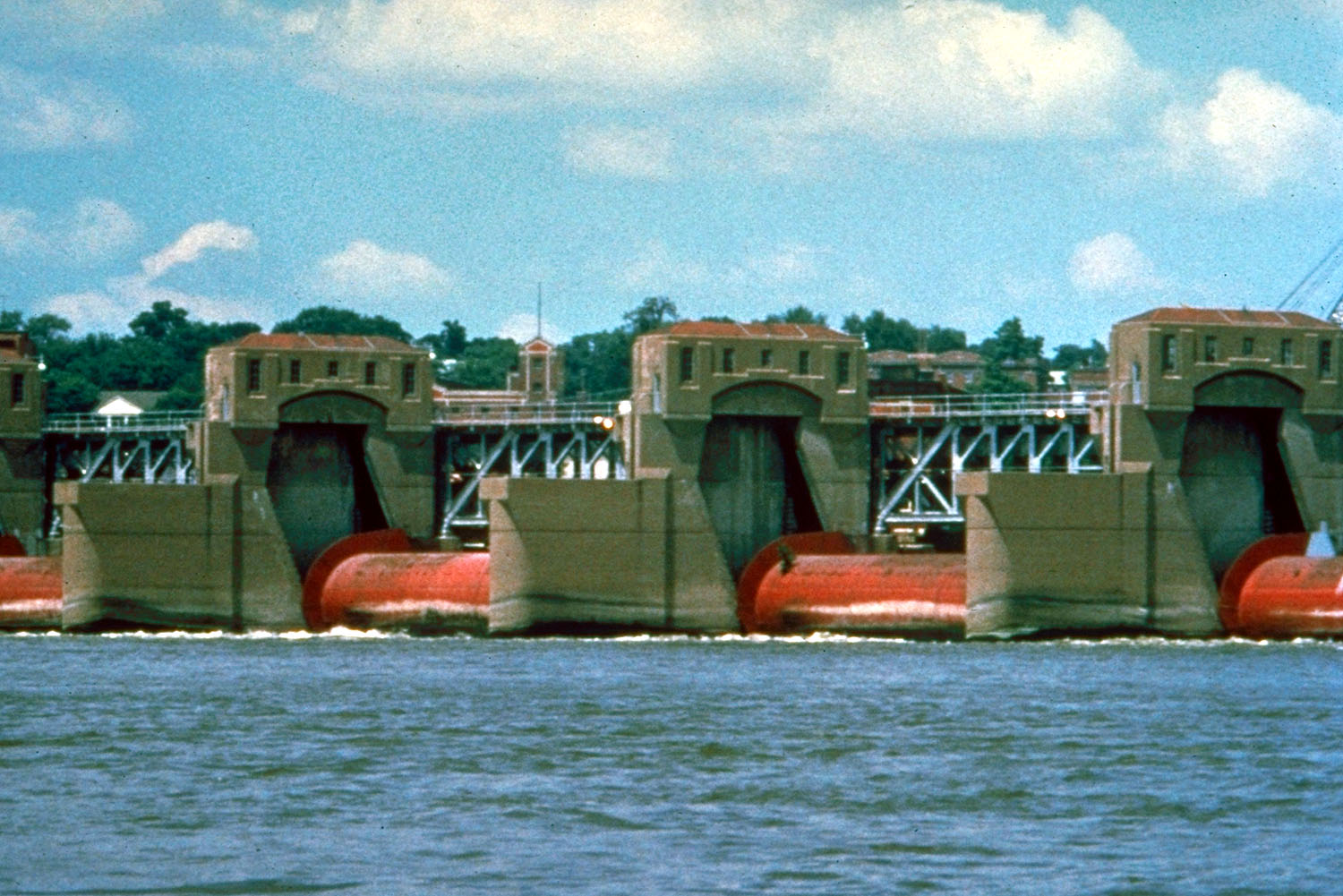
As so often happens on our road trips, our visit to the Mississippi River Visitor Center at Lock and Dam 15 on Arsenal Island turned out to be much more than we expected.
We went to the center expecting to see exhibits on the flora and fauna of this stage of the river, the general history of how the Corps of Engineers made (and keep) the Mississippi navigable, and the specific history of Lock and Dam 15.* At most, we hoped to see a boat go through the lock—eternally fascinating as far as we are concerned. (Though not quite as magical as watching a blacksmith at work.)
In fact, the vistors’ center had all of that, including what turned out to be a detailed topographical map of the area around the lock and dam on the first floor of the center, with a clever way to display the map’s scale. (Turns out I have a six-mile foot. Who knew?)

We would have been perfectly happy with all of the above. But when we walked in, the ranger on the desk asked “Are you here for the tour?” We were not. When she asked if we would like to join, we did not even have to confer with each other. The answer, obviously, was yes.
Once again, we had an enthusiastic and knowledgeable volunteer guide. He talked about how the lock and dam worked, the unusual bridge that links Arsenal Island to the Iowa side of the Mississippi and its predecessors, and the role Fort Armstrong played in the American Civil War. We got to see boats go through the lock, and a close up look at the bridge swinging open to accommodate the process. (We also got a close up look at water running over the dam, and the bright yellow “last chance ropes” suspended from the bridge. Together they emphasized just how dangerous the dam is.)
Here are the bits that caught my imagination:
- Rock Island was the site of the first railroad bridge to cross the Mississippi. The bridge was finished in April, 1856. Two weeks after it opened, the steamboat Effie Afton hit one of the bridge’s pillars. Both the steamboat and the bridge caught on fire. The Effie Afton sank. The Illinois side of the bridge collapsed onto the wreck of the steamboat the next day. The trial that followed played an important role in the conflict between riverboats and railroads over which technology would control access to the west—not an insignificant issue at the time. (It also had a role in the career of a little known Illinois lawyer named Abraham Lincoln. )
- Government Bridge has two layers: the top layer is a railroad bridge and the lower lay was originally for horse drawn vehicles. Which seems wrong. After all, trains are heavier than horse drawn vehicles, and you always put the heavy stuff on the bottom for balance. However, it turns out that horses are freaked out by having trains go under them. Who knew?
- The bridge is now painted with radar resistant paint for security purposes. Which somehow struck me as funny.
*Because every lock and dam on the river has its own story that begins with the river conditions at a certain spot.
Travelers’ Tips.
For those of you who did not read the last post here on the Margins,# Arsenal Island is home to the Rock Island Arsenal and the district headquarters of the Army Corp of Engineers Since the Arsenal is an active military base, you need to get a pass to get to the welcome center. (Unless you have a military id.) Take the bridge from Moline—not the bridge from Davenport—and follow the signs to the Visitor Control Center. You will need a valid state id or U.S. Passport.
There are public tours of Lock and Dam 15 on Saturdays. However, you can schedule a tour at other times. The website says you need a group of ten or more people, but the tour we joined up with was originally a group of two. You don’t know until you ask.
#Not pointing fingers. I realize you have many choices about things to read, on line and off, and I appreciate any time you choice to spend with me.
Rock Island Arsenal, Part 1: Colonel Davenport’s House, and a Couple of Long Digressions
Visiting “Colonel” George Davenport’s house on the Rock Island Arsenal* turned out to be more interesting than I expected, in part because of our knowledgeable and enthusiastic guide. And also because it turned out that “Colonel” Davenport was right at the center of things in the history of the the region. Something I also hadn’t expected. (Somehow it didn’t dawn on me until our visit that the city of Davenport was named after him. *Duh*)

George Davenport, ca. 1845
Davenport was a British sailor who came to the United States on a British ship in 1783, after the Treaty of Paris, which in theory resolved issues between Great Britain and its former colonies.** Shortly before the ship set sail from New York back to Britain, one of Davenport’s fellow sailors fell overboard. Davenport jumped in after him, breaking his own leg in the process. Because a sailor with a broken leg was of no use on board ship—and possibly an active liability—Davenport as left behind when the ship sailed.
Instead of finding his way back to Britain when his leg healed, Davenport decided to settle in the United States and joined the American army. He served for ten years, working his way up to sergeant. He served during the War of 1812, fighting against the British and mustered out at the war’s end.***
During the War of 1812, the American army lost two skirmishes with Native American allies of the British in the area of the Upper Rapids, a difficult part of the Mississippi River between the modern towns of Davenport and Le Claire.**** Concerned about continued relationships between the Sauk and Meskwaki peoples and Canada, the Army decided to build an outpost on Rock Island—a location that would allow them to command the Upper Rapids and give them easy access to both the Sauk city of Saukenak and two nearby Meskwaki villages.
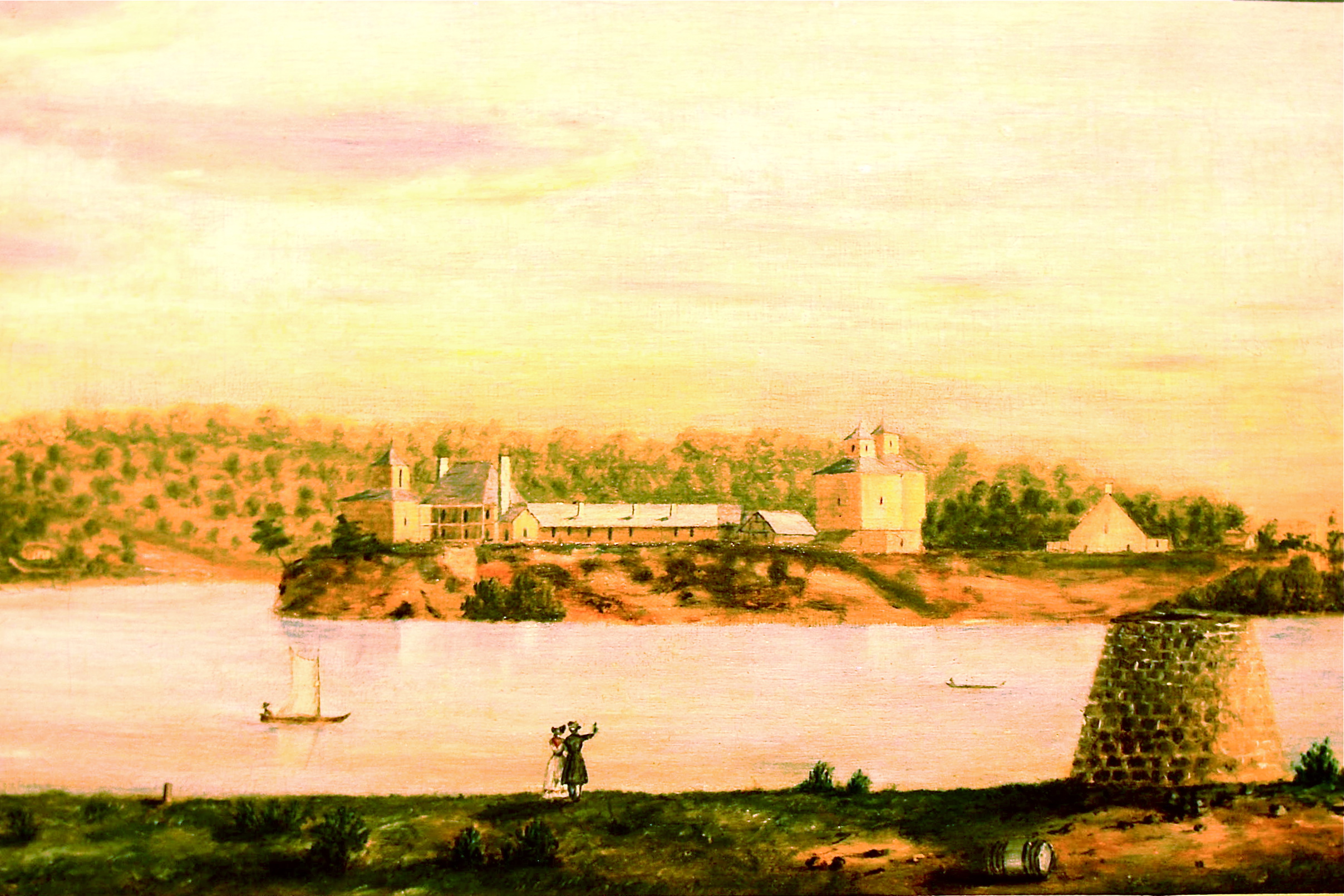
Fort Armstrong
Davenport accompanied the army as the post sutler: a civilian contractor responsible for providing the army and its builders with everything they needed. He also made a claim on a substantial amount of land on the island and built a log cabin for himself and his family. His wife Margaret and her two children from a previous marriage came with him. (As an aside: There is no proof that Margaret and George were married and lots of speculation about their relationship. He publicly acknowledged Margaret was his wife, but she was 14 years older than he was and Davenport openly had two sons with her daughter Susan. Lots of questions, no good answers. )
By the time Fort Armstrong was completed, Davenport decided it was time to move on to a more lucrative endeavor. He got a fur trading license and developed a network of posts that ranged from Galena down to southern Iowa and west to Des Moines, with his base at Rock Island.
When the Black Hawk Wars began in 1832, the governor of Illinois appointed Davenport quartermaster of the Illinois militia and gave him the rank of Colonel—no doubt for reasons that made sense to the governor. Despite the fact that the historic site is called the “Colonel Davenport house,” Davenport does not appear to have used the title after the war. Perhaps he agreed with Eddie Rickenbacker that you shouldn’t use a title you hadn’t earned.
In 1833, Davenport built the house that we toured, which is roughly contemporary to the house at the John Deere historic site. The most interesting thing about it as far as the architecture is concerned is that though it looks like a frame house, the main part of the house is a two story log cabin with clapboard siding. (Lumber was expensive on the frontier.)
In the meantime, things were changing in the territory around the Upper Rapids and Davenport was involved in all of it. He gave up his fur trading license and focused on trading with members of the growing white population in the region. He piloted the first steamship upriver through the Upper Rapids, helping open the northern section of the river to the steam boat trade. Then he sold cord wood to steamships heading up the Mississippi. He was instrumental in establishing the towns of Rock Island and Davenport. And he was one of the movers and shakers involved in founding the Rock Island Line: a 75-mile long railroad that linked Rock Island with Chicago.
Davenport did not live to see the railroad come to fruition He was murdered in his home on July 4, 1845. Drawn by rumors that he had at least $20,000 in his safe, several would-be thieves broke into the house during the 4th of July celebration in Davenport. They assumed the house would be empty. Unfortunately, Davenport was not feeling well and decided to stay home. The robbers shot him in the leg, and then forced him to open the safe. When they discovered that it contained only $400, they beat him unconscious and left him for dead, taking a few small valuables with him.
Davenport revived and lived long enough to give a description of his robbers before he died. Five men were captured and charged with his death.
* Just to make it clear, there are two Rock Islands in the Quad Cities area. One is the city of Rock Island, Illinois. The other, technically Arsenal Island, is the largest of three river islands in the area and home to the Rock Island Arsenal. Unfortunately, most people still call Arsenal island by its former name of Rock Island, leading to confusion among the uninformed.
**As is so often the case, the treaty left significant issues unresolved. Hence, the War of 1812.
***During the course of our visit, I found myself wondering whether Davenport ever became an American citizen. Our guide didn’t know, and on discussion we realized that neither of us knew how a person became a citizen in the first decades after the United States.
I knew from an earlier project that at the time the British defined an American as someone who lived in the thirteen colonies prior to 1783 or who was born there. They did not recognize the right of a British emigrant to become a citizen of a new country. (In other words, from the British perspective, Davenport remained a British citizen until the day he died.)
The United States recognized the need for a naturalization process almost from the start. Congress passed the first naturalization act on March 26, 1790. The act provided that any free, white, adult alien, male or female, who had resided in the United States for 2 years was eligible for citizenship and could apply for citizenship to any court of record. (The naturalization process was finally opened to African immigrants in 1870.)
None of which answers the question of whether Davenport became a citizen.
****One of those skirmishes occurred on Credit Island, so called because it was the place where French fur traders negotiated how much credit they would give Native American hunters in the fall against furs to be hunted over the winter, and where they later settled accounts with those hunters. A colonial relative of two addresses that caught my eye during a recent visit to an Atlanta suburb: Cashback Bonus Boulevard, near Credit Card Court. I cannot make these things up.
__________________
Traveler’s Tip:
The Davenport house is located on the Rock Island Arsenal, which is an active military base. You need a pass to get on base unless you have a military id. Take the bridge from Moline—not the bridge from Davenport—and follow the signs to the Visitor Control Center. You will need a valid state id or U.S. Passport.
Give yourself plenty of time. (As far as I’m concerned, this is always a good idea no matter what you’re doing.) There may be a line.
Road Trip Through History: Black Hawk State Historical Site
My Own True Love and I are big believers in stopping at the local tourist information center in any town we go through, even if we are simply in transit rather than on an official Road Trip. More than once, a local booster has steered us to something we might not have found on our own. The Quad Cities tourist information center in Moline did not disappoint.*
Once she learned that we were interested in history, the young woman at the information desk insisted suggested strongly that we visit Black Hawk State Historic Site, just outside Rock Island, Illinois. She assured me that the park’s museum covered more than just the Black Hawk War, which we had already spent a great deal of time thinking about on our last trip along the Great River Road.** In fact, she patiently assured me of this several times because I could not quite believe it was true.
It turns out that she knew her stuff. From the history buff’s perspective, the site is a two-fer.
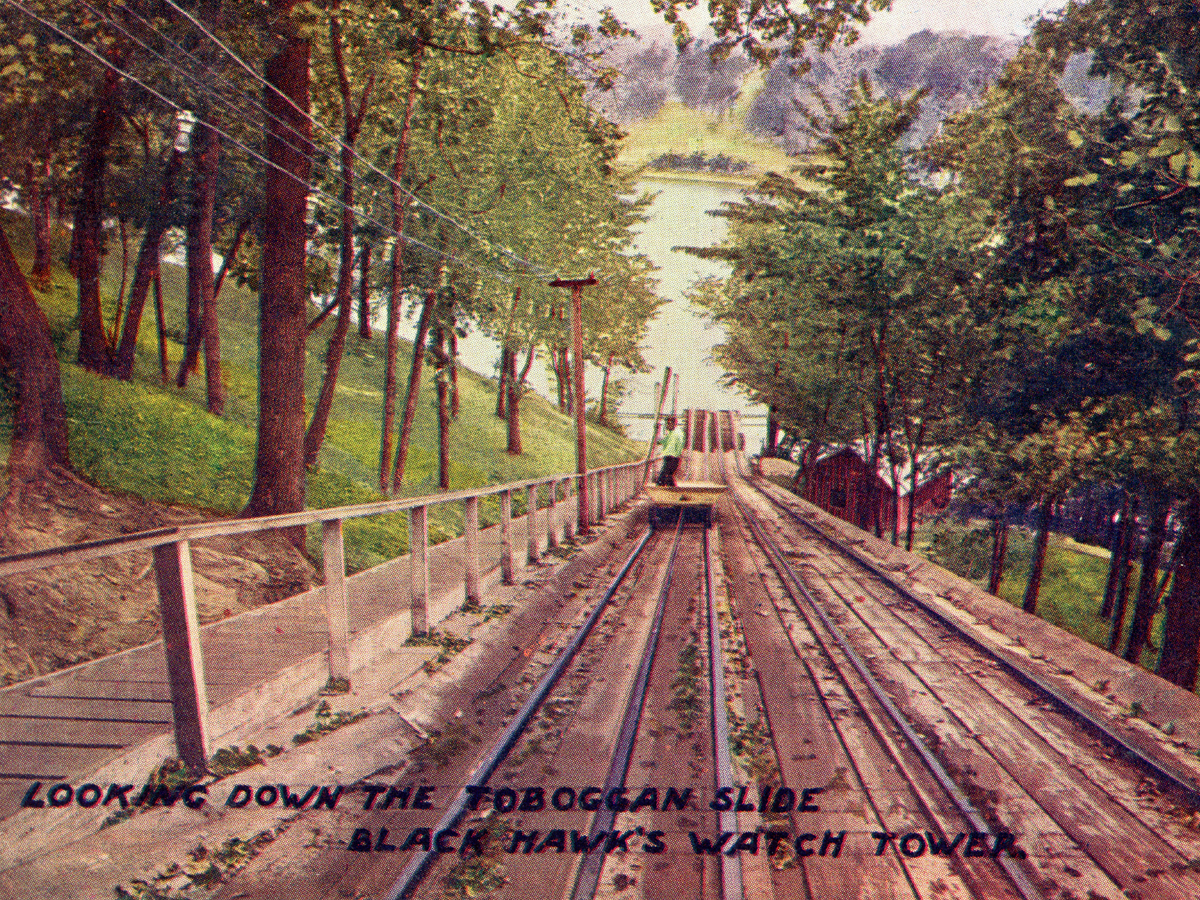
The park itself was the site of the Watch Tower Amusement Park, which operated from 1891 to 1925. Operated by the local street car company, the park was located at the end of the line. (Admission was free if you came on the streetcar.) The park had everything you would expect at amusement park, including a 1,000-seat amphitheater where traveling theater troupes of all kinds, from opera to vaudeville, performed. Thousands of people visited the park each day
The most popular ride was called “Chute the Shoots”: the prototype for the toboggan slide rides that became popular in amusement parks across the country within a decade. Flat-bottomed boats ran on greased wooden tracks from the top of a steep bluff down to the Rock River, gathering speed along the way. (Up to 80 miles an hour according to one source.) When the boat near the bottom of the track, the ride’s operator released the boat from the tracks, which then skimmed over the water. The conductor would pole the boats back to the bottom of the Chutes, where they were hauled back up using electricity from the street car lines. Personally, I think it sounds terrifying. But then, the Tilt-a-Whirl is the wildest ride I’m willing to go on.
In 1925, the Tri-City Railway closed the park which had become too expensive to run. In 1927, the State of Illinois purchased the site, removed the rides and attractions, and created Black Hawk State Park.
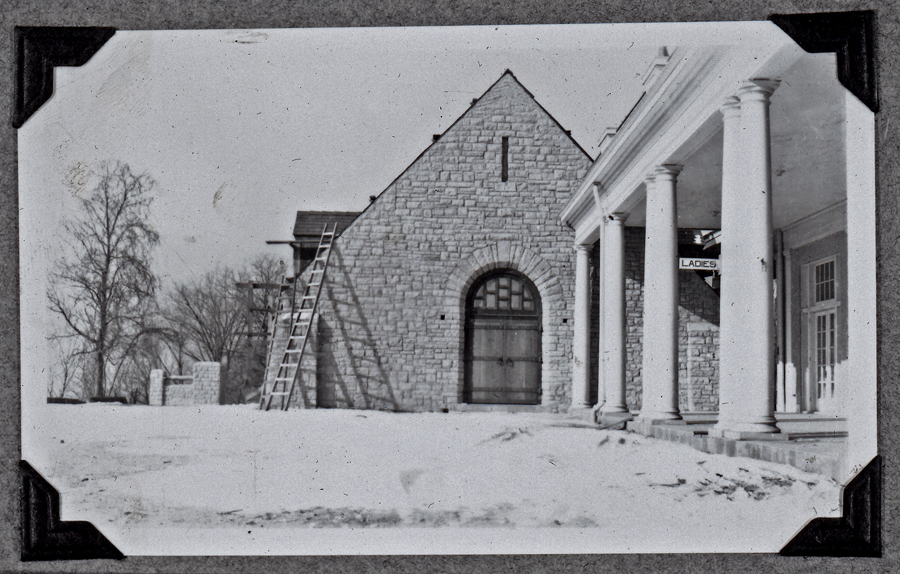
The amusement park was a lagniappe as far as we were concerned. We were there for the Hauberg Indian Museum, which is housed in a located in a massive stone and timber lodge built by the Civilian Conservation Corps.(Though in truth, we are always happy to wander around a CCC building. And this one is a stunner.)
The a small museum focuses on the Sauk and Meskwaki*** peoples. The first room tells the history of the two nations from the time they settled in the region in the mid-18th century through the Black Hawk war, which was the heart of the museum as far as I was concerned. The second room contains a set of four life-size dioramas depicting the live traditional lives of the two nations across four seasons—which I wasn’t particularly interested in—and photographs of some of Black Hawk’s descendents—which I found fascinating.
Here are the things that stuck with me abut the years before the Black Hawk War:
- The Sauk (or Sac, depending on who you read) and Meskwaki were Algonquin language people who arrived in the area near what is now the Quad Cities around 1760. They had been forced out of their home in the Great Lakes region as a result of fur trading conflicts with the Huron. In turn, they forced the Illini Confederation peoples west out of the Rock River Valley.
- Both peoples were semi-nomadic, occupying permanent settlements during the growing season and hunting and trapping furs during the winter to trade for supplies. The Sauk lived south of the Rock River in a city called Saukenak. With a population of some 5,000 people, it was the largest city in Illinois at the time of the 1822 census. The Meskwaki lived in several smaller villages that were built 25 to 30 miles apart, about one hard day’s ride on horseback.
- Saukenak was the site of the westernmost battle/skirmish/conflict of the American Revolution. Colonel George Rogers Clark ordered an expedition against the Sauk city in retaliation for Sauk support of the British. A small force of American, French and Spanish soldiers destroyed the city. The Sauk rebuilt Saukenak, only to have it attacked again in 1814. Black Hawk was thirteen when the city was destrtoyed.Perhaps it should come as no surprise that he was not a fan of the United States.
* For those of you who aren’t from the Midwest, and maybe for some of you who are, the Quad Cities are four small cities clustered around the banks of the Mississippi. Moline and Rock Island are in Illinois. Davenport and Bettendorf are in Iowa. (Personally, I always have trouble keeping them straight in my head.)
**Not enough time to be considered experts, but definitely more than a casual glance. (Are there Black Hawk War buffs?)
*** The French called them Reynards (Foxes), for reasons that I have not been able to discover, and they show up as the Fox people in many English language accounts. But that is not what they called themselves, and there is no reason we should continue the practice. You could call me Patsy, but it wouldn’t make it my name.
_________
Travelers’ Tips:
• If you put the official park address in your GPS, it will take you to the park office. The woman at the office made it clear that she was with the conservation police and knew nothing about the museum. She did, however, offer to issue me a fishing license. If you are at the site for history-buff reasons, you want to stop at the Watch Tower Lodge, which appears to be closed. Drive past the locked gates and follow the sign to the parking lot.
• Try the ice cream at Largomarcino, in Moline. They’ve been making their own ice cream in the basement since 1908 and it is fabulous.
Edited: I now have the answer: there is at least one Black Hawk War buff and he has written a guide not only to the sites and landmarks, but to first hand accounts. http://benstrand.com/