




Going Viral, 1930’s Style
These days I spend a fair amount of time reading memoirs of people who were in Berlin at the same time as Sigrid Schultz, particularly memoirs written by her fellow journalists. They give me a slightly different perspective on what it was like in Berlin. They often share nuts and bolts of working with German press officers and censors, in the Weimar Republic as well as under the Nazis. Occasionally, Sigrid appears on their pages in a cameo role. (That always makes my day.)
And now and then one of them tells a good story that I can’t wait to share:
On July 16 1931, Louis Lochner, the head of the Associated Press Berlin bureau attended a stag luncheon* hosted by Ambassador Frederic Sackett. In the course of conversation, Ambassador Sackett mentioned that he frequently had conversations with President Hoover via transatlantic phone call—a rarity at the time. The purpose of the calls was to discuss business related to Germany’s economic situation and America’s response to the same, included the general moratorium on Germany’s war debt which Hoover had just announced. Then Sackett casually added that he and the president often spoke in American slang to confuse anyone eavesdropping in the line. Journalism gold!**
As soon as he could reasonably excuse himself, Lochner headed to a phone booth, dictated a “short crisp story” to his office and instructed them to relay the story to New York.
Wire services like the Associated Press held an unusual position in the world of foreign correspondents. They provided news coverage for papers that could not afford their own correspondents. Even major papers relied on the wire services for “spot news”: small news stories that were of immediate interest and updates on important stories. As a result, a human interest story like the one Lochner cabled that day was potentially read by millions of readers.
-
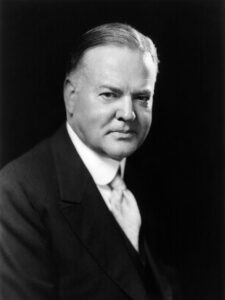
- President Hoover
-
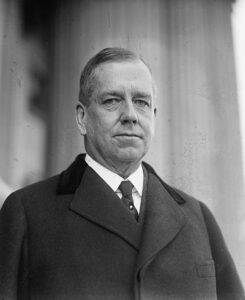
- Ambassador Sackler
And read it was. Not only did readers enjoy it, but editors and columnists across the country had fun inventing what the president and ambassador might have said. Here’s a sample from a column by Frank Sullivan that ran in The New Yorker on July 25, titled “You tell ‘em, Mr. Ambassador.”
“The Ambassador: So he says: ‘No sir, I wouldn’t give the Heinies one thin dime.’
The President: Nertz! What did you and he do then—phht?
The Ambassador: No, but we darn near did. I didn’t wan to tip my mitt to him so I just tried a little bluff. I says to him: ‘O. K., if you don’t want to play ball, then roll your hoop. Take your playtoys and beat it. Come on, bum, ooskrat. Twenty-three skiddo! Scram! Pick out a nice spot and go lay an egg there.’
The President: Boy, was that giving him the Bronx cheer! Did it work?
The Ambassador: Did it work, Mr. President! I’ll say! He came off his high horse in a split second. ‘All right,’ he says, ‘you win. You outfumbled me. I’ll pay the taxi. What do the pretzel-benders want? How much time?’ So I says: ‘Never mind, we’ll take care of that. You just put your John Hancock on this space here.’
The president: Clever, clever you, Mr. Ambassador.
The Ambassador: It’s the army game, Mr. President. Never give a sucker and even break’.”
(As far as I’m concerned, the funniest part is the two men addressing each other as Mr. President and Mr. Ambassador.)
According to Lochner, Ambassador Sackett thought the whole thing was a hoot. ( Not Lochner’s exact words, but I like to keep in the spirit of the thing.)
*No idea why it was a stag luncheon. Now and then some of “the boys” tried to keep Sigrid out of an event, but there was no sign of that in Lochner’s account. Possibly the ambassador’s wife simply wanting a day off from hostessing and turned her husband loose to entertain on his own. In the diplomatic protocol of the day, that would have meant no women were invited. Not even a female “newspaperman”.
**Historian’s gold, too, for that matter. If I were writing a different book I’d be hoarding that detail.
Mrs. Ruth Shipley, Chief of the US Passport Office
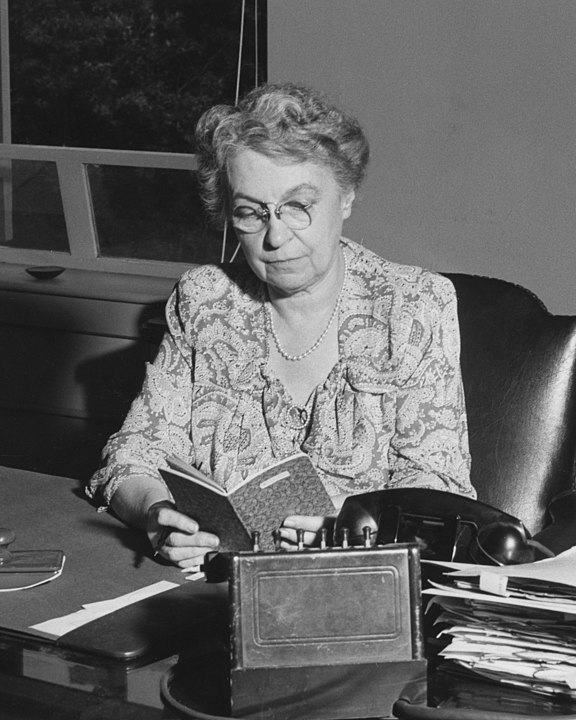
Every formal communication or article about Ruth B. Shipley, whether written by journalists during her lifetime or by scholars in the decades since her death, refers to her as Mrs. Ruth Shipley. She was formidable. She was powerful. And in the end, she was controversial. In 1951, Time magazine described her as “the most invulnerable, the most unfireable, most feared and most admired woman in Government.” And yet, she is largely forgotten today.*
Mrs. Shipley* was the Chief of the State Department’s Passport Division for 27 years, from 1928 to 1955. She did not simply run the department—she personally approved and disapproved passport applications, often based on her own sense of whether an applicant would, as Reader’s Digest described it “be a hazard to Uncle Sam’s security or create prejudice against the United Stats by unbecoming conduct.” As a result, many Americans whose names we do remember corresponded with her about their travel plans.
Shipley took her duties seriously. In 1933, she led a successful campaign to prevent a magazine from using the word “passport” in a advertising campaign for its promotional literature. She believed such use “cheapened…the high plane to which a passport has been raised.*** In 1937, she changed Passport Division policy and began issuing passports in a married woman’s name without caveat, if the woman requested it. Previously married women’s passports were issued with her name followed by the phrase “wife of”.****
The functioning of the Passport Division was affected by larger issues of American politics. The Neutrality Acts of the 1930s restricted the ability of American citizens to do business abroad, and Shipley’s office became responsible for monitoring Americans’ international travel. A duty she exercised with a heavy hand and a lack of imagination regarding the consequence of some of her decisions. Since her decisions were not subject to judicial review, they were difficult to overturn, particularly since she did not offer reasons for the denial of any particular passport. (When she insisted on including the phrase “ on Official Business” on the passports of OSS agents, effectively “outing” them to enemy governments, the agency’s head, “Will Bill” Donovan, had to go all the way to President Roosevelt to get the decision reversed. )
Shipley’s single-handed control over the passport process put her in the center of political controversy at the height of McCarthyism and the Red Scare. In 1950, Shipley helped draft legislation that made it illegal for members of communist organizations to hold an American passport. As a staunch anti-Communist, she used the power of her office to restrict the travel of left-leaning Americans whether they were avowed Communists or not. Critics claimed, with some validity, that she was denying passports on arbitrary and personal political grounds. Her supporters defended her actions as important in the fight against Communism.
In 1955, Mrs. Shipley reached the mandatory retirement age of 70. Secretary of State John Foster Dulles, a Cold Warrior of some note, asked her to continue in her post, but she chose to retire, perhaps because the power of her position was being dismantled through a series of judicial decisions that required the passport division to implement due process procedures and a review system.
*In all fairness, many equally powerful male civil servants are also forgotten today outside of specialist circles. It is easy to forget how easily we forget.
**I see no reason to change the convention
***Obviously a short-term victory. I wonder what she would think of, say, the National Park System’s passport program.
****The impact of marriage on not only passport status but even citizenship prior to the 1930s is a complicated and infuriating subject. The fundamental idea was that a woman’s citizenship was tied first to that of her father and then to that of her husband. Don’t get me started.
* * *
A couple of notes about the blog:
1. Those of you who subscribe to the blog may have noticed that it disappeared for several weeks. (At least, I hope you missed me.) Apparently my used of a diacritical marker in a Slavic place name in an earlier post The Free State of Fiume upset the subscription software. I kept writing posts, but they weren’t going out by email. And it took me a while to notice. It’s been fixed. This post should go out in an orderly way. And the new system will include links to the last few posts so it will be easy to catch up with any you missed.
2. I am deep in the first “real” draft of my latest book. And I’ve got to admit, it’s going slowly. My manuscript is due May 1, 2023, which feels like tomorrow as far as I’m concerned. I love writing these blog posts, but for the foreseeable future I’m going to cut back to one post a week.
Thanks for reading.
Carolyn Wilson, From Fashion Reporter to War Correspondent
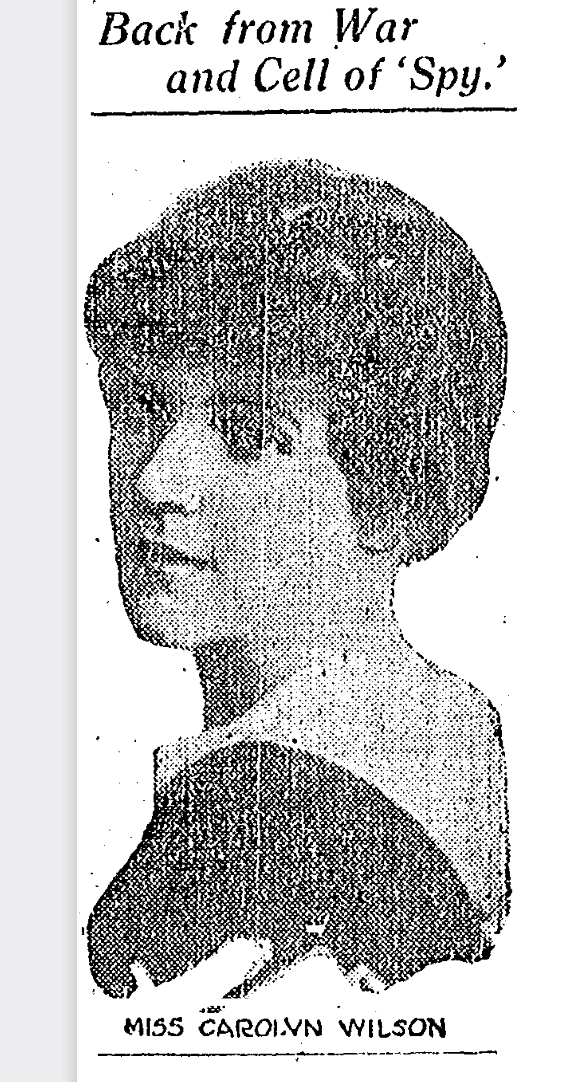
When I was writing Women Warriors I kept stumbling across women I’d never heard of.* I did not expect to have the same experience with women who served as foreign correspondents and/or war correspondents. After all, I’m writing about one particular woman, not a history about women journalists as a whole. And yet, women I’ve never heard about just keep popping up.
Case in point, Carolyn Wilson of the Chicago Tribune.
Like many of my contemporaries who went on to careers in journalism, Wilson was editor of her college newspaper. She graduated from Wellesley in 1910, spent a brief time studying in Germany, and then went to work for the Sunday section of the Tribune. She may have dreamed of reporting on hard news, but her first beat was a typical one for a young female journalist at the time, a chatty by-lined column titled”A Matinee Girl Sees Players; Clothes Worn on Chicago Stages” in which she wrote about actresses, their roles, and their clothes, on-stage and off.
Over the next two years, Wilson managed to score an occasional feature outside the women’s pages, including an interview with Orville Wright.** She had hoped to get a ride in the plane, but she had to settle for a discussion about the aviation stabilizer he was developing. He made it clear that he didn’t think she would understand what he was talking about, but she let her readers know that she was an aviation geek and had no problem keeping up: “not for nothing have I talked myself blue in the face at the Burgess hangar in Marblehead, and studied aerodynamics and. aeronautics with a zeal usually to be found only in boys.” She followed up the technical interview with a visit to the airplane factory. I am sorry to report that she ended the piece with a self-deprecating nod to her usual beat: “But do you want to know what tormented me all the way back to Chicago? I never had a chance to wear that adorable aeroplane cap.” Apparently she felt the need to soften the impact of her “boyish” zeal for airplanes.
In June, 1914, the Tribune sent Wilson to Paris, with a commission to “observe and record matters concerning the lighter side of life in that capital”. For the most part that meant society gossip and fashion news—a specialized form of foreign correspondence, though seldom recognized as such. She managed to push the boundaries of the form to include aviation: one of her early Paris columns centered on a technical discussion of the Sperry gyroscope, another airplane stabilizer, disguised as a frothy description of taking a plane ride with Sperry fils. (Airplanes were hot news in the first decades of the century well before Lindburgh made his famous flight across the Atlantic. In fact, I would argue that the high news value of aviation in general made Lindburgh’s flight possible. But that’s a discussion for another day.)
When the Great War began on July 28, 1914, Wilson added war correspondence to her job description.*** She filed her first piece about the war on August 1, a description of the war panic that gripped Paris; it appeared on August 11.
For the first few months of the war, Wilson continued to write her illustrated fashion column, titled “Smartest Styles at Common Sense Prices,” alongside pieces that looked at the war through what newspaper publishers called “the woman’s angle”: women taking on the jobs of men as they leave for the front, women knitting for soldiers, women volunteering as nurses. But by September she had broadened her scope. In addition to “the woman’s angle,” she wrote human interest pieces dealing with soldiers, reported stories from both sides of the front,**** interviewed soldiers, and produced thoughtful political analyses. She was even arrested in Genoa on suspicion of being a spy and held for several days until the British ambassador intervened on her behalf—an event she described as fulfilling a life-long ambition
The last article I can find by Wilson dates from November, 1918, when she clearly was working as a foreign correspondent, not a fashion writer. I don’t know what she did after the war. I do know that she left a legacy at Wellesley, where she endowed a lecture series intended to introduce students to the important issues and figures of the day. Today the Wilson lecture continues to host impressive guests.
*I still am. Apparently the supply of women who fought or led troops is limitless.
**For any airplane buffs among my readers—and I know I have at least one—the interview appears on January 18 1914, p. E4
***Nothing I have found so far tells me whether the Tribune asked her to do this or whether she just grabbed the opportunity and ran with it. Either is possible. The Tribune’s owner and publisher, Robert McCormick was certainly not one to waste the opportunity for some “woman on the spot”coverage.
****She claimed the Germans were more welcoming to reporters than the Allies.