




Dr. Mary Walker–Two Ways
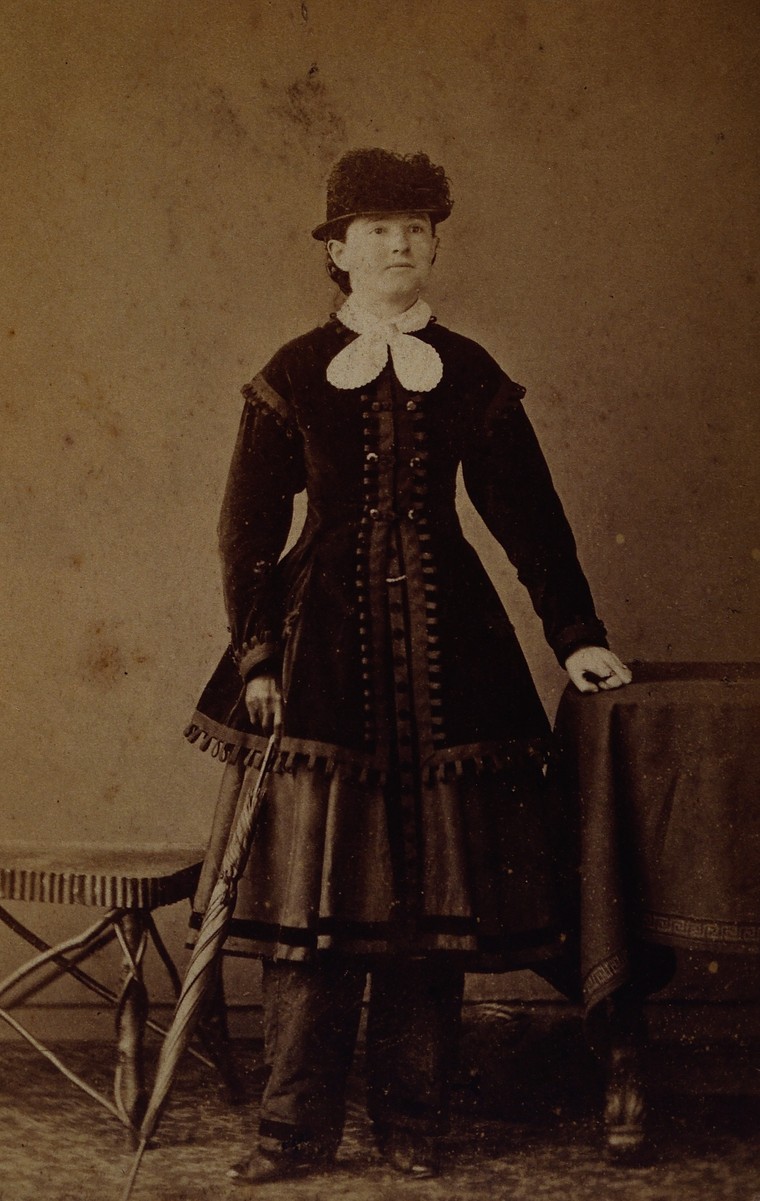
This is more of a public service announcement than a blog post. Women’s History Month is almost here and cool things are popping up in my in box that I am eager to share.
For those of you who live in or near Hopewell, New Jersey, Independence: The True Story of Dr. Mary Walker will be playing at the Hopewell Theater on March 20. (It was originally scheduled to run there in March, 2020, but you know how that went.) The play is a one-person show about, surprise, Dr. Mary Walker, Civil War surgeon, suffragist, reformer, and shin-kicker. You can read information about the show here. Tickets are available from the Hopewell Theater here. The promo code to waive online ticketing fees is INDEPENDENCE22.
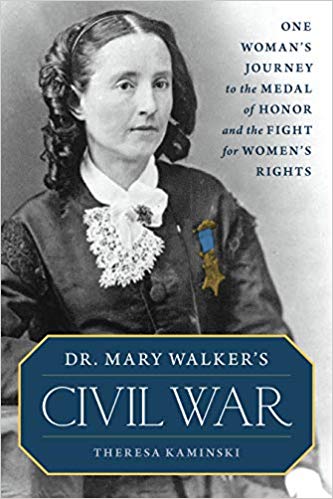
For those of you who are not close enough to attend the play* but are interested in Dr. Mary Walker, I recommend Theresa Kaminski’s Dr. Mary Walker’s Civil War: One Woman’s Journey to the Medal of Honor and the Fight for Women’s Rights . It’s an excellent biography of an often difficult woman who helped change the world.
*In another time, under different conditions, I would have been tempted to meet my BFF in New Jersey for a Women’s History Month weekend.
_________________________
And speaking of Women’s History Month, I am busy organizing my fourth year of mini-interviews with people doing interesting work in the field of Women’s History, including Theresa Kaminski. She has a new book coming out about Dale Evans, Queen of the West.
Don’t touch that dial!
Jeanne Mammen, “Neue Frau”
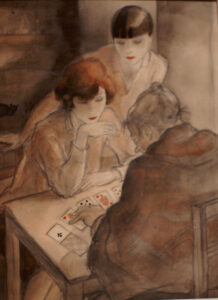
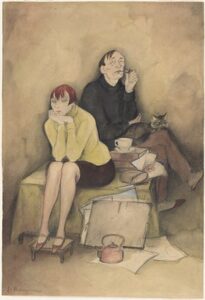
And speaking of the “New Woman,” as I believe we were, allow me to introduce you to German artist and illustrator Jeanne Mammen (1890-1976) whose life and work in the 1920s and 1930s embodied the “Neue Frau” in Berlin.
Mammen was born in Berlin in 1890, but her family moved to Paris when she was 10. She studied art at the Académie Julien in Paris, then at the Académie Royal des Beaux-Arts in Brussels When her family was forced to return to Berlin in 1915 due to the war, she earned her living through her art, creating illustrations for the large number of magazines targeted at female customers.
Much of her work from the interwar years focuses on the lives of women in Berlin. In her drawings and watercolors in particular, she depicts socialites, members of the demi-monde, and the growing class of white collar workers on Berlin’s streets and in its bars, cafés and theaters. Whether creating caricatures for the satirical magazines that flourished during the Weimar republic or intimate drawings of women’s lives for more general magazines, Mammen combined satire with emotion.
When the Nazis took over in 1933, most of the magazines she worked for were discontinued or bought into the party line. Mammen no longer had a market for her intimate images of women, with their elegant lines and hint of decadence. Unwilling to build a new life in a foreign country for a second time, she refused to flee Germany. She survived by taking small commissions, selling books from a hand cart, and accepted a little help from her friends.
Sigrid Schultz, the “New Woman,” and Fanny Fern Fitzwater
Sigrid Schultz always described herself as a newspaperman. She worked in a largely male world, first as a foreign correspondents and later as a war correspondent in World War II. She was proud of her role as the first woman to be a foreign bureau chief for an American newspaper.
Schultz, and the small number of other women who worked as correspondents, weren’t the only women stepping into a new role in the years between the two world wars. Women had taken on new jobs during World War I, replacing men who had gone to the front. It wasn’t a new idea—women have always run farms and businesses when men go off to war. But the sheer scale of the war meant that the numbers of women involved was new. And so was the number of women who remained in the work force after the war, whether because of economic need resulting from war casualties or because they did not want to give up their new freedom. * (“How ya gonna keep them down on the farm after they’ve seen Paree?” applied to young women as well as to returning soldiers.)
[reminder: if you’re reading this in an email, you may need to click through to your browser to see, or in this case hear, the video.]
The “New Woman” doesn’t show up much in Sigrid Schultz’s letters, so whenever she mentions a woman who is not the wife of a fellow correspondent,** diplomat, or other player in Schultz’s world, I take the time to try to track her down. This week one of those searches led me to illustrator, fashion designer, business woman, and “influencer” Fanny Fern Fitzwater (1886-1966).
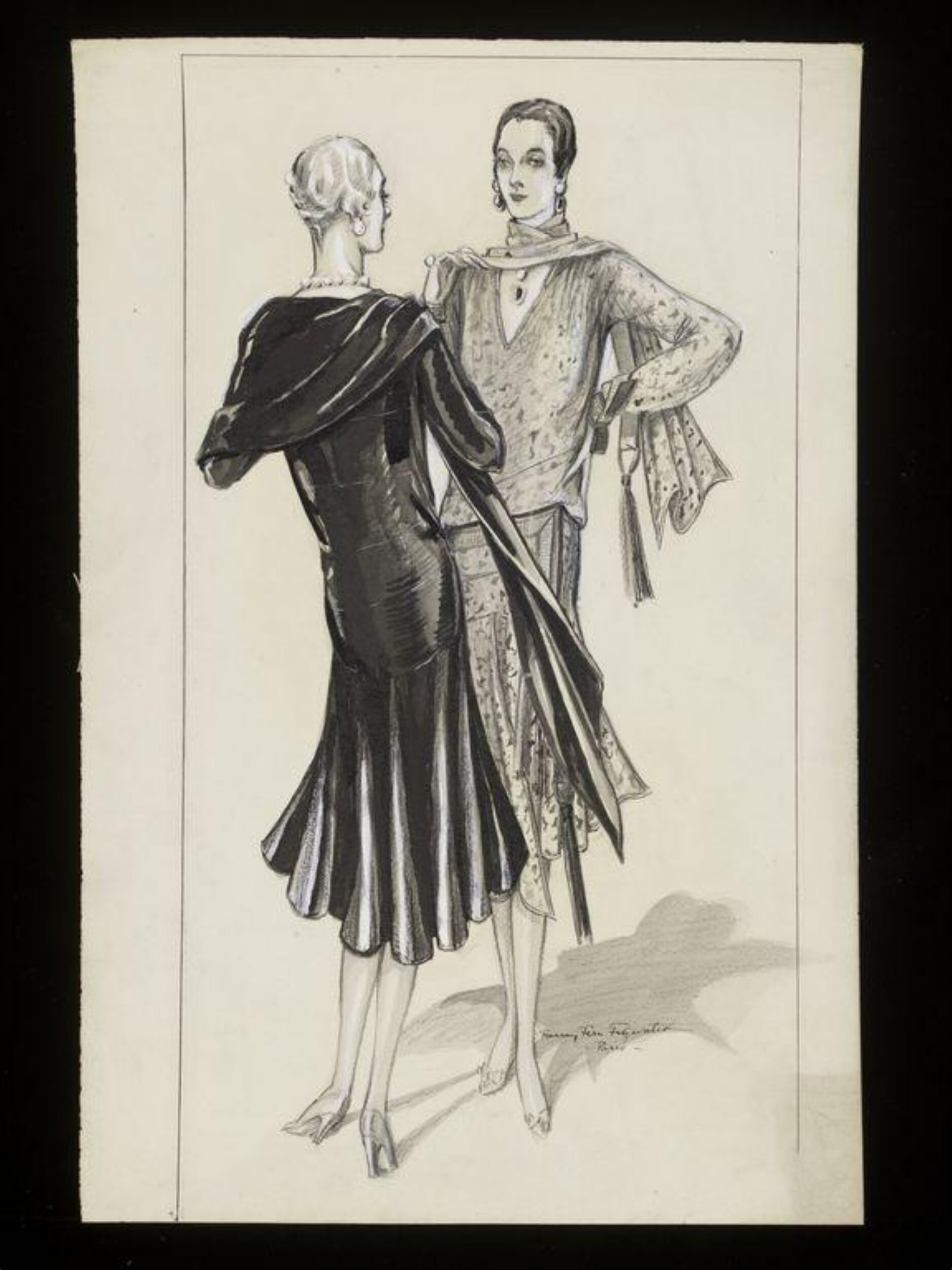
A Worth design illustrated by Fanny Fitzwater, late 1920s.
Fitwater appeared in a throw away line in one of Schultz’s letters. Schultz was constantly looking for a side gig. In 1927, she had the idea for a syndicated “strip”: an illustrated combination of fashion, travel, gossip and news. On a trip to Paris on newspaper business, she went looking for collaborators: “Grace Ziegler Brown to write the captions, Fanny Fitzwater draw the pictures and I provide the ideas.”
At the time, Fitzwater was a fashion reporter for the New York Herald Tribune who lived part-time in Paris, in order to report on French fashions. Unlike most other fashion reporters, she illustrated the designs she reported on. (She was a trained artist, who had studied at the Art Students League in New York and then spent several years in Paris working with French artists and fashion designers.) Her columns were soon syndicated nationwide. (Unlike Schult’z proposed strip, which went nowhere.)
After World War II, she taught fashion design and illustration at the Kansas City Art Institute for a time. In 1952, Elizabeth Arden offered her the job as head of Arden’s newly formed fashion department. At Elizabeth Arden, she managed the firm’s in-house designers and developed its clothing line until her death in 1966.
Fitzwater was a recognized fashion aauthority in her time, but is largely forgotten today.
Now if I could just find out something about Grace Ziegler Brown. Anyone have a clue?
*It should be pointed out that the idea of women working outside the home was new only in the middle and upper classes. Working class women had, by necessity, always worked. It is all too easy to filter women’s history through the lens of privilege.
**In fact, the wives of many of Sigrid’s colleagues were themselves journalists when they met their husbands and continued to work on a freelance basis after their marriages. If this is something you’re interested in, I discussed in my newsletter about a year ago. You can find it here.
https://missouriartists.org/person/morem164/