




Karl May is tracking me down
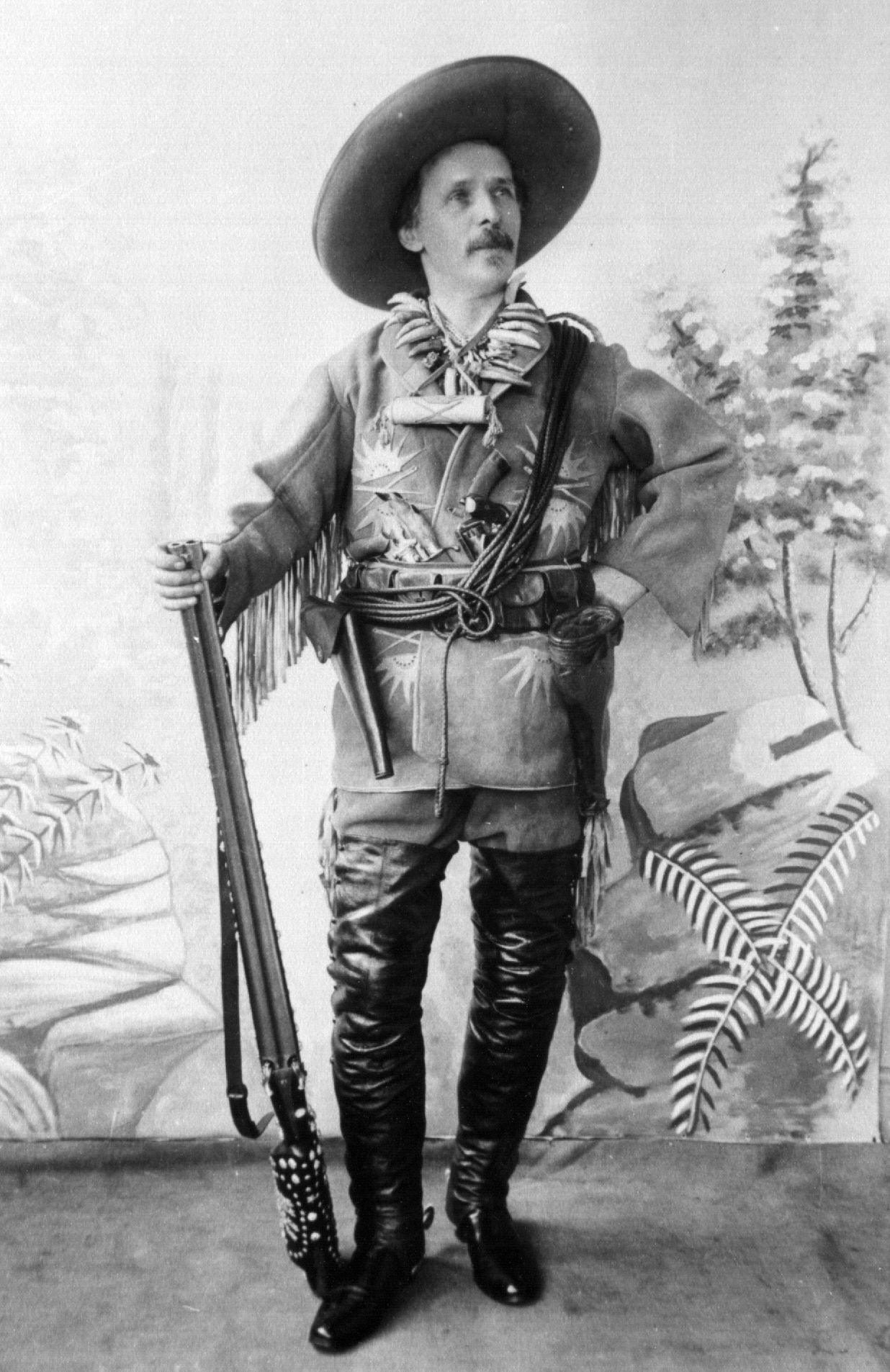
Karl May as Old Shatterhand
I’ve mentioned this phenomenon before: you become aware of a subject and suddenly you are stumbling across it with some regularity. It happened to me with Erasmus Darwin. It happened to me with the Sand Creek Massacre. It happened to me with Walter Gropius and the Bauhaus school. Eventually I give in and do a little research. Often it leads to a blog post. Sometimes it leads to a new project. Sometimes it fills a gap that I didn’t realize existed in a current project. At a minimum, I learn something new. (There is no downside to learning something new, right?)
Popular nineteenth century German novelist Karl May (1842-1912)* has been tracking me down for a while now. I first came across him in an author’s note at the back of a modern fantasy novel in which the popularity of May’s novels played a critical element in the plot. Then he popped up while I was doing research for an article on satirical German artist George Grosz, who was an enormous fan of pulp fiction in general. He’s been crossing my path ever since.
This may have something to do with the fact that for the last several years I’ve been hanging out in early and mid-twentieth century Germany, when May was still a popular author. George Grosz wasn’t the only young German who found the window to a larger world in May’s adventure stories in the years between the world wars. Albert Einstein, Hermann Hesse, and possibly Adolf Hitler were all fans.**
May wrote adventure stories set mostly in highly fictionalized versions of the American West and the Middle East: non-stop action stories set in vividly imagined landscapes (As someone who wrote my dissertation on Romantic Orientalism, I am fascinated to see the same ideas applied to the American West) His most popular novels deal with the adventures of the Mescalero Apache Chief, Winnetou, and his German friend/sidekick, Old Shatterhand—an interesting inversion of the pairings with which Americans are familiar, from the novels of James Fennimore Cooper to the cinematic adventures of the Lone Ranger and Tonto. May allowed his readers to think that Old Shatterhand was his thinly veiled alter-ego, but in fact, he did not visit either the Middle East or the United States until late in his life. And he never made it to the West where his most popular books were set. The America which caught the imagination of generations of young Germans was in itself a creation of May’s imagination, aided by extensive research of the nerdiest variety.
May was Germany’s first best-selling novelist. His adventure novels are still in print and are estimated to have sold more than 200 million copies in 40 languages. Today, or at least pre-pandemic, thousands of people make the pilgrimage to the annual Karl May Festival.
It’s not clear to me who would be the English-language equivalent of Karl May. I have seen his work compared to both Indiana Jones, in terms of the content, and the Harry Potter books, as a cultural phenomenon. The Indiana Jones comparison seems fair, with the caveat that I haven’t actually gone so far as to read one of May’s novels. (It would be an interesting test of my very academic German reading skills.) We won’t know whether Harry Potter can hold his own with Winnetou for another 80 years or so.
*First thing I learned: the name is pronounced “my”, which is not the way I’d been saying it in the privacy of my own head. Luckily I haven’t had many chances to say it out loud in front of anyone who would know better.
**So was Arnold Schwarzenegger, later in the century. Schwartzenegger claimed that May’s books “opened up my world and gave me a window to see America.”
In which I recommend a newsletter
I recently subscribed to a newsletter that I eagerly read each time it appears in my email in-box.*
I am not sure what led me to World War II on Deadline —my guess is that someone linked to an issue on Twitter. Whatever the path, I was immediately hooked. The newsletter, and the website behind it, are a passion project of journalist Marc Lancaster. In each issue, he tells a story about news from the front and the journalists who wrote it. Sometimes he looks at a story I’m familiar from the perspective of how the story was written, which almost always gives the story a new twist. Sometimes he introduces me to war correspondents I’ve never heard of or to people I am familiar with in another context but did not realize were war correspondents in WWII. (I’m looking at you Andy Rooney.) No matter what approach he takes, it is consistently interested and well told.
If you’re interested in World War II, journalism, or a good story, you might want to give it a look.
And now if you’ll excuse me, I need to go work on my own story about a journalist.
*All of us who write newsletters and blogs dream of achieving “must-read” status for at least a handful of our readers. (And yes, I also have a newsletter, in which I discuss writing and thinking about history. Totally different material that you read here on the Margins. If you think that might be your shot of 12-year old scotch, you can subscribe here: http://eepurl.com/dIft-b . When you subscribe, you’ll get a link for a very cool downloadable timeline of the Roman emperors and the women who fought against them or supported them, which I created with the people behind The Exploress podcast–which I also highly recommend.)
City of the Century

Many moons ago I bought Donald Miller’s City of the Century: The Epic of Chicago and the Making of America as background material for a book proposal I was working on. I stopped the proposal halfway through, when I got the commission to write Mankind: the History of All of Us for the History Channel and my writing career took an unexpected leap forward.* City of the Century languished unread on the To-Be-Read shelves for almost a decade.
I recently pulled it off the shelf, thinking I would read it in conjunction with Erik Larson’s Devil in the White City as background material for my current book. I quickly abandoned Devil in the White City—I’m just too squeamish for the serial killer part of the story. But I continued reading City of the Century, even after I realized that the questions I was hoping to answer weren’t actually relevant for the book I’m writing.*** All 500+ pages of it.
Miller begins with Marquette and Joliet’s voyage of exploration and ends with the years immediately after the Columbian Exposition of 1893.**** He tells a lot of stories that I already knew, thanks in part to several decades of living in Chicago as a history nerd: , the Great Chicago Fire and its aftermath, the rise of the skyscraper, the foundation of Jane Addam’s Hull House, the Haymarket Square riot, and the Pullman strike. But he links those stories in ways that were new to me, sets them in expanded contexts, and occasionally he changed my mind about a story I thought I knew. He looks at the impact of both wealth and poverty, the growth of the city as a transportation and industrial hub, the importance of immigrant ethnic groups in Chicago politics, and the efforts of wealthy and middle-class “native-born” Protestants to de-fang such groups politically and to control and assimilate them. The result is a fascinating and rich account of Chicago’s history.
I am now eyeing another book of Miller’s that has been aging on my shelves for a while now: a history of New York in the jazz age.
*Truth be told, I probably would have abandoned the proposal anyway.**
**Pro tip: Proposals are maddening to write, but you should be excited by the material. If writing the proposal bores you, imagine how bored you’ll be writing the book.
***The start of the research process—or at least the start of my research process—is as much about finding the shape of the story and the things I don’t know as it is about finding answers. I read deeply in my central subject, but I also read widely in the period surrounding my subject. It is messy. It is not very efficient. But it works for me.
****I was disappointed to realize that he left out Jean-Baptiste Pointe DuSable.