




The Birth of the Microphone

Recently, while reading a history of the German revolutions of 1918 and 1919,* I ran across this sentence about the events of November 10, 1918:
“With the meeting interrupted, the soldiers going wild in the lower rows and the workers in the upper rows engaged in bewildered discussions with each other, there was feverish negotiation in the aren—under the eyes of the agitated crowd, but not within their hearing, for microphones were not yet invented.”
Really? I thought. And off I went to find out more. **
It turns out that scientists have been trying to figure out ways to amplify sound for a long time. In fact, most of the sources I looked at on the history of the microphone started with Robert Hooke’s creation in 1665 of the acoustic cup and string “telephone” that most of us were introduced to in grade school.*** If the Oxford English dictionary is to be believed, the first recorded use of the word occurred 20 (okay, 19) years later, in 1684, as a description for something like an ear trumpet.
The “first” practical modern microphone was invented in 1876 by German-born inventor Emile Berliner, who was working in Thomas Edison’s workshop at the time. Known as a carbon-button microphone, it was drum-like device that enclosed two electric contacts separated by a thin layer of carbon. One contact was attached to a diaphragm that vibrated when struck by a sound wave; the other was connected to an output device. In other words, the carbon-button microphone converts sound into voltage, making it perfect for use in early telephone prototypes. In fact, Alexander Graham Bell bought the rights from Berliner for $50,000 for exactly that purpose.**** (For that matter, an improved version of the carbon button was still used in most telephones until the 1980s. )
People continued to tinker with ways to amplify sound, but the real impetus to developing microphones came with the advent of radio broadcasting and disc recording in the 1920s. They were not used to amplify a human voice in live performance until the 1930s.
And there you have it.
*It turns out that the initial revolution that gave birth to the Weimar Republic and the Spartacist uprising followed in January 1919 were only the high points (or low points depending on your point of view) of a following period of continuous street fighting and revolution that continued into April 1919.
** You call it easily distracted. I call it insatiable curiosity. (With a hat tip to Rudyard Kipling.)
***Having typed that sentence, I wondered if kids of the digital age were still introduced to concepts about sound using tin cans and string. A quick side diversion revealed many many current on-line lesson plans with titles like “How to make a simple string telephone” and “How does a string phone work?” Evidently some things don’t change.
****As is so often the case with groundbreaking inventions, the story is actually messier than this, with several less successful steps taken by earlier inventors, almost simultaneous invention of a similar device by David Edward Hughes in England (credited with applying the old word microphone to the new device), and a patent battle between Berliner and Edison. Edison got the patent.
The Puckle Gun (Not to be Confused with Pickleball)
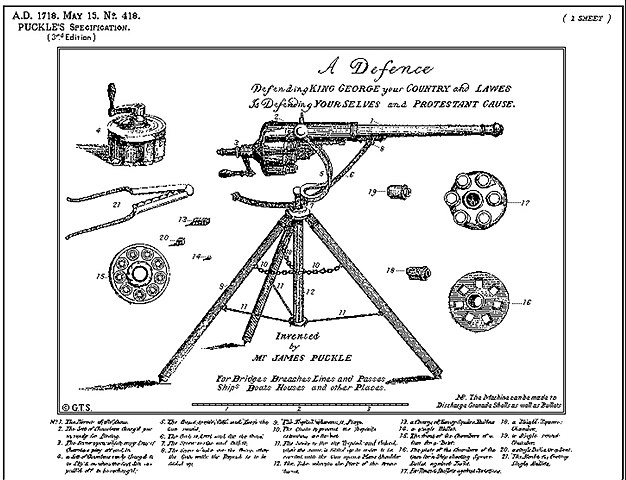
Recently My Own True Love and I were discussing machine guns over breakfast. (What, you’ve never discussed armaments over an omelet and an order of hash browns?)
In the course of settling the question of whether the Gatling gun or the Maxim gun was the first machine gun,* we discovered an ancestor of the machine gun that neither of us had heard of before. The Puckle gun, also known as the Defence Gun, was invented by British solicitor James Puckle in 1718. Down the rabbit hole I went.**
The Puckle Gun was designed to defend British ships against attack by Ottoman pirates, who attacked larger ships using small maneuverable boats. British ships were equipped with broad ship cannons designed for naval combat against ships of similar size. They could blow a Turkish ship out of the water, but only if they could hit it. They didn’t have the speed or flexibility needed to engage a moving target.
The Puckle Gun was repeating rifle, rather than a true machine gun. Mounted on a tripod, it was a single bore cannon with a flintlock firing mechanism and a revolving cylinder that could be loaded with round bullets, square bullets or powder and shot.*** Like the Gatling gun, the shooter operated the gun by hand-cranking the cylinder; unlike the Gatling gun, it fired one chamber at a time. Depending on its configuration, the cylinder could fire between six and eleven rounds before it had to be removed from the gun and reloaded. By eighteenth century standards, it was lightening fast. When it worked, the Puckle Gun could fire nine shots a minute, compared to the average musketeer’s rate of two to five shots per minute.
“When it worked” being an important point, apparently its flintlock mechanism was not only clumsy but unreliable. And while it could deliver roughly the same fire power as three men in the same time period, it required two to three men to handle. Not a net gain.
British officials did not jump to add the Puckle Gun to the armory. In addition to being unreliable, it was more difficult to make than a simple musket, requiring multiple complex parts and assembly that placed it well beyond the skills of most gunsmiths. (Personally, I don’t think the unintentionally humorous name Puckle Gun helped sell it as a serious armament.)
*Turns out that I was right. The Gatling gun was invented in 1862. The Maxim gun was invented in 1884. Not that I am gloating.
** Much to the confusion of Google, which thought sites about pickleball were a much better idea.
*** “Square bullets?” you ask. So did I. Puckett believed square bullet do more damage and designed this option specifically for use against Ottoman Turks. He reserved the more “merciful” round bullets for Christian enemies.
When Women Ruled the World
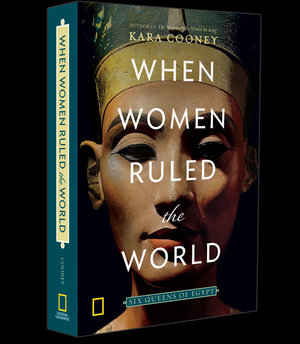
For some reason, I resisted reading Kara Cooney’s When Women Ruled the World: Six Queens of Egypt the first seven or eight times it crossed my path. I should have been all over that book. I’d been fascinated by ancient Egypt since I was about nine. Hatshepshut was the subject of the first adult biography I remember reading. But I dug in my heels * Not even Cooney’s engaging episode on the What’s Her Name podcast convinced me to, well, engage.**
I have now seen the light. I recently watched Cooney give a presentation on the material in the book on One Day University *** and started reading the book soon thereafter.****
When Women Ruled the World is a fascinating and accessible read, written in an informal style that in no way detracts from Cooney’s serious academic credentials.
Cooney begins with the question of why women have been and still are excluded from the highest levels of political power. (She points out that some of the most powerful women in American society are erased or forgotten in a very short time. In fact, I am embarrassed to admit that I had to look up one of her examples. None of us are innocent in this regard.)
She moves on to present ancient Egypt as an anomaly, where women were repeatedly called upon to rule in times of crisis. She introduces the reader to six women who ruled—five of them as kings in their own name. (I had only heard of three of them, and only knew that two of the three had ruled.) She traces the political crises that lead to each woman’s rule, and her accomplishments once on the throne. She considered the ways in which their names were (sometimes literally) erased from monuments and king lists by the men that followed them. The memories of those who couldn’t be erased were traduced. (I’m looking at you, Cleopatra.) And Cooney acknowledges that the same social structures that allowed them to take power, generally as placeholders for a “rightful” male ruler who was unable to rule, limited their authority: women rulers didn’t follow women rulers.
In short, I don’t know what took me so long. I guess it’s time to check out Cooney’s podcast, Afterlives.
* This is not the first time I’ve avoided a book for reasons that I can’t articulate—and that almost always turn out to be erroneous.
**It is possible that I got so wrapped up in the story she told that I didn’t connect it with the book.
*** A rabbit hole for history buffs and other passionate learners. Be warned.
****In all honesty, even if I had purchased the book the first time I heard about it, there is no guarantee that I would have gotten to it any earlier. Books come in faster than I can read them, as the piles in my office attest.***** I recently whittled my “must read immediately” pile down from 40 to 15—not including books that are research adjacent.
*****I recognize that my sentence construction suggests that I have no agency in acquiring those books. (Books come in. Mistakes were made.) But sometimes it feels like that is, in fact, true. At least that’s my story.
And speaking of women left out of history:
Those of you who are watching THE HARDER THEY FALL on Netflix may not realize that the character of Cuffee is modeled on that of a real-life woman, Cathay Williams, who disguised herself as a man and enlisted in the United States Army as William Cathay. I wrote about her in Women Warriors. You can read her story here: https://www.beaconbroadside.com/broadside/2021/11/gender-conceal-when-cathay-williams-went-to-war-in-disguise.html