




From the History in the Margins Archives (more or less): Lest We Forget
Here in the United States, we are heading into the Memorial Day weekend. In the past, My Own True Love and I have always found a way to honor the war dead on Memorial Day. We’ve gone to services in small towns and distant suburbs, usually put on local VFW chapters with a Boy Scout color guard, and visited military museums. In recent years, our go-to service has been the one put on in Grant Park, which manages to have all the emotional punch of a small town service even though it occurs in the heart of downtown Chicago.
In 2018, we had the amazing experience of attending the memorial service at the American Cemetery in Normandy, near Omaha Beach as part of a D-Day tour put on by the National World War II Museum in New Orleans.* (In some ways, the entire tour was an extended Memorial Day experience, defined by General John Logan, the official holiday’s founder, as “cherishing tenderly the memory of our heroic dead, who made their breasts a barricade between our country and its foe.”)
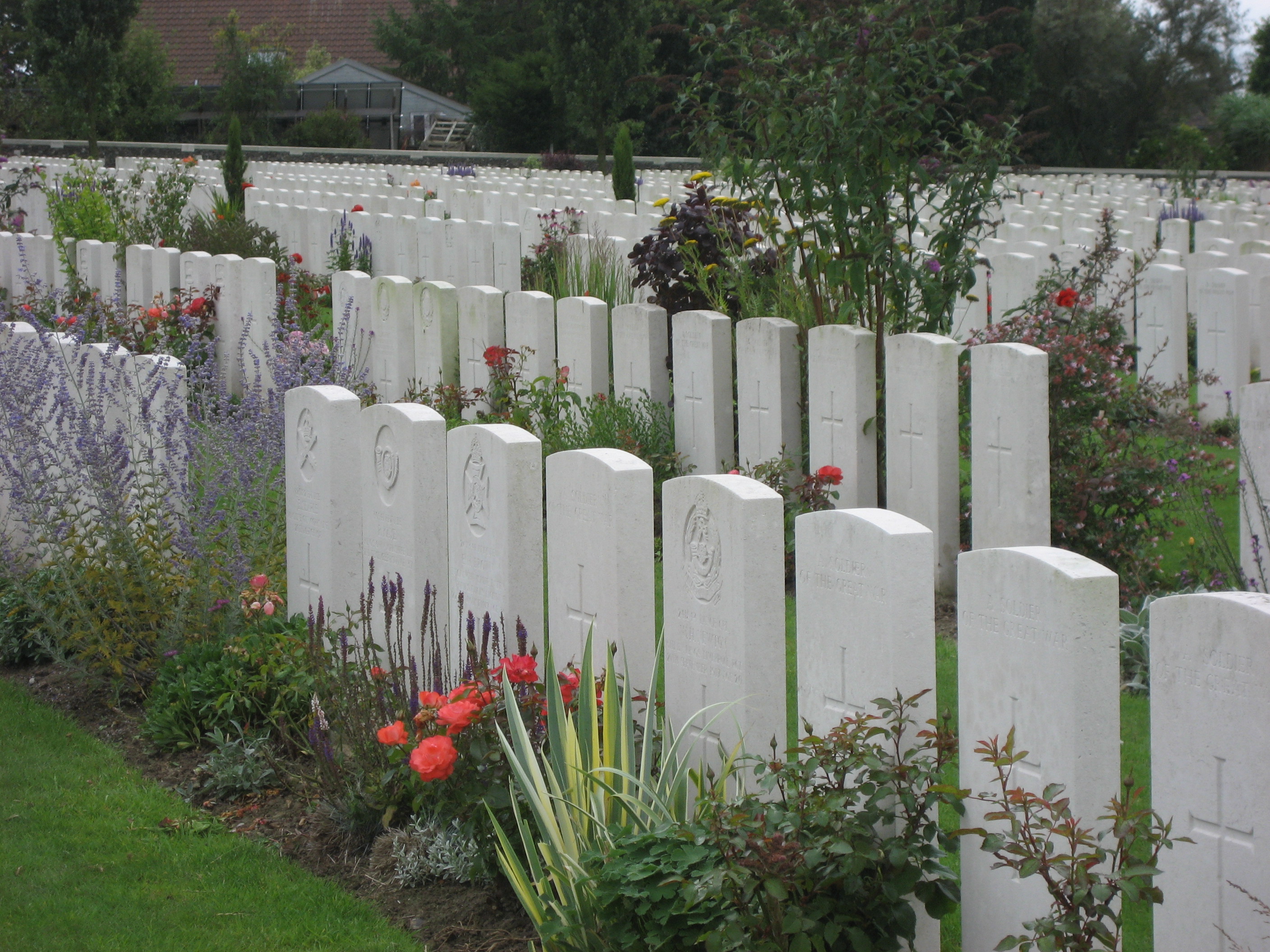
We expected the service to be a heart-wrenching experience, but it soon became clear that the official service was too distant to have much impact. For us, the real memorial service occurred when our guide led us through the cemetery, telling us stories about fallen soldiers, love, loss, and heroism. The National World War II Museum had provided us with a flower arrangement and a large number of white roses. One member suggested that we leave the arrangement on the grave of an unknown soldier. Another suggested that the veterans in our group present the arrangement. It was a powerful moment. Tears were shed. (In fact, I am tearing up typing this after the fact.) As a ceremony, it had all the impact that the official celebration did not. Afterwards, we scattered to place individual white roses on graves.**
As I walked back to the bus, I heard the sound of a lone bugle playing Taps at the end of the official celebration. I stopped to listen with a lump in my throat and an ache in my chest. The perfect ending.
Remember the fallen. Thank the living. Pray for peace.
*It appears that I never wrote a blog post about our visit to the museum back in 2015. The short version: it was fabulous. We signed up for an all-day special tour that was remarkable
** I would have liked to place mine on the grave of one of the four women buried in the cemetery. (I am pleased to say that one of the male members of the tour asked where they were buried before I could.) Unfortunately, their graves were in a portion of the cemetery that was roped off to protect the ground due to recent weather conditions. While I am perfectly willing to kick open a door when there is a good reason, this didn’t seem to be one of these times.
.
Eddie Rickenbacker in WWII: Not a Flying Ace, Still a Hero
First, a caveat: I got an email from a regular reader in response to my first post on Eddie Rickenbacker in which she said she had vivid memories of reading the story I’m about to tell you in the sixth grade. I’m pretty sure I first read this story a couple of weeks ago.(1) But it’s possible that all of you already know it. If so, humor me.
When the United States entered the Second War, Eddie Rickenbacker was the president of Eastern Airlines, and one of the most important figures in American aviation.(2) In September, 1942, Secretary of War Henry Stimson asked Rickenbacker to evaluate the condition of military equipment and personnel in England, calling on what Stimson described as Rickenbacker’s “clear and sympathetic understanding of human problems in military aviation.” (In other words, he’d been there and done that.) Stimson offered Rickenbacker a commission as brigadier general. Rickenbacker refused. Then Stimson offered him a commission as major general. Rickenbacker again refused. Captain Rickenbacker (3) accepted the job with an annual salary of one dollar and paid his own expenses. He wanted to maintain his independence as an observer.
When Rickenbacker returned to the United States a month later, Stimson sent him to perform a similar mission in the Pacific. (He also was given a message from President Rooosevelt to General MacArthur, with instructions to memorize it and deliver it verbally. We do not know what that message was, but the assumption is that it was a sharp response to MacArthur’s very public, very negative comments about the administration.)
After visiting several bases in Hawaii, Rickenbacker was given transportation to the South Pacific on an older B-17. En route between Honolulu and a fueling station at Canton Island, the B-17 went hundreds of miles off-course, due to an out-of-adjustment navigation device. Out of fuel, the aircraft’s commander, Captain William Cherry, was forced to ditch the plane in a little-traveled part of the Pacific. It was the beginning of a 24-day ordeal for Rickenbacker, his friend and business partner Colonel Hans Adamson, and the plane’s six crew members.
The eight men retrieved three rafts, some limited rations, and a few supplies from the sinking plane. They lashed the three rafts together to make a larger target. Rickenbacker immediately took charge, even though he was a civilian.(4) He doled out what food and water they had in equal shares each day.(5) He alternately cajoled and insulted the men. When one tried to commit suicide, Rickenbacker accused him of being a coward and hauled him back into the boat. Rickenbacker became the focus of the other men’s anger—anger which may have helped some of them stay alive. (He later found out that several of them swore an oath that they would survive just so they could have the pleasure of burying him at sea. )
They were constantly low on food and water. (And low may be too generous a description.) They collected rainwater when Pacific squalls blew through and caught occasional fish. (Though never enough.) At one point, a sea bird landed on Rickenbacker’s head. He reached up slowly (coached by the other men), caught it, twisted its neck, and divided it into eight equal shares. (They used the innards as bait for more fish.)
On November 13, navy pilots located the missing crew in the Ellice Island chain, more than 500 miles beyond their destination of Canton Island. All of them suffered from exposure, dehydration, and starvation. (One member of the airplane’s crew, Sergeant Alex Kacmarcyk, died before they were rescued. ) Rickenbacker had lost sixty pounds and was badly weakened by their ordeal. He could have gone home, where he would have received a hero’s welcome. Instead he chose to continue on his mission.
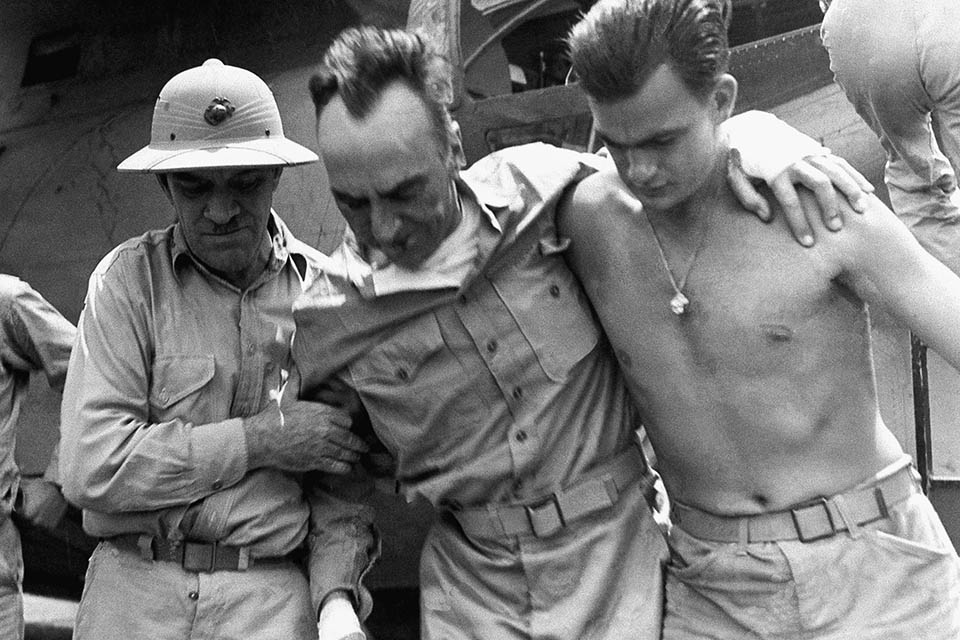
Once home, he made extensive recommendations to Secretary Stimson about additional equipment that would increase the chances of survival in life rafts, including a rubber sheet to protect the raft’s occupants from the sun and catch water and emergency fishing kits. His recommendations also led to the the development of a small kit to distill drinkable water from sea water. (Both items are now standard equipment on military life rafts.)

Workers with Rickenbacker’s life raft. Rickenbacker used the story of his rescue to illustrate the value of milage restrictions during the war: “One tire that is not wasted on pleasure driving may save the lives of seven men as ours was saved,.
In April, 1943, Rickenbacker accepted one more mission from Stimson: a three-month trip inspecting military bases and production facilities in Africa, Asia, and the Soviet Union.
As the 1944 presidential election approached, Rickenbacker was approached with the idea of running for president against Roosevelt, whom he had disagreed with often and loudly. He declined on the grounds that he was too controversial to win.
(1) If it was discussed in my sixth grade class, I wasn’t paying attention.
(2) The only American aviator of greater renown at the time was Charles Lindbergh, whose relationship with the United States military in World War II was complicated. But I digress.
(3) As I mentioned in my previous post, he was technically Major Rickenbacker at this point, but he continued to go by captain, a rank he felt he had earned. Anyone want to take bets on whether he would have accepted an honorary doctorate if someone offered him one?
(4) This should surprise no one. Rickenbacker was a Big Deal and used to running things. One of the crew members, Joe Bartok, speaking about the events in 1998 at Auburn University, probably summed up the feelings of them all when he said: “Captain Eddie Rickenbacker—when I was fourteen years old he was my hero because the war, World War I.” When Rickenbacker climbed into that B-17 9 years later, Bartok was more than a little star struck.
(5) Quoting Bartok again: “So the second day comes around we had an eighth of an orange…When I say an eighth of an orange, I don’t think you’ve got scales in this whole university that could measure an eighth of an orange as accurate as he did.”
Introducing Eddie Rickenbacker, America’s Ace of Aces

Capt. E.V. “Eddie” Rickenbacker wearing the Congressional Medal of Honor. (U.S. Air Force photo)
Recently My Own True Love and I were discussing aviation history over dinner, as happens more often than you might think. My recent blog post on the Hat in the Ring Squadron had led us to talking about Eddie Rickenbacker. As we pooled what we knew, we realized that there was more to his story than being a World War I flying ace.
Rickenbacker was already a minor celebrity before he gained fame as “America’s Ace of Aces” in World War I.
He was born in 1890 in Columbus, Ohio, the son of Swiss immigrants. His father was a day laborer. He died in a construction accident when Rickenbacker was twelve. Rickenbacker later wrote, “that day I turned from a harum-scarum youngster into a young man serious beyond my age.” In order to support his mother and four younger siblings, he took on any job he could find. He sold newspapers, eggs and goat’s milk. Always looking to earn more money, he worked in a glassmaking factory, a foundry, a brewery and a monuments works. In 1906, he got a job working as a mechanic for Lee Frayer, a race car driver who was an owner of the Frazer-Miller Automobile Co. Engines and cars became his passion. In 1912, he became a race car driver in his own right and soon earned a reputation for daredevil driving. (He set a world speed record at the Daytona 500 in 1914.)
When the United States entered the war in 1917, Rickenbacker volunteered. Not surprisingly, he wanted to learn to fly.* Celebrity or not, he didn’t fit the criteria. At 27, he was too old for the army’s pilot training and he didn’t have a college degree. Because of his fame as a race care driver, he was sworn into the army as a sergeant rather than as a private and given the assignment of chauffeur to Colonel William “Billy” Mitchell, now considered the father of the United States Air Force. Mitchell, himself a pilot, was the chief of the Air Service of the First Army. Rickenbacker pestered his new boss (and lied about his age) until he was approved to apply for flight training.
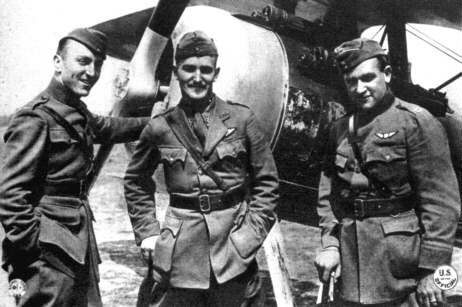
Aviators from the Hat in the Ring Squadron
Not surprisingly, the race car driver was a natural pilot, though he was afraid of heights and had to overcome a dislike for aerobatics. Seventeen days into his flight training, he was promoted to lieutenant and assigned to the 94th Aero Squadron, also known as the Hat in the Ring Squadron. At first he didn’t fit in to the squadron, which was largely made up of Ivy League college graduates. (One of them described him as a lemon on an orange tree.) Rickenbacker was older than the rest of the squadron, did not have a college degree of any kind, and had a distinct Swiss accent courtesy of his parents. His colleagues considered him a country bumpkin with no social graces and a tendency to throw his weight around. (So much for the value of celebrity.)
He may not have been immediately popular with the rest of the squadron but he soon became a darling of the American press, which dubbed him America’s Ace of Aces. He enjoyed his first victory on April 29, 1918, in conjunction with another member of the squadron. He was made squadron commander on September 25, and was promoted to captain by October 1. By war’s end, he had scored 26 aerial victories,** survived 134 encounters with German pilots, and flown 300 combat hours, more than any other American pilot in the war. He earned a Medal of Honor and the French Croix de Guerre.
When Rickenbacker left active duty, he was promoted to major, a title which he refused to use. Instead, he continued to use the title captain, which he felt he had earned.
After the war, Rickenbacker was an important player in both the automobile and aviation industries and continued to make headlines with heroic adventures, including making a thirteen-hour coast-to-coast flight in the Douglas DC-1 to protest using army pilots to deliver the mail*** and surviving 22-days in a rubber life raft in the Pacific when the B-17 on which he was a passenger ran out of fuel. An event that deserves its own blog post. Don’t touch that dial!
*He had taken his first airplane ride only six months earlier.
**Or 24.33 if, like the U.S. Air Force, you only give him partial scores for shared victories.
*** Rickenbacker described it as “legalized murder” because Army pilots were dying on the mail routes. Rickenbacker’s protest played a large role in the creation of the Civil Aviation Authority.