




From the Archives: The Ballet that Caused a Riot
This weekend I walked away from desk–deadline or no deadline–to go the ballet. The Joffrey Ballet performed The Little Mermaid–a version that had nothing to do with Disney and everything to do with Hans Christian Anderson. The performance was dark, brilliant, and demanding. We came away exhausted. Now I’m back at work at The Book, which is also demanding. May 1st is just a few days away. (Wish me luck!)
In the meantime, here’s a post from 2013 about another ballet that was dark, brilliant and demanding.
 On May 29, 1913, an excited audience, fashionably dressed according to poet and filmmaker Jean Cocteau* in “tails and tulle, diamonds and ospreys,”** waited for the curtain to rise at the Theatre des Champs-Elysées. Serge Diaghilev’s Ballet Russe was premiering a new ballet with choreography by Nijinsky and music by Igor Stravinsky– The Rite of Spring.
The Ballet Russe was a breeding ground of early twentieth century modernism.*** Diaghilev produced work that was innovative, exciting, challenging. The music for Stravinsky’s two previous ballets, The Firebird and Petrouchka had been agreeably avant-garde, just enough to make the fashionable crowds who attended the ballet feel proud of their sophistication but not enough to be unenjoyable.
The Rite of Spring, subtitled Scenes of Pagan Russia, was a different pair of toe-shoes. When the curtain opened, the audience saw the dancers sitting in two circles in a wasteland scene dominated by massive stones. When the music began, the dancers moved: knees bent, toes turned in, stamping and stomping in a dance style that was the antithesis of classical ballet. The music and dance alike were dissonant, brutal, and self-consciously primitive, telling the “story” of a pagan rite in which a chosen victim dances herself to death as a sacrifice for the spring will come.

The fashionable audience hissed and booed, primitive in their own way. Soon the noise from the audience drowned out the orchestra. The dancers couldn’t hear the music on stage; Nijinsky shouted out the count from the wings to help them keep time. Artist Valentine Gross, whose sketches of the Ballet Russe were on display in the lobby, later wrote, “The theatre seemed to be shaken by an earthquake. It seemed to shudder. People shouted insults, howled and whistled…There was slapping and even punching.”
Maybe not a riot by soccer standards, but pretty shocking for a night at the ballet.
* Best known today for the film Beauty and the Beast (1946).
**Large artificial plumes, not large fish-eating birds of prey.
***Over the course of his career, Diaghilev would commission librettos by Cocteau, sets by Picasso, Braque, and Matisse, and music by Ravel, Satie, and Stravinsky.
Jane Matilda Bolin: Another Guest Post by Rebecca Bratspies
I am delighted to have Rebecca Bratspies back with another story about a woman who deserves to be remembered.

On July 22, 1939 Mayor Fiorello LaGuardia appointed Jane Matilda Bolin to the New York City Domestic Relations Court (now the Family Court). This made Bolin the very first Black woman to serve as a judge in the United States. (LaGuardia was himself the first Italian-American to serve in Congress, and the second to be a mayor of a major US city. )
The appointment reportedly came as a surprise to Bolin. She was just 31 years old and had been working for the last two years as a lawyer assigned to the Domestic Relations Court on behalf of the City. On the fateful day, Mayor LaGuardia summoned Bolin, along with her husband and fellow attorney Ralph Mizelle, to the City of New York Building at the 1939 World’s Fair in Flushing, Queens. Bolin in fact thought she was about to get a reprimand of some kind. Instead, LaGuardia held a swearing-in ceremony.
LaGuardia emphasized that Bolin’s appointment, like all his other appointments, was made based on merit. While “merit” has recently become a code-word for anti-diversity efforts, LaGuardia meant the phrase differently. He was stating that the lack of Black officials was due to racism, and that merit-based appointments were an antidote to racial discrimination. Black newspaper coverage of her appointment repeatedly emphasized that Bolin was not appointed because of her race or gender, but in spite of them. There is no question she was eminently qualified.
The New York Times reported her judicial appointment under the headline “Negress Takes Oath of Office.” The Washington Tribune ran the story under the heading “Jane Bolin is Gotham’s First Woman Judge” with the subheading “Wife of D.C. Man Gets Job Paying $12000 yearly for 10 years.”
The pressure on Bolin to “make good” must have been immense. For her first twenty years on the bench, she was the ONLY Black woman judge in the United States. It was only in 1959, with Juanita Kidd Stout’s appointment to the municipal bench in Philadelphia, that Bolin had any company. (For perspective on how recent this all is, Jane Bolin was only two years older than my grandfather, her son is the same age as my mother.)
Before Judge Bolin made history as the first Black woman judge in the United States, she broke through many other barriers.
Bolin held degrees from Wellesley and Yale. Both institutions now proudly claim her, though her experiences at Yale and Wellesley were fraught with racial and gender-based hostility.
At Wellesley, Bolin was one of two Black students. (She had originally hoped to attend Vassar, but was rejected her because of her race.) Even though Wellesley admitted her, the school barred Bolin from living in the dorm with her white classmates. Bolin was forced to find housing off-campus.
Bolin graduated 1928 as a Wellesley Scholar, an honor given to the top 20 students in each graduating class. Despite her academic excellence, Bolin’s college counselor discouraged her from pursuing law school because she was Black. Even her father, himself a lawyer, tried to dissuade her from attending law school, though his concerns stemmed from his belief that women should be shielded from the seamier side of life.
But Bolin had grown up around the law, spending time in her father’s law office, and his shelves of leatherbound law books. Moreover, articles and photos of lynchings published in NAACP’s magazine The Crisis had shocked Bolin to her core, and inspired her to law school, and to public service.
Bolin persisted and after graduating Wellesley, she matriculated at Yale. She was one of three women and one of two Black persons attending Yale Law. Bolin remembered some of her fellow students taking delight in slamming doors in her face. Bolin reminisced that years later, after she was a judge, one of those very students later invited her to speak to his Texas ABA group. She declined.
Despite the hostile climate, in 1931 Bolin became the first Black woman to graduate from Yale. She was admitted to the New York Bar in 1932, and became the first Black woman to join the New York City Bar association. Despite her record of excellence, Bolin struggled to get a job. “I was rejected on account of being a woman, but I’m sure that race also played a part.”
In February 1933, Bolin and fellow attorney Ralph Mizelle married in secret for {reasons] (I don’t know what they were but I am confident they had some). Two years later, Bolin and Mizelle announced their marriage to the world and moved in together in the Inwood neighborhood of Manhattan. They briefly practiced law together though Mizelle soon became an assistant solicitor for the Post Office. In 1936, Bolin unsuccessfully ran for State Assembly as a Republican. The next year, she fought racial and gender discrimination to obtain a position with the New York City corporation counsel, the City’s legal department.
This job thrust Bolin into the public limelight. The Black press portrayed it as a significant racial advancement for Black people. Black newspapers began including Bolin on the list of heroes, alongside luminaries like Marion Anderson, Joe Lewis, Gwendolyn Brooks, Richard Wright, and George Washington Carver.
Fun Facts: In 1943, Bolin was part of the committee that welcomed fellow Wellesley graduate Madame Chiang Kai-Shek to Madison Square Garden. The committee chair was John D. Rockefeller Jr. In 1944, Bolin was named as one of Vogue Magazine’s “Women of the Year,” and in 1949 Ebony Magazine featured Bolin on its cover. In 1958, Bolin was included in Who’s Who of American Women.
Judge Bolin was a trailblazer on many work/life issues women still struggle to navigate today. Even though she was married to Mizelle, she continued to use her own name. Newspapers routinely referred to her as “Miss Bolin” (widespread use of the term Ms. only happened when another New Yorker, Geraldine Ferraro, became the Democratic candidate for Vice President of the United States.) Moreover, Mizelle and Bolin had a commuter marriage—he worked in D.C. while she was in New York City. She took maternity leave for the birth of her son Yorke Bolin MIzelle, and then went back to work.
As a judge, Bolin helped racially integrate the city’s child services, ensuring that probation officers were assigned without regard to race or religion, and that publicly funded childcare agencies served children without regard to ethnic background. Although widely respected for her judicial temperament, Bolin did not hesitate to call out racism. She issued subpoenas for police officers accused of beating a Black teenager on his way to school. She wrote a letter to President Roosevelt urging him to support anti-lynching legislation. When her hometown Poughkeepsie feted her as a local hero in the 1940s, she called the segregation in the town’s schools, hospitals, and government “fascist,” and criticized the town for “deluding itself that there is superiority among human beings by reasons solely of color, race or religion.”
In 1966, 27 years after Bolin was appointed to the New York court, Constance Baker Motley became the first Black woman appointed to a federal bench. Both Constance Baker Motley and Judith Kaye, the first woman to serve as Chief Judge of the NY Court of Appeals, cited Bolin as a role model and a resource. President Biden made history when he nominated Justice Ketanji Brown Jackson to the United States Supreme Court in 2021. Brown Jackson was confirmed by the Senate on April 7, 2022, making her the third Black person to serve as an associate justice and the first Black woman. (Of the 117 justices to serve on the Supreme Court, only 6 have been women and only 3 have been Black.) The ugly slurs directed at Justice Brown Jackson in 2021, in terms of her abilities and qualifications, might give a slight window into what Judge Bolin undoubtedly navigated daily.
Judge Bolin remained on the bench for 40 years, only retiring when she hit New York’s mandatory judicial retirement age of 70. The Judicial Council of the American Bar Association honored her for her service. Even after retiring, Judge Bolin continued to serve on the boards of the NAACP, the National Urban League, and the Child Welfare League. She was also a member of the Regents Review Committee of the New York State Board of Regents.
Every legislative session since 2017, New York state Assembly member Jeffrion Aubrey has introduced a bill in the NY State Assembly to rename the Queens–Midtown Tunnel the Jane Matilda Bolin Tunnel in her honor. Count me on Team Name It For Bolin! I cannot think of anyone more deserving of this kind of honor!

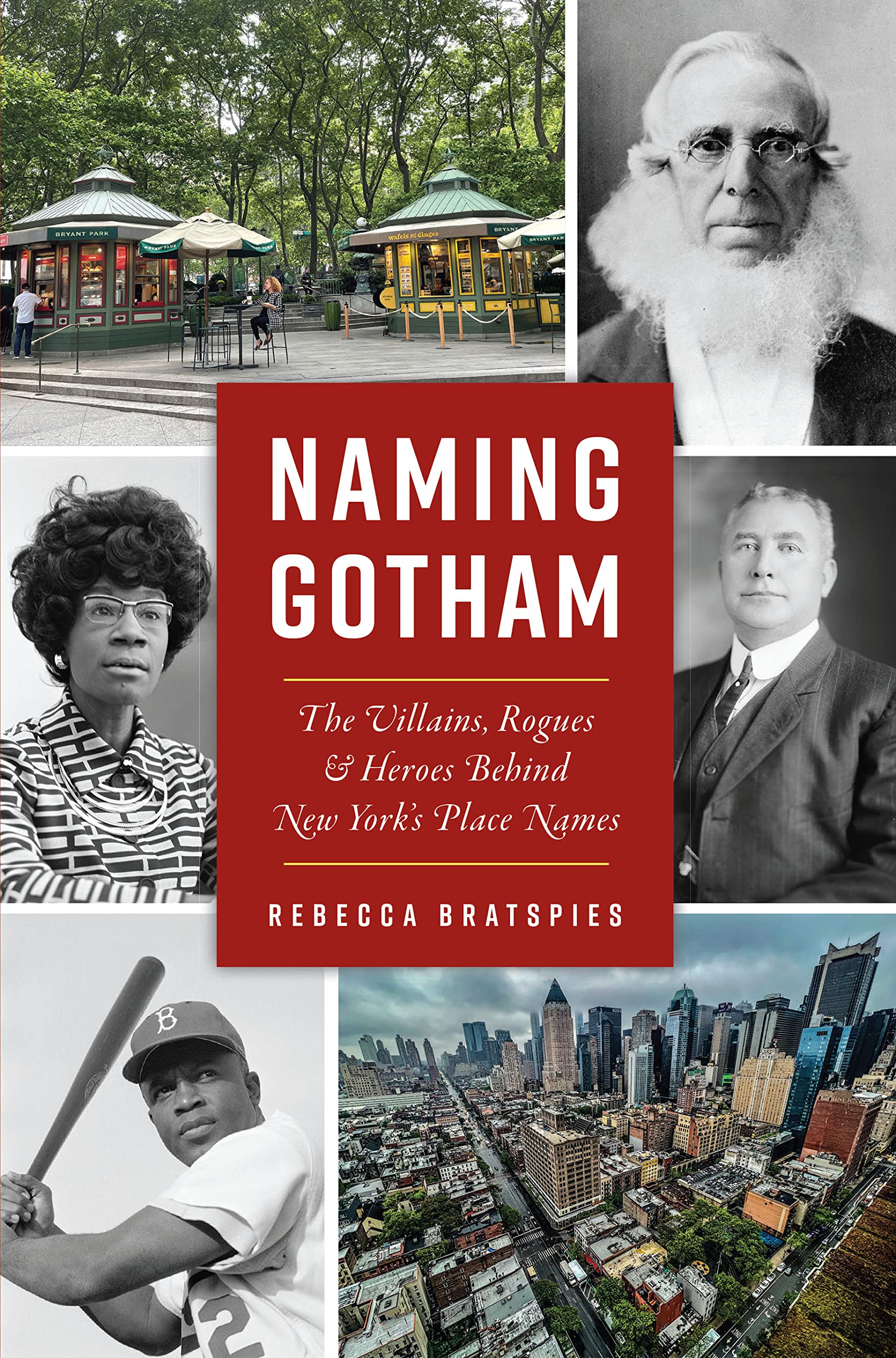
Rebecca Bratspies is a longtime resident of Astoria Queens. When not geeking out about New York City history, she is a Professor at CUNY School of Law, where she is the founding director of the Center for Urban Environmental Reform. A scholar of environmental justice, and human rights, Rebecca has written scores of law review articles. Her most recent book is Naming New York: The Villains, Rogues and Heroes Behind New York Place Names.
Big Fun!
From the Archives: You Could Look it Up.
As I write this, the deadline for my manuscript is 11 days away. (Eek!) I am deep in revision mode. It’s not a straight line process. I just added 134 words to a chapter from which I need to cut many, many words. Thousands of words. And yet the chapter is better for it. (Though it means I now have to cut an additional 132 words somewhere.) While I revise, here’s a post from 2016 for your amusement. Enjoy!
 I am a reference book junkie. I collect reference books the way some people collect Fiesta Ware, Oriental rugs, salt shakers, or black pumps.* I argue that they are useful to me in my career. And sometimes it’s true. (The construction dictionary that I bought more than 25 years ago is proving useful in my current project.) But the immediate needs of my writing career provides no explanation for the itch to acquire, for example, an English to Polish dictionary or an encyclopedia of gods or an historical atlas of Byzantium or–well, you get the idea.
Thanks to author Jack Lynch, I now have a grander explanation for my fascination with reference books.
In You Could Look It Up: The Reference Shelf From Ancient Babylon to Wikipedia, Lynch argues that reference books are “a civilization’s memoranda to itself”.** In looking at a society’s reference books you learn not only the facts contained therein, but something about what that society valued. (Or what some of a society’s members valued: the annotated list of prostitutes from eighteenth century London, for instance, had a specific audience.)
Each chapter pairs two works dealing with similar topics—words, medicine, games, the arts–and places them in historical context. Lynch begins with the ancient law codes that are our oldest reference books and ends with modern books of trivia, which transform the reference book from a compendium of essential knowledge to an amusement for browsers.
The stories of the individual books are fascinating in and of themselves. (The Guinness Book of World Records began as a promotional item designed to settle drunken wagers in pubs.) But some of the most startling revelations come in the form of what Lynch dubs “half-chapters”, short essays in which he investigates broader topics related to reference books, including the antiquity of complaints about information overload, the relative late adoption of alphabetizing as an organizational structure, and the introduction of deliberate errors by reference book editors.
In the end You Could Look It Up is a history not simply of reference books as a genre but of the broader question of how we organize information and why.
*By which I mean shoes, not the working end of a well. Though I suspect that someone somewhere collects black pump handles. The collecting passion is idiosyncratic, personal, and occasional inexplicable.
**Now there’s an excuse for reference book acquisition!