




Road Trip Through History: Legacy of the Plains
The first thing we saw as we drove into the parking lot of the Legacy of the Plains Museum in Gehring, Nebraska, was a half dozen Longhorn cattle that were milling around, while a man who looked nothing like a cowboy waved his arms and tried to shoo them back into their pen.
It turned out to be the perfect introduction to the museum, which turned out to be the perfect counterpoint to the Buffalo Bill Center of the West. The Center of the West described itself as being about the Wild West, and in fact focused in broad terms on cowboys and Indians. The Legacy of the Plains, previously the Ranch and Farm Museum, tells the story of settling the west from the perspective of, well, ranchers and farmers, broadly defined. And it was absolutely fascinating. We spent the better part of a day there.
The first rooms of the museum are deceptive. They look like many other local history museums, with a collection of stuff displayed with little sense of museum craft. Some of the objects had a story attached. Some were displayed with no explanation at all.* Interesting enough, but nothing special.
Then I walked across the hall and through a closed door and found myself in a different museum all together. The first room is an long darkened space where an introductory video plays continuously above a series of interactive panels that introduce themes that are developed more fully inside the main museum, which is an impressive professionally designed space with well-done audio visual displays and interactive exhibits.**
The main museum explores a lot of topics that we had seen discussed in less depth in smaller museums or on historical markers over the course of the trip. Here are the big picture themes that caught my imagination, with some smaller details:
1. The first exhibit after you enter the main hall looks at the region as a historical crossroads: Beginning with the peoples who traveled the plains during the Paleolithic period, the exhibit then looks at the development of generations of routes and roads based on well-established Native American trade routes. Fur trading routes developed into emigrant trails, such as the Oregon Trail, beginning in the 1830s.*** The railroads followed, finally reaching the North Platte Valley at the end of the century, and eliminating the older trails and trading posts in the process. Railroads in turn were challenged by the arrival of paved highways after World War II. ( My favorite quotation from this section? “Railroads made the Oregon Trail obsolete. Automobiles brought it back.” Personally, I think this theme was a very smart way to cover a lot of historical ground. So to speak.
2. Several sections of the exhibit look at the history of settlement in the area, notably homesteading and immigrant groups who settled in the region. Here are a few stories/fact-lets from these sections that caught my imagination:
- The Homestead Act of 1862 allowed single women and African-Americans to claim homesteads—and they did. This was huge.
- The first homesteader was Daniel Freeman, who reportedly claimed his 160-acre tract in Nebraska ten minutes after midnight on January 1, 1863, the day the act went into effect. (My guess is that this is comic-book history at its finest. ) The Homestead National Historical Park is located on the site of his claim.
- Freeman made history a second time thirty years later when he tried to stop the local schoolmarm from teaching the Bible in the classroom. After the school board brushed him off, Freeman took the case to court. He lost at the local level, but won when he took the case to the Nebraska Supreme Court.
- The last homesteader was Ken Deardorff, a Vietnam veteran who filed a claim for eighty acres of land in Alaska in 1974.
- Most of the immigrant groups described in the exhibits were variations on the usual suspects, but one took me by surprise: the area around Scottsbluff had a substantial population of Japanese immigrants. Beginning around 1900, Japanese came to the area to work on the railroad and then found jobs as laborers in the area’s growing sugar beet industry. By 1913, some 200 Japanese families had established themselves as sugar beet farmers in their own right. In World War II, a number of the Japanese families were able to avoid the internment camps and stay in Nebraska, sponsored by local families. (The volunteer on the desk claimed that most of them were not interned at all because they worked in an essential industry. The exhibit did not corroborate this, but I surely wish it were true.)
3. A large portion of the museum dealt with farming. Much of it focuses on farming in a semi-arid climate, which was all new two me. It discussed the differences between dry-farming and irrigation and the conflicts between farming and cattle ranching. **** (Cattle herds arrived from Texas in the 1860s, after the buffalo herds had been almost demolished. The Nebraska sand hills were rotten farmland, but they turned out to be ideal for raising cattle. ) The exhibit includes lots of examples of vintage farm equipment, with descriptions of how they work and how they changed over time. (Not just plows and harvesters, but specialized equipment like bean cutters and beet harvesters.) I must admit, my favorite part of the farm section was the interactive quizzes about farm animals, in which I demonstrated that I know a lot more about pigs than I do about sheep.
The museum also includes an 80-acre working farm, complete with those Longhorn cattle. The museum sells calves to help finance it’s programs and holds a Harvest Days festival in the fall at which visitors can see antique farm equipment in action harvesting the year’s crop and harvest potatoes from a “pick your own” patch. Big fun!
*I really wanted to know more about the non-electric portable piano from the early 1900s: a keyboard in a box, about the size of a modern electronic keyboard, with folding legs and a handle. I cannot imagine how it worked since it did not appear to have room for strings. I haven’t been able to find anything like it. And I wasn’t bright enough to take a picture.
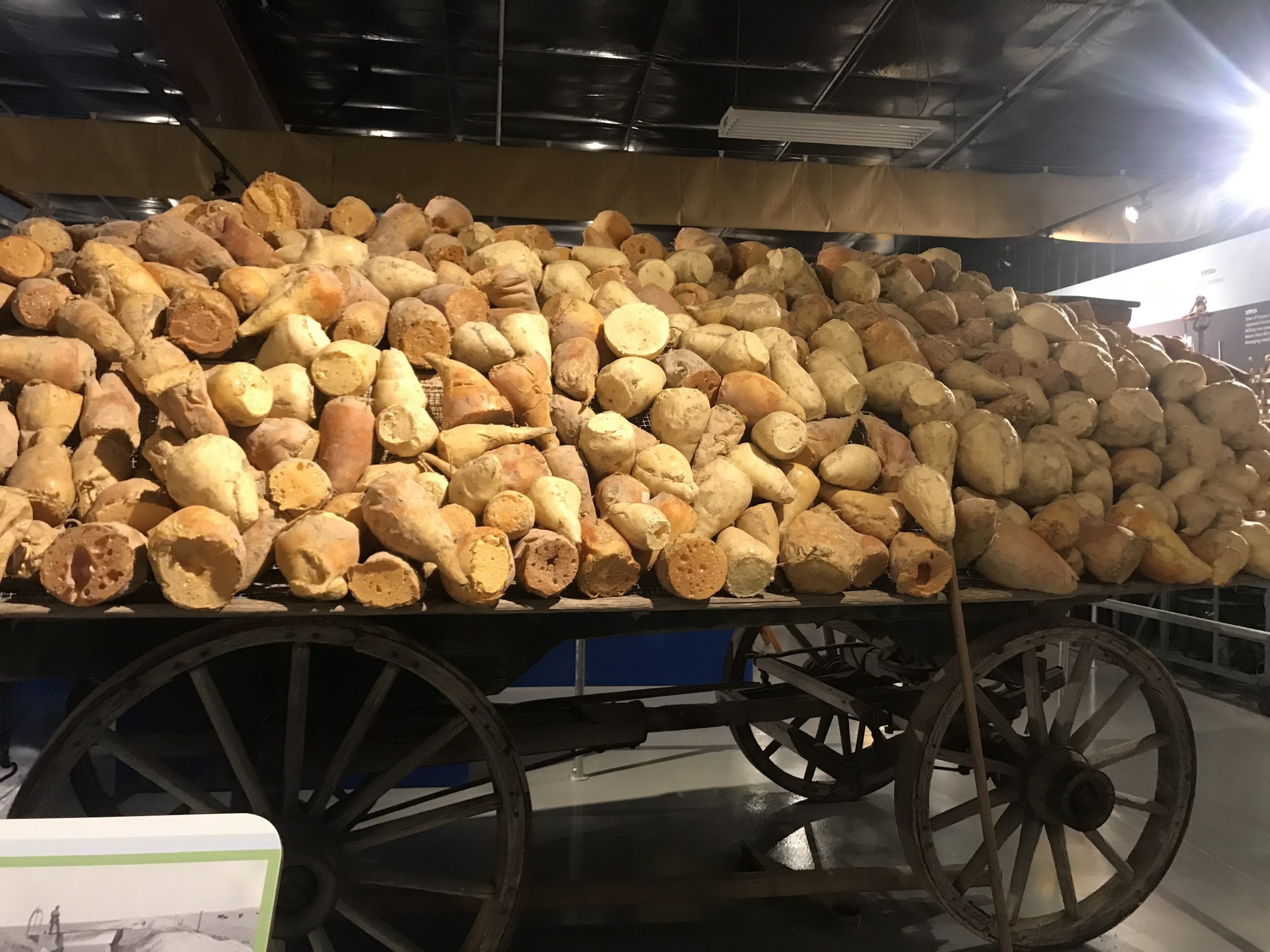
**The volunteer at the front desk told me that they hired a museum professional from New York to design the space, but they provided the information and some sweat equity in building the exhibits. For example, a group of women created the realistic-looking sugar beets in this wagon out of styrofoam:
*** I don’t know about you, but I had no idea these westward trails were called “emigrant trails” until I saw this exhibit. I’m prepared to believe that it is a term of art since the National Park Service also uses it in its series of articles on settlers heading west.
****I spent the rest of my time in the museum with this playing in my head:
Road Trip Through History:Empire, Wyoming and Black Homesteading
This barely counts as a “road trip through history” post. It is more of a “a historical marker sends me looking for more information” post.
The historical marker gave the bare-bones account* of Empire, Wyoming—a short-lived community of Black homesteaders in Goshen County, near the Nebraska-Wyoming border. The marker ended with this sentence: “Empire remains a powerful reminder of the struggles and achievements of African Americans who migrated to the plains seeking land, education, and civil rights.” As far as I was concerned, it was more than a reminder, it was a whack up the side of the head. My mental image of homesteaders has always been populated with white faces.** As soon as we got home I went looking for more information, about Empire, Wyoming, in particular and Black homesteading in general.
Here’s my own bare-bones version:***
Empire was initially settled in 1908 by three families who were closely related by marriage. The Enlarged Homestead Act allowed each family to claim 320 acres.*** *Unlike many homesteaders, they arrived with experience with dryland farming and financial capital to invest in their new farms. Several of them had advanced degrees. Their claims became the foundation for the community of Empire, which grew to about sixty people at its peak in 1915.
Eventually ten families “proved up” homesteads. Other residents directly purchased land or did not claim land at all. By 1909, the community had a schoolhouse and had hired a young black teacher from Cheyenne. (They successfully used a Wyoming law requiring segregation in any school district with more than 15 non-white students to wrest control of their school from the local white-controlled school district.) By 1912, the town had two churches and its own post office. It looked like Empire was a success.
But the challenges of dryland farming were nothing compared to the challenges posed by the racism of white settlers in surrounding communities. The most horrific of the race-based incidents occurred in November 1913—in form that feels all too familiar—with the arrest of Baseman Taylor. Accounts vary as to the reason for his arrest, but witnesses stated that the sheriff and his deputies beat and choked Taylor repeatedly He died in custody three days later.
The community broke into factions after Taylor’s death. Residents began leaving. Some relocated only a few miles, searching for better access to water. Others moved to the larger Black settlement in Dewitty, Nebraska. By 1920, the farms had largely been abandoned. By 1930, only four Black residents remained in Goshen County and the town was gone.
Empire did not last, but other groups of Black homesteaders seized the opportunity to own land and created communities that survived. ***** Once again, it turns out that a story I thought I knew had big holes in it.
*Not a criticism. Historical markers, by their nature, always give bare-bones accounts. This one at least included a couple of photographs, a plat of survey of the homesteaded area, and an image of a homestead patent.
**Not unlike our cultural image of cowboys.
***With thanks to blackpast.org, the Wyoming State Historical Society, and the Homestead National Historical Park in Beatrice Nebraska, which is run by the National Park Service and is now on my list for a future road trip. There is no historical site for Empire itself, only two historical markers.
**** The Enlarged Homestead Act was passed in recognition of the difficulties of dryland farming in the semi-arid land of the western plains. The act expanded the number of unirrigated acres a family could claim from 160 to 320.
***** The first and most dramatic examples came in the 1870s, when more than 25,000 Black Americans, known as the Exodusters, poured into Kansas, which had a history of abolitionist sympathies and a state constitution that declared landownership was open to settlers regardless of race. This probably deserves a blog post of its own down the road. So many stories I’ve never heard.
From the History in the Margins Archives: Custer’s Last Stand?
And speaking of Buffalo Bill, as I believe we were, one small exhibit in the Buffalo Bill Museum circled around the question of the Battle of Little Bighorn.
The focus of the panel, titled “Trail to the Little Bighorn”, was on the role the battle of the Little Bighorn played in Buffalo Bill’s Wild West Show. Cody’s troupe first performed a “re-enactment” of what he called “Custer’s Last Rally” in 1888 at Madison Square Garden. It was wildly popular, and the show would perform it thousands of times over the years—sometimes using actual participants from both sides of the battle as performers. Custer’s widow, who spent 50 some years after Custer’s death burnishing her husband’s memory as a hero, wrote to Cody praising the show’s “terrible” realism. (There is an ambiguity there that I suspect she didn’t mean.)
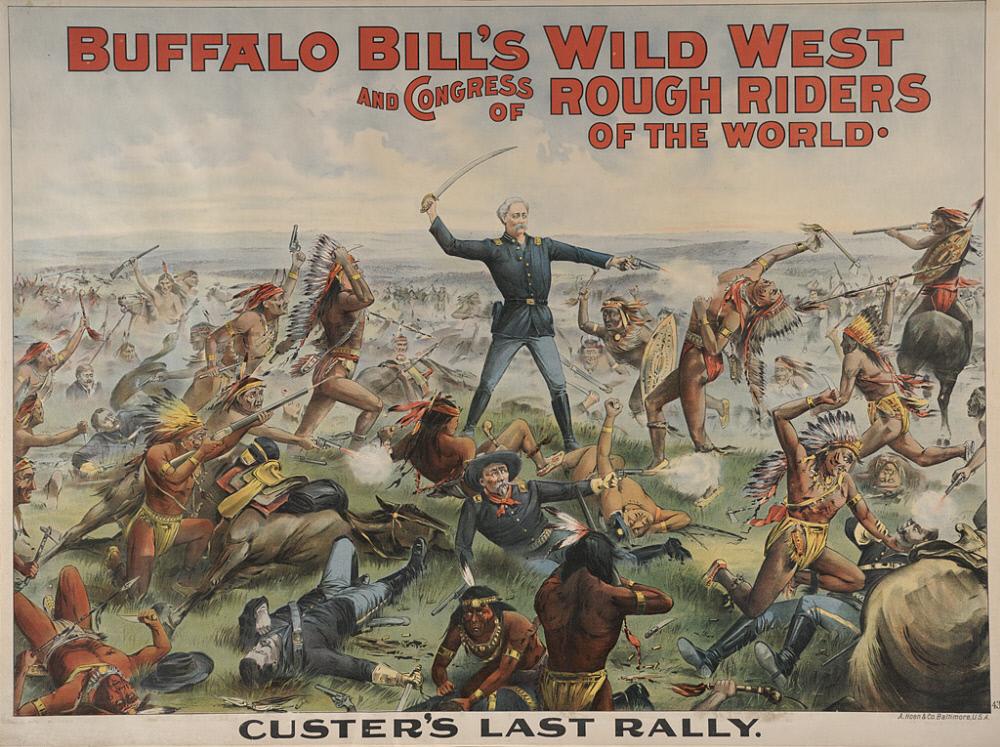
The exhibit tiptoed around the question of the battle itself, and the changing nature of Custer’s reputation over time.* (In all fairness, Custer and the battle were not the real topic of the exhibit.) Which led me right back to this [lightly edited] post from 2016, in which I offer you a few thoughts on Custer’s defeat and how we report on historical events. I think they hold up five years, almost to the day, after I first wrote them.
* * *
Sometimes I think that no matter how much we may know about history as individuals, collectively we know nothing at all.
Case in point: Custer’s Last Stand.
I am currently working on an article that is about a painting about the event that you and I have always known as Custer’s Last Stand.(1) I went into the piece with only the vaguest sense of the historical event, something I felt no shame about because American history is not my field. Here is what I had going in:
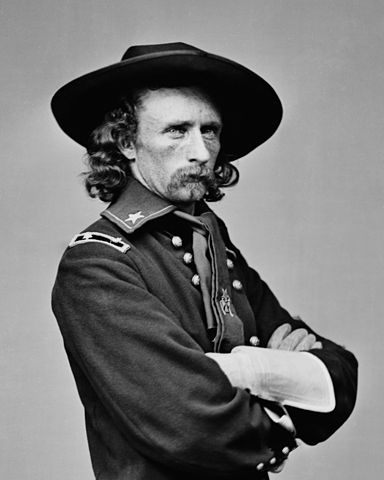
Custer during the Civil War. The long curls were gone by Little Big Horn.
- Custer was a Civil War hero, and he was as problematic after the war as that other Civil War hero, Ulysses S. Grant. Though not in the same way.
- A small group of soldiers under his command died fighting a large group of Native Americans at the Battle of Little Big Horn
- A vague sense that Custer was at fault(2)
- A certainty that it must have been a critical battle, because otherwise why would I have heard about it?
- It occurred after the American Civil War, during the period when the west was “opened”.(3)
None of that is completely wrong. Except for the part about it being a critical battle. It wasn’t. Whether you think the death of the Seventh Cavalry at the Little Big Horn on June 25, 1876 was a military blunder or an act of heroism–or both(4)– the battle changed nothing. It was barely a battle, even by nineteenth century standards. It had no lasting effect on the so-called Indian Wars, or on the drawn-out dreary campaign of which it was a part. The Sioux won the battle, but gained nothing by their victory.
The battle/fight/skirmish is historical fact, but it turns out that the popular image of that skirmish as a “last stand” is an artist’s creation, reinforced by other artists’ creations over the last 140 years. And the power of that largely mythical image is one reason an otherwise meaningless military encounter became, and remains, an important emblem of a ugly struggle that stands at the root of America’s westward expansion.
When it comes to the the Battle of Little Bighorn, we don’t actually know what happened and the question of whether Custer showed poor judgment continues to be hotly debated among those who care. The Seventh Cavalry, under Custer’s leadership, was intended to be one prong of a three-pronged campaign to encircle the Sioux and drive them from their treaty territory. When Custer’s scouts reported the discovery of a Sioux village, Custer divided his forces into three parts, keeping only five companies with him to face what turned out to be a much larger force than the US Army had originally estimated. Companies under the leadership of Captain Benteen and Major Reno retreated to a defensive position on the bluffs rather than attacking an overwhelming force. As for Custer, the last thing we know of him is his often-quoted final message: “Benteen. Come on. Big village. Be quick. Bring packs. W.E. Cooke. P.S. Bring packs.” According to Trumpeter John Martin, who carried the message, Custer was about to charge the village as Martin left.
This is the point at which traditional histories often say that no one survived the battle. In fact, hundreds of people survived the battle–most of them members of the Sioux and Cheyenne nations. Some of them left their own accounts of the battle, but those accounts disagree about the actions taken by Custer’s troops. (This should come as a surprise to no one. Soldiers in the front line of battle seldom have a sense of the big picture.)
Maybe the battle, from the perspective of the 7th Cavalry, was a heroic last stand.(5) Maybe it was a rout. The one thing we can say for certain is that whatever happened, it probably didn’t look like this:

William Cary’s Death Struggle of General Custer appeared on July 19, 1876
(1) If you’re interested, it appeared in the Winter 2017 issue of MHQ: The Quarterly Journal of American History
(2) Almost a reflex for me. I was twelve in 1970, when Little Big Man hit the screen and Bury My Heart at Wounded Knee was released, The ironic Western and revisionist examinations of Native American history are deeply rooted in my brain. Possibly my first step in a career based on trying to walk in someone else’s historical shoes.
(3) A phrase that ranges from problematic to horrific. Once you start looking at a period of history with an awareness that there are two sides to every historical event you find linguistic pitfalls everywhere. I have no good answer for how to cope with this other than to type with my eyes wide open and carry a large bag of quotation marks.
(4) The two are not mutually exclusive. Think the Charge of the Light Brigade.
(5) According to the OED, a last stand is “an act of determinedly holding or defending a position against a (more powerful) opposing force; a final show of resistance or protest”. Wikipedia adds a few critical elements from the popular definition: the defensive force usually takes very heavy casualties or is completely destroyed and (most important for the rest of this discussion) the last stand is a tactical choice taken because the defending forced recognizes the benefits of fighting outweigh the benefits of retreat or surrender.