




From the History in the Margins Archives: The Sand Creek Massacre
As we drove across Wyoming, heading toward the western-most point of our trip, I noticed signs stating that we were on the Sand Creek Massacre Trail, which confused me slightly since I knew that the massacre occurred in Colorado. A quick internet search informed me that the trail was a 600-mile stretch of road from the Wind River Reservation in central Wyoming to the site of the massacre. The joint project of the Northern Arapaho people and the state 0f Wyoming commemorates the wandering of the Northern Arapaho and the Cheyenne in the years after the Massacre.
I first came across the story in 2019. I think it’s worth sharing the post I wrote at the time again. (With a few tweaks.)
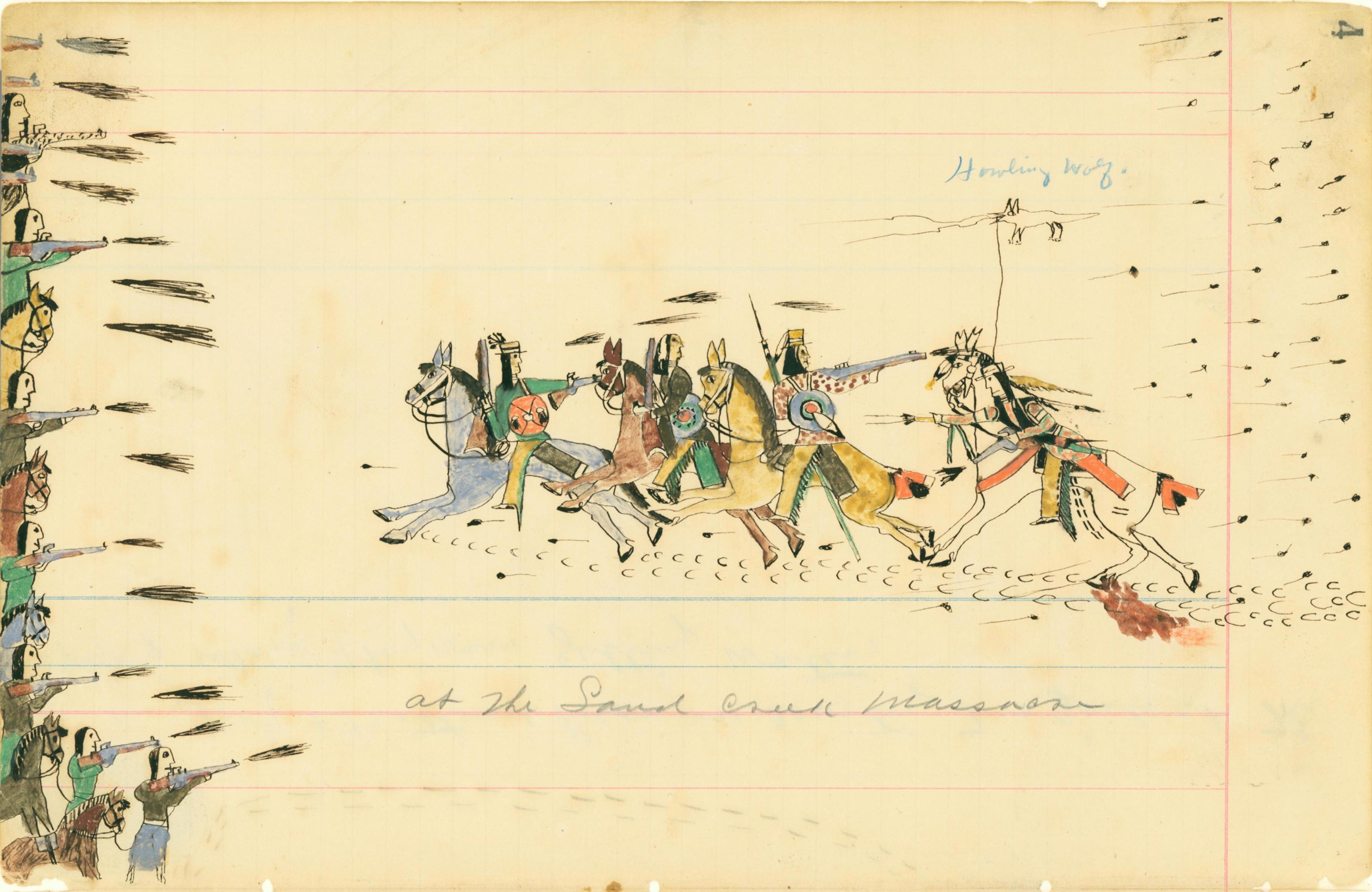
I assume most of you, at least in the United States, have heard of the Battle of Wounded Knee, the final battle of the Plains Wars of the late nineteenth century and the focus of Native American activism in the 1970s.(1) But have you heard of the Sand Creek Massacre?
I stumbled across the story while working on a article on the ledger art of Howling Wolf (2) for MHQ, The Quarterly Journal of Military History Quarterly. I’ve been coming across references to the event ever since.
Here is the rough outline of what happened:
In November, 1864, a group of Cheyenne and Arapaho settled at Sand Creek, 170 miles southeast of Denver. The inhabitants had recently concluded peace negotiations with the governor of the territory and had every reason to believe they would be safe in their camp. [It’s worth noting that this occurred during the American Civil War: something I didn’t notice when I wrote this piece.]
At dawn on November 29, 675 members of the Colorado volunteer militia led by Colonel John Chivington attacked the village. Adult male warriors of the tribes, taken by surprise, attempted to defend the noncombatants, mostly women, children and the elderly, many of whom fled into the dry stream bed for which the village was named. The soldiers followed them, shooting. At a point several hundred yards above the village, the Cheyenne and Arapaho dug pits and trenches to protect themselves. The militia positioned howitzers on the opposite bank and bombarded their improvised defenses. Over the following eight hours, the militia killed roughly one third of inhabitants of the village (estimates as to the size of the village and the number dead vary), most of them noncombatants. The next day the militia returned, set fire to the village, killed the wounded, and mutilated the bodies.
The events were horrifying, but not uncommon in the larger context of the Plains Wars. What made them extraordinary was their aftermath. At first, Chivington was praised for the attack, which was framed as a pacification effort. But a different story began to emerge as soldiers who were opposed to the day’s actions filed reports that described the massacre in chilling detail. In response, Congress began an investigation of the events. A Congressional committee eventually ruled that Chivington had “deliberately planned and executed a foul and dastardly massacre” and “surprised and murdered in cold blood” Native Americans who “Had every reason to believe that they were under [government] protection.” The only reason Chivington wasn’t court-martialed is that he has already resigned his commission.
The deaths at Sand Creek were also the death of any hope of peace on the Plains. Many young warriors of the Plains nations saw the massacre as proof that treaties with the United States meant nothing. (A not unreasonable conclusion based on years of evidence.) Formerly divided nations united in opposition to the United State’s western expansion. Sand Creek was the first step on the path to Wounded Knee. (3)
Today Sand Creek is a historic site maintained by the National Park Service.
It is clear to me that there is a great deal I don’t know about this event, including how it fits into the larger stories of the Plains Wars and the American Civil War. I do know the place to start: Ari Kelman’s A Misplaced Massacre. One more book on the To-Be-Read list. One more topic I want to know more about..
(1) Though I must admit that is the sum total of what I knew about Wounded Knee when I wrote this post. I had somehow failed to read Bury My Heart at Wounded Knee at the time all my friends were reading it the ’70s. I’ve made up for it since.
(2) Not to be confused with blues artist, Howling’ Wolf. Though both of them had good reason to howl.
(3) Am I the only one seeing parallels to the Amritsar massacre here?
Road Trip Through History: Fort Robinson
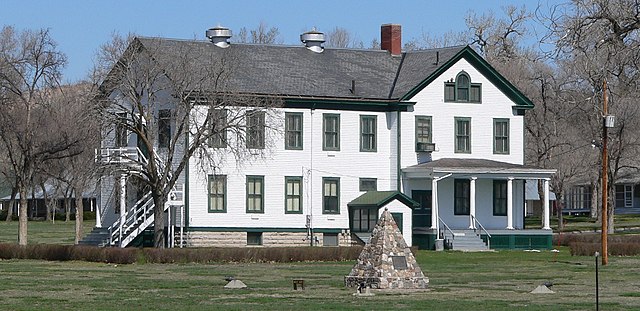
Previously the post headquarters, now the history museum.
Forts and so-called “Indian agencies” and the relationship between them were a recurring them on our trip through the western plains.* The simple version is that agencies were established at various locations to manage trade and treaty obligations between the United States and the Native American nations. In theory, the agencies were intended to insure that both sides of the trade honored the rules and to negotiate disputes between them. But as treaties were negotiated and reservations were established, the relationships between the agencies and those nations became, let’s just say complicated. Increasingly, forts were established nearby to protect the agencies.**
For the most part, our experience of Indian agencies and forts was limited to historical markers. Most of the historical sites we passed were well off our path, and the sheer distances we were traveling each day meant we were less inclined to wander off the trail than we have been on previous trips. But Fort Robinson State Park was right on the way to our next planned stop.
Fort Robinson was an active military post for 74 years, from 1874 to 1948. Today, it is surrounded by a 22,000 acre state park. My guess is that for many park guests, the historical museum located in the 1905 military post headquarters is something to do on a rainy day or when people are worn out from too much outdoor fun. There certainly weren’t many people there during our visit. (In all fairness, we got there about an hour before the museum closed.)
The post was established in 1874 to “protect” the Red Cloud Agency. It was named after Lieutenant Levi Robinson who was killed by Native Americans from the Red Cloud Agency*** and played a critical role in government strategy in the Sioux Wars of 1876-1880.*** With the arrival of the railroad in the mid-1880s, which made it possible to move soldiers quickly as needed, Fort Robinson became the most important military post in the region, with its soldiers involved in the Cheyenne Outbreak, the Fort Robinson massacre (one guess as to who was massacred), the death of Crazy Horse, the rise of the Ghost Dance movement, and the tragic events at Wounded Knee. The fort served as cavalry re-mount station in World War I and as a K-9 dog training center and camp for German POWs in World War II.
Here are two of the tidbits that caught my imagination:
- The second and third Black graduates from West Point served as lieutenants with the 9th Cavalry, one of two all-Black cavalry regiments (known as buffalo soldiers) that were stationed at Fort Robinson in 1885. For the most part, they were involved in support services, like repairing telegraph lines. But the 9th Cavalry was given the job of monitoring the Ghost Dance movement and the 10th Cavalry was sent on a long winter march to rescue the all-white 7th Cavalry from Drexel Mission, where it was trapped after the Battle of Wounded Knee.
- The official K-9 corps was a new development in World War II. People were asked to donate their dogs to serve in the K-9 corps. (Personally, I cannot imagine donating a family pet for military service. It seems like a horrible betrayal.) Almost 18,000 dogs arrived at the various training centers; about 8,000 failed the physical and mental assessment. (Roughly 30% of their human counterparts also were disqualified as physically or mentally unfit.)
All told, an excellent way to spend an afternoon.
*Every time I type that I hear “Out of the clear blue of the western sky, comes Skyyyyy Kiiiing” in the back of my head. Which I realizes dates me. Though not as much as you might think. I only knew the show as a re-run in the late afternoon dead spot after day-time television and before the evening news. It was clearly dated at the time and I loved it.
** Neither the museum exhibits or any of the sources I consulted on Fort Robinson in particular or the Indian agencies in general addressed the question of who was being protected from what. Which leads me right back to the questions of who tells the story of the United States’ westward expansion, how they tell it, and what assumptions they begin from. (And by they, I mean all of us.) As I write these posts, I am almost painfully aware of how seldom this is addressed in even the best exhibits. And how easy it is to let my mind slide over its absence.
***Which tells us something about point of view.
**** Which should probably be called the Lakota Wars—this period of western history is a verbal landmine for anyone who is relatively new to the details and trying to be conscious of colonialism in her language.
Travelers’ tip: Several of the buildings that served as quarters for soldiers and officers stationed at the fort have been converted to lodging for guests to the park. If we had known that ahead of time, we might have tried to spend the night.
Russia, Siberia, and the Fur Trade
And speaking of the fur trade, as I believe we were, the Russian fur trade did not begin in Alaska and the Pacific Northwest of North America. At the same time that French and British (and to a lesser extent, Dutch, and Swedish) fur traders were exploring the virgin forests of North America in the late sixteenth and early seventeenth centuries, Russians were moving east toward the Siberian tundra in search of sable, also known as “soft gold,” the most expensive fur in the world.
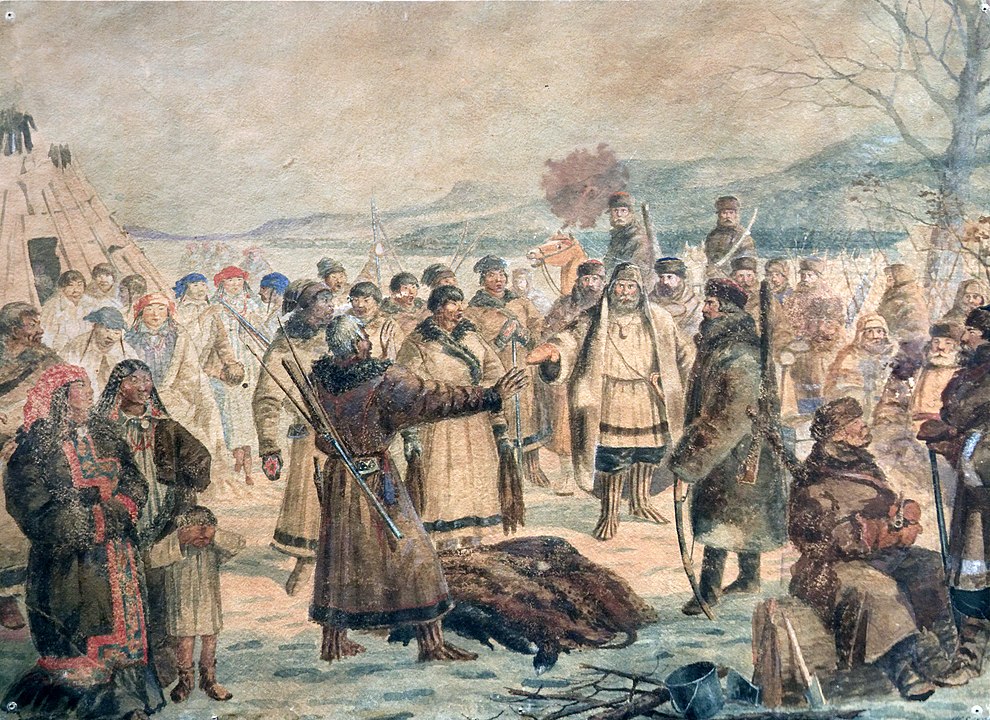
A 19th century print of Cossacks collecting the fur tribute in Siberia, with all the problematic attitudes one would expect
Traders, trappers and hunters were drawn to Siberia by a “fur fever”comparable to the 1849 California gold rush. By the very nature of their work, they became explorers and conquerors. Some worked on their own. Others were employed by the state or by wealthy merchant agents. The line between the two groups was blurry. Many Cossacks, working in the service of the Russian tsar, amassed fortunes for themselves by trading and trapping illegally. Independent traders and hunters frequently worked for the state at the request of local commanders.
Independent fur traders and state employees were equally eager to trap sable, the preferred fur of the Russian nobility and monarchy. A single hunting season could make a poor man rich.
Russians did not find an empty wilderness when they first arrived in Siberia in the 1580s. Conflict was inevitable. Russian traders were in Siberia to exploit the fur wealth to be found on the hunting and grazing lands of nomadic reindeer-herding peoples. Where Russians saw the fur-bearing animals only as a commodity, Siberian nomads combined the necessity of hunting with reverence for the animals they hunted. (Is any of this starting to sound familiar?) Over a period of eighty years, the Russians, armed with guns, imposed their rule on the indigenous populations and forced them to pay tribute in the form of furs.
The Russian conquest of Siberia was a world-changing event that almost no one noticed. The fur trade paid for Peter the Great’s transformation of Russia from a backwoods state with one foot in Asia to a great European power.
*My normal sources for translating a historical currency into today’s dollars failed me totally. I had assumed I would have to do a multi-step conversion from rubles to pounds, using seventeenth century values. Then from seventeenth century pounds to modern pounds, and hence to modern dollars. (A questionable process by any standard.) But none of my sources had a value for rubles prior to 1880. So let’s just agree that 300 rubles in 1650 would be worth quite a bit in today’s dollars and leave it at that.