




History on Display: The Buffalo Bill Center of the West, pt. 2 –The Buffalo Bill Museum, Man of the West, Man of the World
[If you’re joining us late to the subject, you can find an overview of the Buffalo Bill Center of the West in my last post.
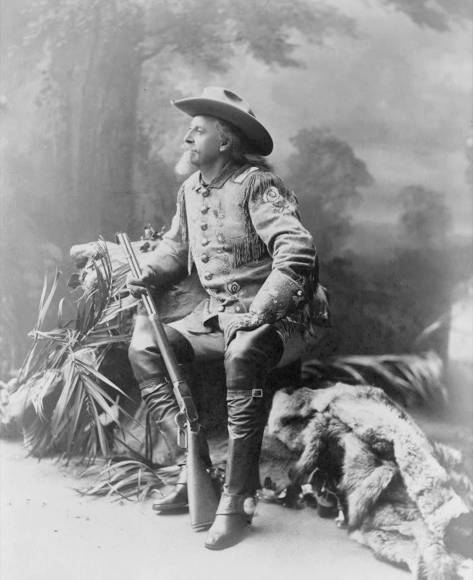
It is not surprising that the Buffalo Bill Center of the West, in Cody, Wyoming, has an entire museum dedicated to Buffalo Bill Cody, and his Wild West Show.* And I wasn’t really surprised, though somewhat saddened, by the fact that the Buffalo Bill Museum was much more crowded than the museum devoted to Plains Indian history and culture. I was surprised by the ways in which the curators used Cody’s story as a lens through which to consider the subject of America’s westward expansion, and to question that popular image of the American west which Cody himself did so much to promote. And I was deeply amused by the number of Buffalo Bill look-alikes among the attendees.
In the first twenty years of his life, Cody took part in some of the most iconic experiences of the United State’s westward expansion.
Cody was born in 1846 in Iowa on the western banks of the Mississippi, which was the dividing line between east and west. The family moved to what became known as “Bleeding Kansas” when the Kansas Territory opened up for settlement in 1854. His father died in 1857 in the violence that surrounded the question of whether Kansas would enter the United States as a free state or a slave state. With his father’s death, eleven-year-old Cody became the family’s principal means of support. He found work on wagon trains carrying supplies west for the freight company, Russell Majors and Waddell. According to some accounts, he paused to try his hand as a prospector in the Pike’s Peak gold rush in 1859. (He seems to have been determined to try all the things.) When Russell Majors and Waddell established its famous and short-lived Pony Express mail service in 1860 and advertised for “skinny, expert riders willing to risk death daily,” fourteen-year-old Cody signed on. (Or maybe not. Cody regularly contributed to his own legend and sometimes it’s hard to untangle fact from fiction. And there was a lot of fiction. According to the museum, Cody is the hero of more fictional accounts than any other figure in American history.) Two years later, as troubles heated up on the Kansas-Missouri border, he joined the “jayhawkers,” anti-slavery vigilantes who raided across the border into Missouri. When the Civil War began, he enlisted in the Union army, working first as a scout and later as a member of the Seventh Kansas Cavalry, which saw action in Missouri and Tennessee. After the war, he headed west again, working as a buffalo hunter for the railroads, which needed meat to feed their construction crews. In 1868, he returned to the army as chief scout, earning the Congressional medal of honor in 1872.**
For those of you who have not been keeping track, Cody was now 26 years old*** and well on his way to becoming an American folk hero, thanks to a series of short stories, novels, and plays about the adventures of Buffalo Bill. At some point after 1872, he made the transition from army scout to American showman. By the early 1880’s millions of people in North America and Europe knew Cody as Buffalo Bill.
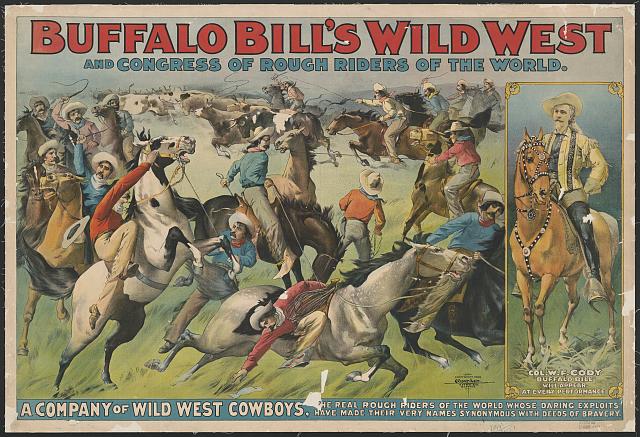
A large part of the exhibit deals with the creation of Cody’s public persona as Buffalo Bill, his role in creating that persona, the development of the Wild West Show and the Congress of Rough Riders of the World, the importance of the Wild West Show in shaping the image of the American West, and the tension between Cody the person and his persona. I was fascinated. So fascinated that I stopped taking notes—not a conscious choice and something that almost never happens. (My favorite fact: Cody was in favor of women’s suffrage.)
I came away from the Buffalo Bill Museum with one big idea: before Buffalo Bill, most people saw cowboys as social outcastes. Through his Wild West Show, Buffalo Bill created the image of the cowboy as a heroic icon and elevated the United State’s westward expansion to an epic adventure.**** That’s powerful stuff.
*Not to be confused with Wild Bill Hickok, seen here with Buffalo Bill and Texas Jack Omuhundro at the time of Cody’s first Wild West show, Scouts of the Prairie (1873), in which all three men performed. Their paths crossed a lot and I for one find it easy to muddle the combination of Wild and Bill.
**His medal was revoked in 1917, when Congress retroactively tightened the rules for the honor. One of those changes was that the award could only be given to military personnel, and scouts were considered civilians. (To which I can only say, huh?) His medal was reinstated in 1989.
***Anyone else feel like a slacker by comparison?
****Leaving out big chunks of the history in the process, as happens when history is transformed into myth or reduced to comic book.
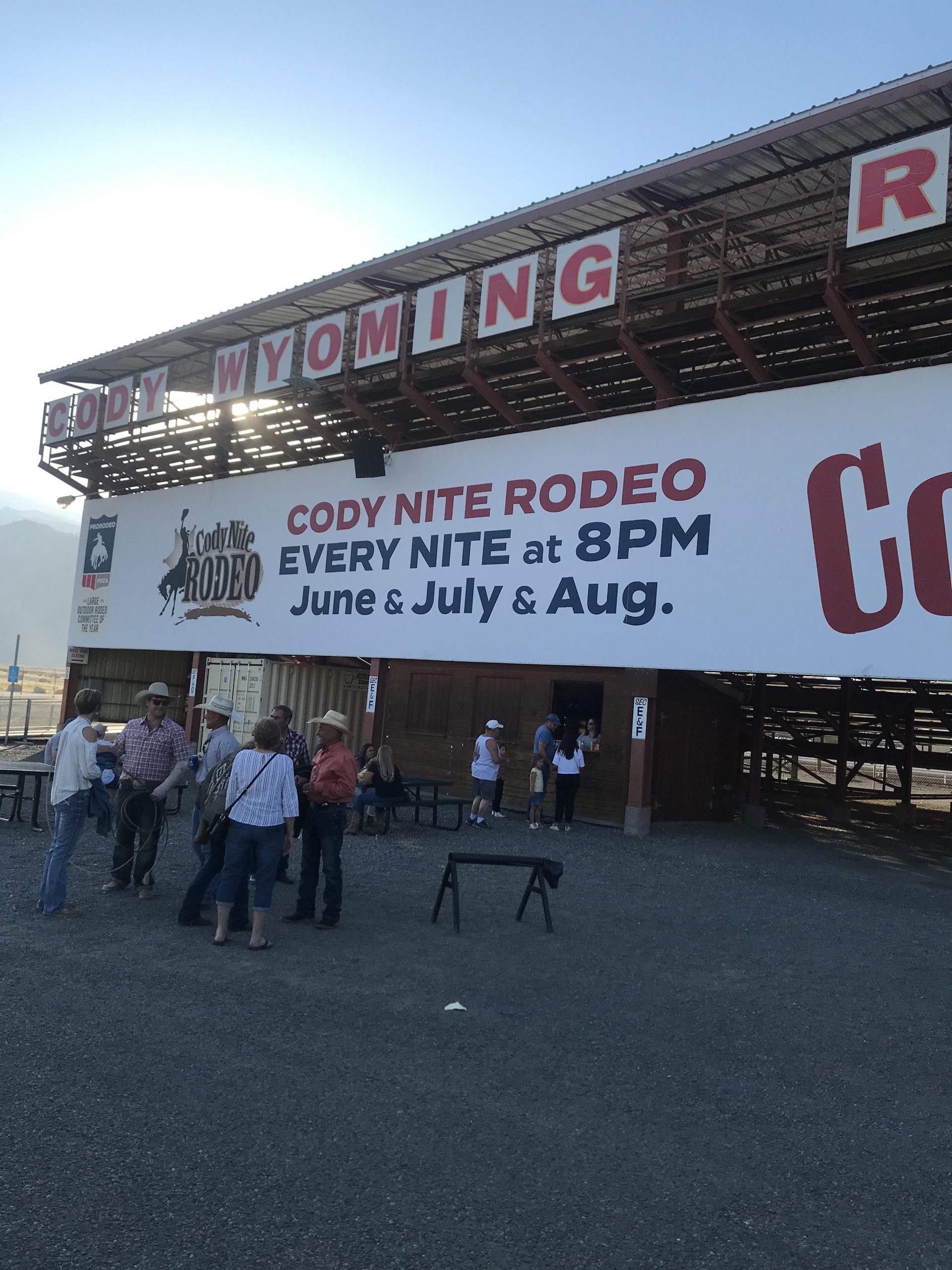
Travelers’ Tip: While you’re in Cody, make sure you visit the nightly rodeo. Lots of fun, though I must admit in the events that involved lassoing and typing up an animal, I found myself rooting for the animals.
History on Display: The Buffalo Bill Center of the West, pt. 1 –The Plains Indian Museum
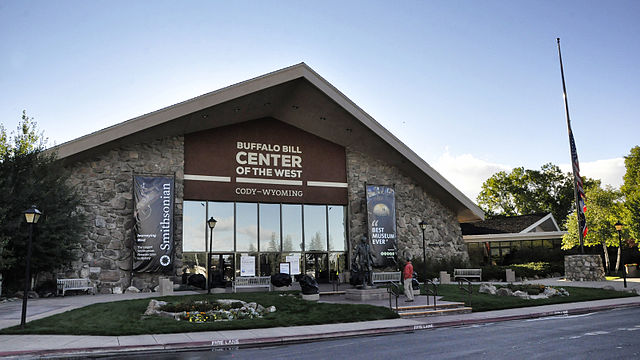
The Buffalo Bill Center of the West in Cody, Wyoming, was the ultimate goal of our two weeks on the road. And it was well worth the trip.
The museum is, in fact, a cluster of five museums dealing with different aspects of the American West—the Plains Indian Museum, the Buffalo Bill Museum, the Cody Firearms Museum, the Draper Natural History Museum, and the Whitney Western Art Museum—plus a special exhibit space. I went through three of the five museums and the special exhibition space, which featured a photo essay by Ivan McClellan titled Eight Seconds: Black Cowboys in America.
This is not the museum campus to visit if you are interested in homesteading or the role of the railroads in transforming the west. On its website, the museum bills itself as “Five Museums, One Wild West” and offers visitors a chance to explore Plains Indian cultures and “trailblazing cowboys and cowgirls.” On the surface, it’s a fair description. Looked at in broad terms, the museum focuses on “cowboys and Indians.” And yet, that is not the whole story. In each of those museums, the exhibits look at the subjects they present with depth and perspective and the curators question popular representations and iconic visions of the west, wild and otherwise. In fact, the exhibit on Black cowboys included a useful discussion of the difference between icons and stereotypes.*
The Plains Indian Museum looks at Plains Indian cultures in terms of both historical adversity and contemporary renewal, with an emphasis on “own voices”, traditional and contemporary. The result is a fascinating balancing act between big ideas and specific details. It explores questions of identity, and how the various nations are rebuilding their identities today using cultural centers, events, history and language.** It dives deep into the use of “material culture,” both through an extraordinary collection of traditional objects dating from the late 1700s to around 1890 and by looking at how modern Native artists have reinterpreted familiar objects. It shares important stories from traditional cultures and highlights the problem of missing and murdered indigenous women. One wall is devoted to a timeline of encounters between Native peoples and European-Americans—physically at the center of the gallery, but not the center of the exhibit.
Here are some of the things that particularly struck me:
- Earth lodges and tipis belonged to the matriarch of the dwelling.
- The models on which traditional clothing and horse equipment were displayed were all abstract and made it neutral tones. It was visually striking, but the curators made it clear that the decision was not simply aesthetic: “Our monochromatic figures intentionally look this way to avoid stereotyping Indigenous Peoples and their any skin and hair colors. The models are created in natural earth tones to highlight the museum objects.
- There was a tipi-shaped structure made of brush and branches that I assumed at first was another example of a modern artist exploring a traditional shape. It turned out to be a temporary “camouflaged” lodge built in the woods on hunting and war trips.
- This verse of modern poetry, which led me to learn more about the poet: “When we sing/We are not playing/We are praying for life. “ Lance Henson. “For Soft Dresser”
- This verse of a traditional dong: “If there is anything difficult/If there is anything dangerous/That is mine to do.” Kit Fox Society Song. Oglala Lakota.
I would have counted our visit to the Buffalo Bill Center of the West as a win based on the Plains Indian Museum alone.
Next up: The Buffalo Bill Museum
* Ivan McClellan’s mission statement for the show is worth sharing:
“I come from a place where black folks work the land, tend to animals, rope, ride horses, and identify as cowboys., this is a narrative rarely told by media. People of color are mostly presented as victims, criminals, rapers or athletes….My aim is to expand the cowboy icon to include people of color. To saturate the world with this image so my kids will draw a cowboy with brown skin.”
**Language is always a big issue when a people are asserting their identity. Sometimes the first issue.
In which I finally finish reading The Three-Cornered War
My last blog post was pulled from the History in the Margins archives: a piece on the Sand Creek Massacre in Colorado, an early event in the wars between the United States government and the Plains Indian nations that ended at the Battle of Wounded Knee. In the course of reviewing the piece before I posted it, I realized something I had not noticed before: the Sand Creek Massacre occurred during the American Civil War and could, in fact, be seen as an incident in the often overlooked “westernmost” theater in that war.

Those thoughts led me back to a book that was sitting unfinished on my reading pile: Megan Kate Nelson’s The Three-Cornered War: The Union, the Confederacy, and Native Peoples in the Fight for the West.* I received a review copy in February, 2020 and galloped through the first 180 pages. Then Covid hit, the world went crazy, and my brain shut down for a couple of weeks. And then, just as I was regaining my ability to focus, I signed a contract to write my book about Sigrid Schultz, which changed my non-fiction reading priorities. When I picked it up The Three-Cornered War last week, I realized I only had about fifty pages left to read and settled down to finish it. If anything, reading those last pages through the lens of my recent exposure to the history of the American West made them even more compelling.
Using the stories of nine people, chosen to represent different viewpoints, Nelson draws connections between the Civil War, the Indian Wars, and the United States’ western expansion, presenting them as three parts—three-corners—of one national conflict. She gives the reader an up-close look at the the efforts of the United States to remove native peoples from their homeland in order to allow white expansion into the west as seen from the perspective of both the Union soldier who engineered the campaigns against the Navajos and Apaches and an Apache chief who resisted that expansion. (Getting into the head of something who believed fervently in the need to control if not exterminate the Native American nations makes the familiar story even uglier.) She unfolds the far less familiar story of the conflicts of the Union and Confederate armies over control of New Mexico and Arizona, setting them within the larger framework of the war. (I don’t know about you, but I had no idea that the Confederate Territory of Arizona existed.) And by drawing connections between events that are often presented as entirely separate, she makes the surprising (to me, if not to you) point that the emancipation of enslaved people in the American South and the attempted elimination of indigenous peoples in the American West were contemporaneous events. (As seems to be a theme around here lately, the answer to “who’s missing from the story?” sometimes gives you a very different picture.)
The result is a complex, well-written account of the Civil War that re-frames our collective past.
*The fact that I let it sit was a comment on my life, not on the quality of the book.