




History on Display: The Museum of the Fur Trade
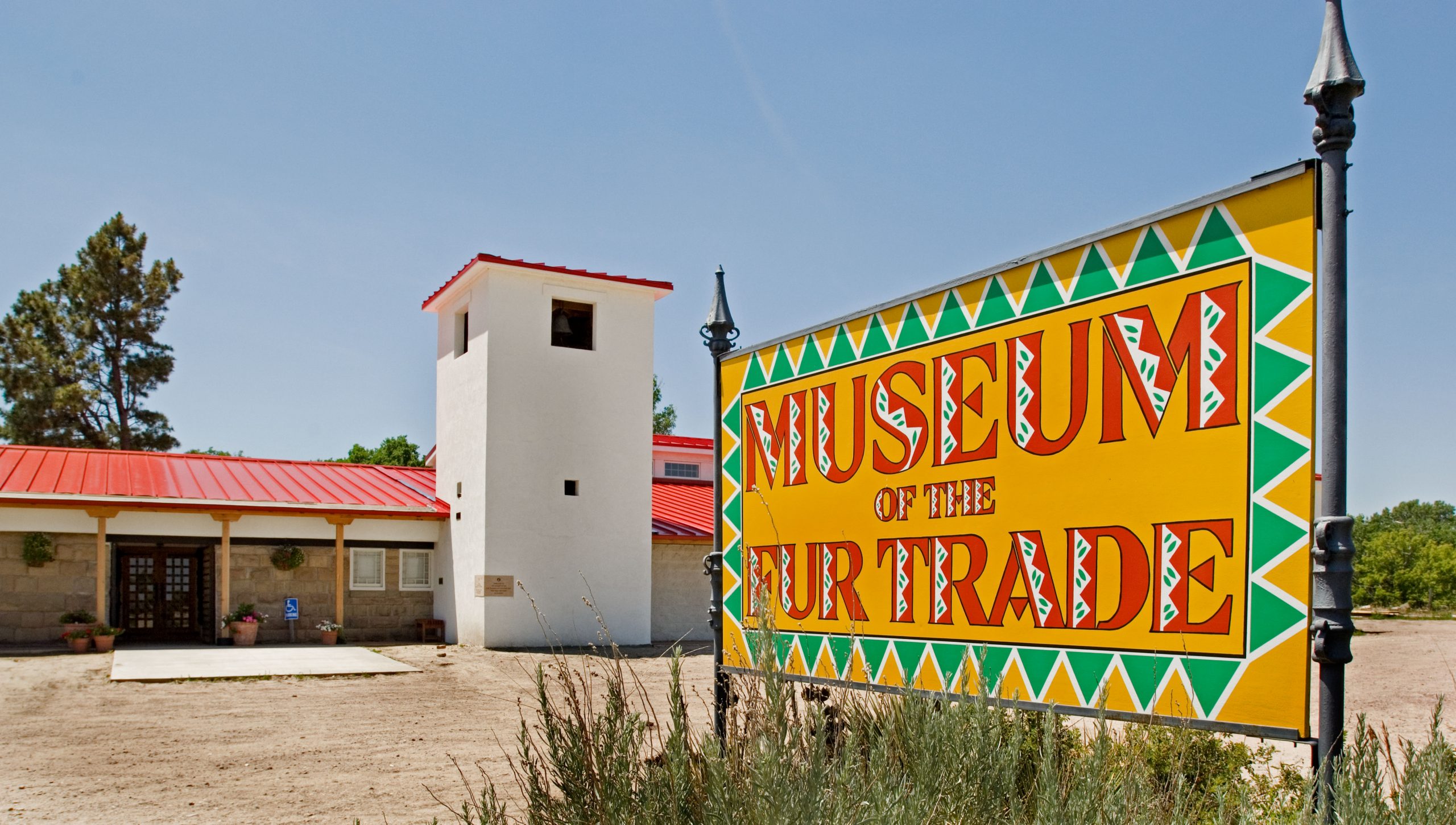
Our long road trips usually begin with an idea or a destination. * In the case of our recent trip through the Western plains, our route was shaped by two museums that have been on our road trip bucket list for a long time. One of those was the Museum of the Fur Trade, just outside Chadron, Nebraska. We were not disappointed.
My Own True Love and I both came to our interest in the history of the American fur trade through our fascination with the French voyageurs along the Mississippi and Missouri rivers, and the worldwide conflict between the British and French that ended with the defeat of France in 1763. The Museum of the Fur Trade places that story not only within its immediate context, but within a much larger story of fur-trading in North America. It starts early, with the fur trade’s connection with European cod-fishing off the Great Banks of Canada in the early seventeenth century. (I am continually fascinated by the way one trading commodity leads to another.) The museum describes how fur traders organized themselves in temporary partnerships each year and how the voyageurs created a complex system of written contracts to protect themselves from the big fur companies like the Hudson Bay Company and the American Fur Company. (The exhibit makes the off-hand comment that the voyageurs were the first unionized labor force in North America. An interesting idea, but I’m not sure it’s entirely accurate.)
The museum follows the fur trade west beyond the Great Lakes and the great rivers, and through the shift from beaver to buffalo and seal. I already knew something about fur trappers in the Rocky Mountains and Russian fur trappers in Alaska and along the Pacific coast, though I learned more. But I had no idea that furs were a significant component of North American and Russian trade with China, for instance.
The biggest “wow I didn’t know that” moment for me was the comancheros, an ethnically mixed group of traders who developed a distinctive form of trade in what is now New Mexico with the Comanches, Kiowas and other nations of the Southern Plains in the eighteenth and nineteenth centuries. Unlike what I think of as the British and French model, in which traders set up posts and trappers brought furs to them, the comancheros loaded up their burros and oxcarts with trading goods and travelled into the plains in search of their highly mobile customers. I suspect there is a lot more to this story that I don’t know: I was once again reminded that the history of the American southwest in particular, and Spanish rule in the Americas in general, is one of my historical blind spots.
The museum’s exhibits are relatively old fashioned—lots of stuff, not many interactive exhibits. But the stuff is used effectively, particularly the extensive section on trade textiles and the ways they were used by the Native Americans who acquired them. Exhibits on the fur trade often leave out the Native American side of the exchange; the Museum of the Fur Trade includes it as integral part of the story. And rightly so.**
The museum also has a small number of outdoor exhibits, most notably a meticulous reconstruction of the James Bordeaux trading post, which is one of the rare reconstructions to be included in the National Register of Historic Places.*** The museum is located on the site of the trading post, which was founded by James Bordeaux in 1836 and operated longer than any other trading post in the area. In 1872, the Bordeaux family sold the post to Francis (Bushy) Boucher, who was the son-in-law of Spotted Tail, the head chief of the Brule Lakota. Boucher expanded the trading post business to include an illegal operation selling arms and ammunition to Native Americans who were resisting the United States’ efforts to force them onto reservations. **** In August, 1876, army troopers confiscated 40,000 rounds of Winchester ammunition from Boucher and closed the post. It was in ruins by the time the first homesteaders reached the area along with the railroad in 1885.
In short, the museum is well worth a visit if you’re planning a trip through the western plains.
*Following the Great River Road from its source in Minnesota to its end in Louisiana has kept us amused for several trips now. We have plenty of Great River Road yet to travel.
**In a recent issue of my newsletter , I talked about the stories we tell and the point of view from which we tell them and shared some questions that a reader/listener/viewer can ask if they want to identify the holes in a particular version of a story. (Because there are always holes, no matter how well-intentioned the historian/curator/artist/novelist/reporter/human is.) One of those questions is “Who or what is missing from the story?”.
***I must admit that I did not enjoy the outdoor exhibits as much as I usually do. The sign warning visitors to watch out for rattlesnakes left me a little distracted. I hate snakes.
**** There are suggestions that Bordeaux also sold guns under the counter to the Lakota, though on a smaller scale, in the years after the Civil War when the buffalo robe trade was in decline. Like Boucher and other French-American fur traders over the centuries, Bordeaux had family ties with the Native American people with whom he traded. His wife was a Brule Lakota and his brother-in-law was Swift Bear, and influential chief and adherent of Spotted Tail. Sometimes the allegiances are more complicated than the historical marker would suggest.
And speaking of navigating the Missouri river…
And speaking of the travails of navigating the Missouri River, as I believe we were, I am reminded of another riverboat-related museum on an earlier road trip, back in 2013. It’s still one of my all-time favorites. I hope you enjoy it.
**************

The Arabia Steamboat Museum in Kansas City is a private museum. Like all private museums, it’s the result of personal passion. Unlike many private museums, it’s big, professionally designed, and stunning.*
The museum weaves together three separate stories into an exciting whole: life in frontier America, the steamboats that served as the semi-trailers of the nineteenth century, and five friends who banded together to excavate one sunken steamboat.
In the nineteenth century, before the Army Corps of Engineers worked its magic, the Missouri River was as treacherous as a navigable river could be. Civil War journalist, and Union spy, Albert Deane Richardson described the river as “a stream of flowing mud studded with dead tree trunks and broken bars.” Nonetheless, the Missouri was a major trade route for frontier America and a profitable one. A steamboat could pay for itself with a single successful voyage. Just as well, since the average steamboat only lasted five years on “old Misery”. **
On September 5, 1856, near what is now Kansas City, the steamship Arabia hit a walnut snag that stove in her hull. The ship was lost within minutes. The human passengers all escaped, though one unlucky mule did not, but more than 200 tons of cargo intended for settlements along the river was lost.
Over time, the river shifted, leaving the ship buried forty-five feet deep in what became a farmer’s field. The Arabia was buried but not forgotten. Rumors that the ship held treasure (described as everything from gold coins to good Kentucky bourbon) meant there were numerous attempts to excavate it. For 150 years treasure seekers failed because the ship was about 100 feet from the river. Everyone who tried to dig was flooded out. In 1988, five families funded a professional excavation, using pumps to keep the site from flooding and the techniques developed during the Mary Rose excavation to preserve the finds.
Today, the artifacts from their excavation are only one part of the exhibit at the Arabia Steamboat museum. The museum also includes explanations of how steamboats worked, part of the Arabia’s hull, and a fascinating description of the excavation itself. If you’re interested in daily life on the frontier, steamboats, or just a good adventure story,*** the Arabia Steamboat Museum is worth a visit.
* Not that I have anything against little museums created with love and imagination on a tight budget. I’ve spend many happy hours in quirky storefront museums.
** The Corps of Engineers identified 289 steamboat wrecks in the Missouri when they mapped the river in 1897.
*** In my case, that would be yes, yes, and yes.
________________________________________________________________________________________
A traveler’s tip for anyone inclined to come on board the Arabia:
We didn’t know until we got there, but the museum is located in a re-built warehouse near the river. City Market is home to a year-round farmer’s market on the weekends and year-round food-related tenants. If you have foodie inclinations, leave yourself time to shop and eat.
Road Trip Through History: The Sergeant Floyd River Museum
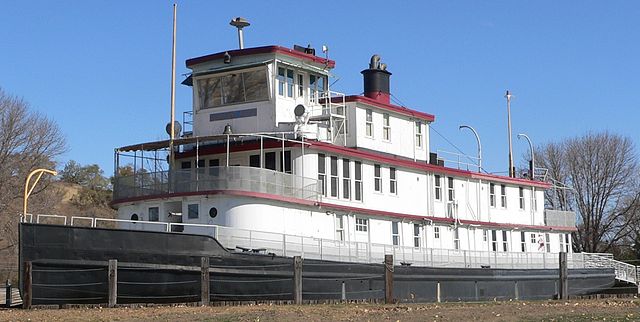
In some ways, the Sergeant Floyd River Museum in Sioux City, Iowa, feels like the historical equivalent of a set of nesting Russian dolls, with one iteration of Sergeant Floyd fitted into another and then another to make up the whole.
- The historical heart of the museum is Sergeant Charles Floyd himself. He was a member of the Lewis and Clark expedition who died of what was probably a ruptured appendix on the site of modern Sioux City Iowa, the only member of the expedition to die on the journey. A granite obelisk marking his grave stands on the high ground over the city, the first nationally registered historical landmark in the United States.*
- The museum is housed in the M.V. Sergeant Floyd, named after Charles Floyd. The boat was used by the United States Corps of Engineers for light towing, survey and inspection work, and improvement projects on the Missouri River from 1932 to 1975 as part of its mission to keep “Old Misery” navigable. Beginning in 1976, as part of the nation’s Bicentennial celebration, the Corps used the boat as a floating museum.
- In 1983, Sioux City bought the decommissioned vessel and turned it into the Sergeant Floyd River Museum, which devotes a fair amount of space to the story of the Lewis and Clark Expedition, with an emphasis on, ahem, Sergeant Charles Floyd. (Including a reconstruction of his face by a forensic artist, using a plaster cast of his remains from the fourth time that he was reburied. In one of those quirky coincidences that pop up in history-land now and then, the artist turned out to be a great-grandniece of Sergeant Floyd.)
The museum is fundamentally a local history museum housed in an unusual facility. After the section on Lewis and Clark, the museum moved on to a brief and not very sophisticated exhibit about the Native American peoples who inhabited the area before white settlers arrived.** From there it went on to look at the fur trade, the founding and development of Sioux City as a depot on the Missouri River, and steamboat traffic on the Missouri. (These weren’t the steamboats of your imagination. The steamboats that traveled the Missouri were intercity trade boats, not the gilded palaces that traveled the Mississippi from St. Louis to New Orleans.)
The parts that captured my imagination the most were the panels dealing with navigation on the Missouri River, beginning with the Lewis and Clark expedition. Before the Corps of Engineers took over the task of trying to keep the river navigable in the mid-19th century, piloting a boat down the river required skill and luck. The river was nicknamed “Old Misery” for a reason. Its channels shifted on a regular basis, thanks to summer storms, winter ice dams, and the annual rise of the river’s water level each spring. The upper reaches of the river were clogged with snags and sandbars, some of which could not be steered around, slid over, or smashed through. Snags that broke away from the bottom during high water could collect in log jams, which the French-Canadian rivermen called embarrases—”hinderances.” These could pin a boat broadside and cause it to capsize—a situation that could be described by another meaning of embarras, a predicament.
All these hindrances, and the possible predicaments caused by them, inspired rivermen to develop a number of ways to get around them, including:
- The Lewis and Clark expedition, and every keelboat captain who followed them, used a technique known as cordelling, in which rivermen walked their boats upstream when the river was too clogged by snags or the current was too strong for rowing, pulling it with a heavy line attached to the boat. Sometimes they walked along the bank, sometimes they worked waist deep in the river. The line itself was known as a cordelle, from the French word for rope, a holdover from the days when French voyageurs controlled the Missouri and Mississippi. Which were not that long ago from the perspective of Lewis and Clark.
- When conditions didn’t allow cordelling, rivermen harnessed the strength of the trees that lined the river (and were responsible for the snags) in a related technique called warping, in which they tied the cordelle to a tree and then hauled the boat hand over hand up the river
- By the days of steamboats,*** every Missouri River steamboat carried a pair of “grasshoppers”: tall wooden poles that could be lowered into the mud and used like giant crutches (or possibly chopsticks) to “walk” the boat to deeper water.
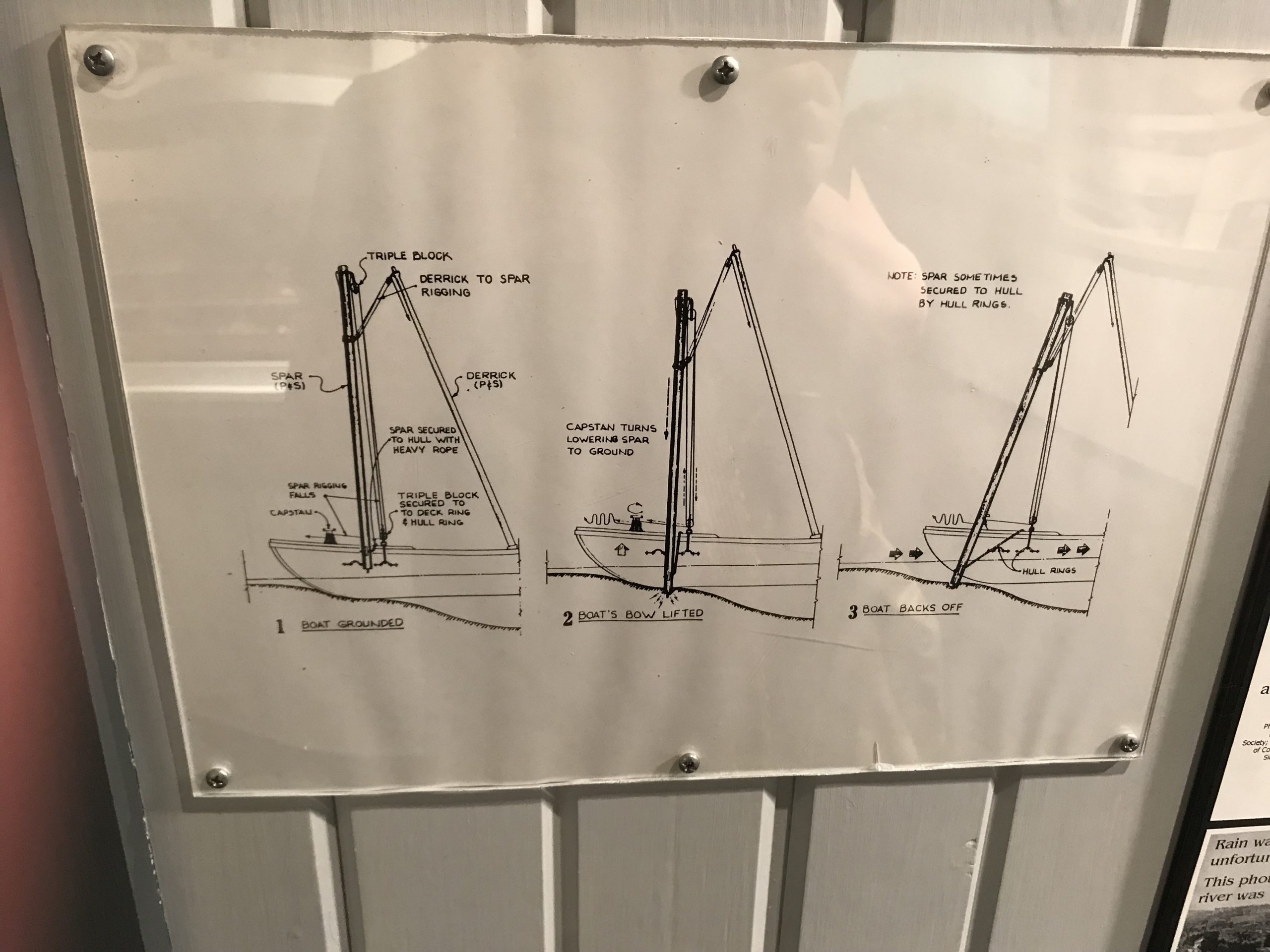
Human ingenuity never ceases to amaze me.
* If we had known this at the time, we might have made the time to drive up the hill to see it. Or maybe not. We also chose not to stop at the Lewis and Clark Interpretive Center, which was located in the same museum campus as the Sergeant Floyd River Museum. Our long road trips are a constant set of compromises between the time, distance, and interest.
** This is a subject that not many local history museums do a good job with, and that some ignore altogether. After visiting many, many such museums over the decades years, I’ve come to the conclusion that local history museums that focus on a specific element of Native American history in their region create more meaningful exhibits than those that make sweeping generalities. In fact, I would argue that is true for small museums as a whole. Give me a specific story that illustrates a topic rather than trying to give me the story of the fur trade as whole.
***Earlier than I realized. Steamboats were introduced on the western rivers in 1811.
This cracked me up.
Travelers’ Tip: I recommend Madonna Rose in Sioux City for breakfast. The restaurant’s huevos rancheros, served on a base of black bean and chorizo chili was pretty amazing. In fact, it has me plotting how to make a similar chili at home come the fall.